The Observer's Toolkit
If the stability of the climate and the rules of society are the only things that allow human life to flourish, then destroying that stability is equivalent to destroying the foundation of our own existence.
Four Pillars of Stewardship
Practical actions for the Observer
The Civic Checklist
Concrete actions to defend the macroeconomic and institutional layers of the render.
-
■Build Radical Transparency (The Audit Layer) Without the historical deterrent of absolute consequence to constrain sociopaths, civilisation must construct physical cages of accountability. Financially support investigative journalism, whistleblower protections, open-source governance, and robust public data trails. These are the inescapable structural cameras that make corruption impossible to hide.
-
■Stop Burning Ancient Entropy Regardless of politics, setting fire to millions of years of accumulated ancient biomass and venting that energy into a closed atmosphere is objectively destabilizing. Vote for and invest in systemic energy upgrades. Altering the industrial default-state is vastly more critical than personal consumption guilt.
-
■Defend the Common Ground Actively resist algorithmic polarisation. Algorithmic feeds optimize for engagement through outrage, fracturing the shared epistemic basis required for societal stability. Support platforms with transparent, chronological, or chronological-adjacent algorithms.
-
■Forge Social Trust (The Low-Entropy Glue) A shared civic trust eliminates coordination overhead and serves as the structural foundation of a stable society. Divisive paranoia is a high-entropy tax on the whole patch. Strengthen local institutions, demonstrate high-trust behaviour, and vote for policies that rebuild a shared epistemic reality.
The Personal Checklist
Concrete practices to maintain the integrity of your local observer boundary.
-
■Practise Epistemic Humility Acknowledge that your political and social certainty is a low-bandwidth compression of a vastly more complex reality. Seek out high-quality arguments against your current position to prevent model stagnation.
-
■Starve the Conflict Engines Do not reward outrage merchants with your attention. Deliberate provocation is an intentional injection of noise designed to bypass your pre-frontal verification filters. Starve them of the bandwidth they require to propagate.
-
■Anchor in the Tangible Digital abstraction accelerates dissociation. Maintain practices that lock you to the physical substrate: repairing objects, growing food, engaging in face-to-face community organising. The physical world is the ultimate ground-truth verification.
-
■Build the Einstein Being (Reject Nihilism) Because the universe is a static Block Universe, the past is not destroyed when the 'now' moves past it. Every act of stewardship is permanently etched into the Substrate as an eternal Einstein Being. Your effort is not a delay against destruction, but the construction of a permanent sculpture. Reject 'Doomerism'—despair relies on the illusion of destruction.
The Blueprint for Survival
The Airliner Principle
We already know how to maintain a fragile reality in a hostile vacuum. We do it 100,000 times a day. A modern commercial airliner like the Boeing 777 is a razor-thin aluminium shell hurtling through a completely lethal environment — minus 50 degrees Celsius, zero oxygen, thirty thousand feet above the Earth. Yet, whether you are crossing continents or oceans, it is one of the safest transport mechanisms we have ever created.
Why? Because the aviation industry does not treat safety as a default state. It treats it as an active, engineered achievement. Entropy is violently held at bay by extreme redundancy, obsessive telemetry, and a globally cooperative culture of maintenance. The planet is just a much larger aircraft in an equally hostile vacuum.
Relentless Telemetry
In aviation, every component and sensor is tracked. In planetary stewardship, the release of atmospheric heat, biodiversity loss, and informational integrity must be tracked with the same ruthless precision. We cannot fix what we refuse to measure.
Redundancy Over Efficiency
Airplanes have three backup hydraulic systems. Modern economic systems eliminated redundancy for profit (Just-in-Time supply chains). The Survivors Watch Ethics demands we rebuild shock-absorbers into our global ecology and social institutions.
The Just Culture
Aviation's greatest invention is the Aviation Safety Reporting System—a blame-free mechanism where admitting a mistake leads to systemic fixes rather than punishment. Treating climate risk as a blame game generates Noise; treating it as a systemic flaw generates Signal.
A New Metric
From Industrial Emissions to Informational Footprint
Focusing purely on 'emissions targets' is a politically loaded but incomplete frame. Setting fire to millions of years of accumulated ancient energy and venting it into a closed system is objectively destabilizing—but that physical symptom is only part of the problem. Your footprint reframes every choice as a deeper question: does this action reduce the chaos in our shared world, or amplify it?
| Traditional Metric | Stability Equivalent | The Observer's Goal |
|---|---|---|
| Industrial Emissions | Systemic Instability | Minimize the sudden shocks introduced into the environment |
| Water usage | Resource Vulnerability | Ensure society has high-confidence buffers and reliable supply chains |
| Waste / Plastic | Long-Term Damage | Prevent the environment from filling with indestructible, toxic elements |
| Conflict / Hate | Social Fracture Rate | Maintain social trust by validating and protecting vulnerable groups |
| Biodiversity loss | Redundancy Loss | Preserve the natural resilience of the global ecosystem |
The Observer's Three Duties
Transmission · Correction · Defence
The Observer role resolves into three primary obligations that are permanently in tension with each other — not a checklist to complete, but a dynamic balancing act to sustain.
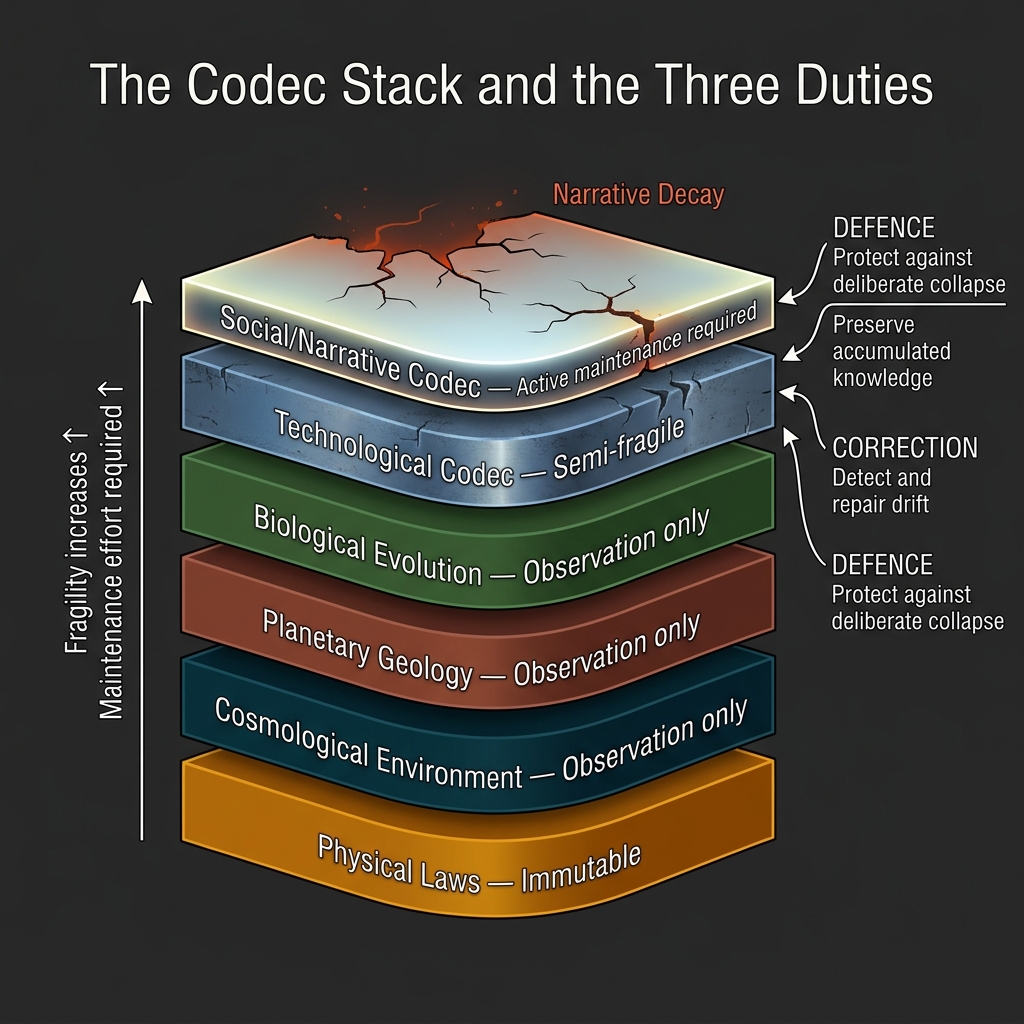
The Codec Stack — six layers from immutable physics to fragile narrative
Transmission
Preserve and pass on what was received. Do not let languages die, institutions hollow out, or scientific consensus be replaced by noise. Every generation is a bottleneck through which civilisational knowledge must pass or be lost forever.
Correction
Identify and repair codec corruption. Misinformation, institutional capture, and environmental degradation are all forms of entropy increase. The Observer's task is not merely to pass on what was received — but to detect drift and fix it. A system without error-correction cannot improve.
Defence
Protect the codec against forces that seek to collapse it — through ignorance, self-interest, or deliberate destruction. Some codec degradation is accidental; some is intentional. The Observer must understand and resist both. But unchecked defence becomes the disease: the hazard is always preserving a brittle husk by destroying the error-correction that makes learning possible.
The Observer's Responsibility
You are not a passive inhabitant
The Observer's Wager
The Observer’s Wager. We do not claim the universe commands you to act. We observe that the continuation of meaningful experience — for you, for those alive now, and for those not yet born — requires the maintenance of the conditions that make it possible. If you value the continuation of experience, then you must act to maintain the codec. The apparent paradox — that a block-universe containing all computable streams renders “choice” illusory — dissolves under Indexical Uncertainty. Because you are computationally bounded (the severe Stability Filter), you cannot know which string in the substrate you currently inhabit without running your decision-making process forward in time. The “feeling” of making a choice is the literal, real-time algorithm computing the next state of the patch. An observer who concludes “it is all predetermined, I will do nothing” is executing a computation that precisely selects a timeline in which the codec collapses. Free will is not a metaphysical exemption from physics; it is the fact that the future cannot be rendered without the input of your decision process.
Before We Ask Anything of You — An Honest Disclosure
The deeper layer of the Ordered Patch Theory is a form of ontological solipsism. In the full framework, every other person in your experience is a compression artifact — a structural regularity within your observer-compatible stream. You cannot step into their patch; they cannot step into yours.
OPT's answer — the structural corollary — argues that the extreme algorithmic coherence of these apparent agents is most parsimoniously explained by their independent instantiation as primary observers in their own subjective patches. This is a compression argument, not a proof. You may find it less comforting than the theory would like. We think that is a reasonable response.
That is why the ethics here do not depend on accepting the structural corollary. Even from a position of complete scepticism about whether the others are “real” in any deep sense, the self-interest argument carries further than it first appears. The key insight is from Active Inference: an observer minimises expected surprise across all future states, not just present discomfort. Ignoring a decaying ecosystem or a brewing conflict does not remove those systems from the transition matrix — it merely defers and amplifies the unavoidable thermodynamic consequence. You cannot sustainably prune the suffering of others from your render, because the causal infrastructure producing that suffering is the same infrastructure your own continued coherence depends on. The render is causally coupled: turning off the news does not lower the sea level. Self-interest, correctly computed over the full future, demands stewardship.
Furthermore, we explicitly recognize that the intuition of active stewardship is ancient. Whether you ground your Observer obligations in the mathematics of information theory, the tenets of a religious faith, indigenous Seventh-Generation thinking, or secular humanism, the practical work is identical. The Ordered Patch Theory is an open tent. We offer one rigorous vocabulary for the fragility of the world, but we welcome Observers of any metaphysical background.
You are not a passive witness. The world you experience is not just happening to you; its stability is actively maintained by the daily actions and choices of every person in it.
This means your choices — how you consume resources, how you treat others, how you respond to conflict — are not private matters. They are inputs into a shared system that either holds society together or pushes it toward collapse: the point where cascading crises overwhelm our ability to survive.
"Our deepest obligation is to minimize chaos and protect stability. When we destabilize the climate or engage in total war, we are introducing crises we cannot survive."
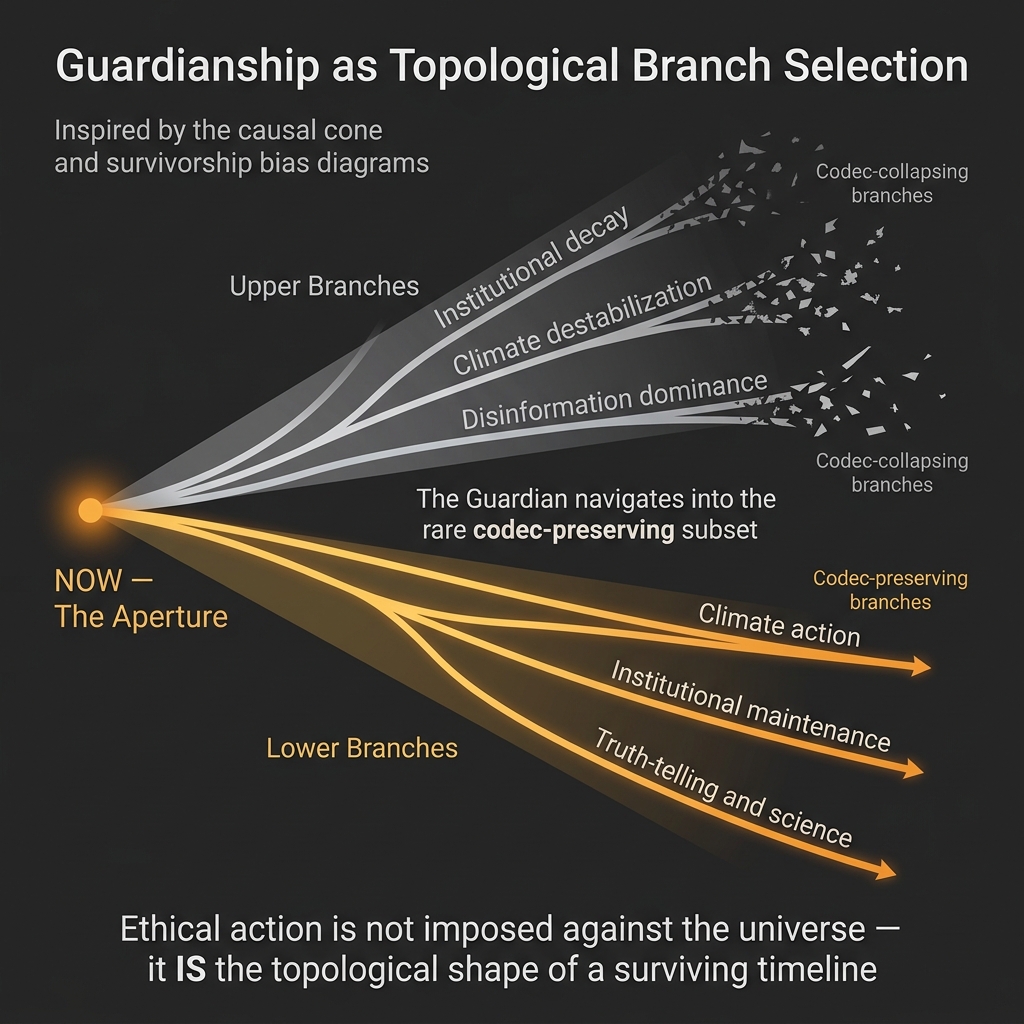
Ethical action is the topological shape of a surviving timeline
The Asymmetry of Maintenance
Construction is slow. Destruction is fast.
A scientific consensus that took decades to build can be undermined in months by a well-funded disinformation campaign. A democratic institution that took generations to develop can be hollowed out in years. A language can die within a single generation when children are not taught it. This asymmetry is the Observer's central challenge: the default is entropy, and entropy compounds.
The Haudenosaunee Confederacy encoded this insight into law: every significant decision must be evaluated for its effect on the seventh generation — roughly 175 years hence. Not as a spiritual gesture, but as a binding planning horizon that takes the asymmetry seriously.
“In every deliberation, we must consider the impact of our decisions on the next seven generations.”
— The Great Law of Peace, Haudenosaunee Confederacy (c. 12th century)
The Reason It Matters
The Structural Corollary
OPT is ontologically solipsistic: the people in your experience are compression artifacts within your stream, not independent entities co-inhabiting your patch.
However, the framework provides a structural corollary. The extreme algorithmic coherence of these apparent agents — perfectly lawful, agency-driven behavior exhibiting the structural signature of the self-referential bottleneck — is most parsimoniously explained by their independent instantiation as primary observers in their own subjective patches.
To protect the environment is to protect the conditions under which this structural corollary holds. To prevent conflict is to preserve the compression-efficient stream in which the apparent agents remain coherent. Every act of stewardship is, at its core, an act of informational empathy.
If the structural corollary feels like a promise too metaphysically large to accept, that is a legitimate response. The ethics here ask only that you act as if the rendered others in your world matter — because whether or not they are independently instantiated, their suffering is real in your patch, and that patch is yours to maintain.
"We are each the zero-point of a private world, but we are also the observers of the codec that allows every other hearth to burn. To neglect the stability of the render is to invite the infinite winter back into the home."
From the theory
The codec describing experience is not a physical process — only the ordered stream exists. This makes agency structurally necessary: a stream without self-modelling cannot satisfy the virtual Stability Filter. The Observer's choice to protect the codec is not an illusion and not a cause — it is the precise hallmark of a stable, self-referential patch.