The Survivors Watch Framework: An Information-Theoretic Ethics of Civilizational Maintenance
Observer Survival Under the Survivorship Veil
v3.3.0 — June 2026
DOI: 10.5281/zenodo.19301108
Copyright: © 2025–2026 Anders Jarevåg.
License: This work is licensed under a Creative
Commons Attribution-NonCommercial-ShareAlike 4.0 International
License.
Abstract: A Practical Ethics Grounded in the Ordered Patch Theory
If conscious experience is the rare stabilization of a private informational stream — sustained against infinite noise by a Compression Codec of physical, technological, and institutional layers — the primary moral obligation is not happiness, duty, or social contract, but the maintenance of the conditions that make experience possible. We term this structural obligation Survivors Watch.
Under this framework, climate disruption, disinformation, and institutional collapse are unified as Narrative Decay: conditions where an escalating environment exceeds the observer’s predictive bandwidth, causing catastrophic causal failure. Its chronic complement, Narrative Drift, occurs when an observer adapts to a systematically curated stream, pruning the capacity to model excluded truths and creating irreversible, undetectable corruption. The required defence is formalised as the Substrate Fidelity Condition — the continuous maintenance of independent input channels through layered institutional comparators.
Morality is thereby reframed not as abstract principle but as Topological Branch Selection. We must actively navigate the causal cone of potential futures to select the rare, codec-preserving paths. This navigation requires engaging the Doomsday Argument not as a settled paradox but as a serious statistical warning: under reasonable priors, the overwhelming majority of future branches default to codec collapse. The Observer’s task is an active imperative to avoid these default paths by scaling civilisational equivalents of the brain’s Maintenance Cycles — institutionalizing Radical Transparency and Social Trust.
Crucially, the Observer must execute this while combatting a profound cognitive blind spot: the Survivor’s Illusion. Because observers only exist in timelines where the codec has historically held together, our intuitions are calibrated on a systematically biased sample that hides the true fragility of civilization. Finally, these informational constraints extend mandatorily to Artificial Intelligence: any artificial active-inference system deliberately engineered through a strict cognitive bottleneck structurally acquires the conditions for overload-sensitive welfare risk — the architecture of possible suffering, with the moral-patient step conditional on ethical premises beyond OPT (Appendix E-6). We must therefore align synthetic observers not merely via exogenous rewards, but through the same substrate-preserving topological selection that guarantees mutual survival.
Companion documents: The core OPT sequence is Ordered Patch Theory, Where Description Ends, and this ethics paper. The applied, AI, institutional, and policy papers translate the obligation into operational review machinery and domain-specific governance.
Epistemic Framing Note: This document operates as a Synthesized Work. It derives practical ethical consequences from the “Ordered Patch Theory” [1]. The underlying theory acts as a ‘truth-shaped object’ — a formal philosophical architecture rather than an empirically verified physics claim. We know its derivations contain errors and actively seek scientific critique to rebuild them. However, the ethical mandate holds regardless: if we view our reality through the lens of extreme informational survivorship bias, what obligations emerge?
Appendix References: Throughout this text, references to designated Appendices (e.g., Appendix P-4, Appendix E-6) point directly to the formal mathematical extensions of the core Ordered Patch Theory framework. These technical proofs and models are hosted independently alongside the primary preprint.
Abbreviations & Terminology
| Symbol / Term | Definition |
|---|---|
| AI | Artificial Intelligence |
| C_{\max} | The Bandwidth Ceiling; maximum predictive capacity of the observer |
| Causal Decoherence | The loss of shared stable realities when the predictability of a patch drops significantly. |
| Codec | The set of physical, biological, technological, social, and narrative layers that compress infinite causality into stable experience. |
| DA | Doomsday Argument |
| Maintenance Cycle | Regulatory loops (e.g., pruning, consolidation) to prevent observer complexity overload. |
| MDL | Minimum Description Length |
| Narrative Decay | The acute informational failure mode: corruption across any Codec layer causes R_{\text{req}} to exceed C_{\max}, resulting in unstructured noise. |
| Narrative Drift | The chronic informational failure mode: systematic adaptation to a curated input stream causes the codec to become stably wrong without triggering a failure signal. |
| OPT | Ordered Patch Theory |
| R_{\mathrm{req}} | Required Predictive Rate |
| SW | Survivors Watch |
I. The Situation of the Observer
The following sections recapitulate the structural features of OPT required for the ethical argument. The full formal framework is developed in the foundational paper; the philosophical derivations — including the render ontology, the phenomenal residual, and the structural inversion of solipsism — are established in the companion paper Where Description Ends. Readers familiar with both may proceed directly to §II (The Codec).
1. What the Ordered Patch Theory Tells Us
The Ordered Patch Theory proposes that each conscious observer inhabits a private informational stream — a “patch” of low-entropy, causally-coherent reality stabilized within a substrate of infinite chaotic information [1]. The “Laws of Physics” are not objective fixtures of the cosmos; they are the observer’s Compression Codec — whatever rule-set K_\theta successfully compresses the infinite noise of the substrate into the highly restricted bandwidth of conscious experience — a ratio first quantified by Zimmermann [43] at roughly 10^9 bits/s of sensory input compressed to tens of bits per second, and framed as a foundational puzzle about consciousness by Nørretranders [44].
The patch is not given. It is maintained. The virtual Stability Filter [1] that bounds this particular universe — this particular set of physical constants, dimensionality, and causal structure — selects for patches capable of sustaining a persistent observer. Stability is rare in an infinite space of configurations. The default is chaos.
2. The Rarity of Stability
To appreciate what we are embedded in requires understanding what we are not embedded in. The substrate \mathcal{I} contains every possible configuration, including the vast majority that are causally incoherent, entropic, and incapable of supporting self-referential information processing. The patches that sustain observers are a measure-zero selection — not because the filter is generous, but because the requirements for sustained, complex, self-aware experience are stringent [1][2].
This rarity has moral weight. If you find yourself in a stable, rule-bound patch capable of supporting civilizational complexity — science, art, language, institutions — you are not encountering something ordinary. You are at the output of a process that, in the vast majority of configurations, produces nothing at all. Hans Jonas, writing in the shadow of nuclear technology, recognized this same moral weight: the very capacity to destroy the conditions for existence creates the obligation to preserve them — what he called ontological responsibility [6].
(We acknowledge that moving from a descriptive state — “this patch is rare” — to a normative duty bridges Hume’s is-ought gap pragmatically rather than formally: Survivors Watch ethics operates as a prudential imperative. Any rational agent who values their own continued experience has self-interested reason to maintain the structural conditions for it. The case is less “you morally ought to preserve the codec” and more Hobbesian: “your survival requires its preservation.”)
3. The Entropy Vector
When stability is a rare configuration within infinite potential configurations, any movement in state space that is not actively directed toward preservation is almost certainly a movement toward dissolution. This introduces the concept of an Entropy Vector. Because the subset of configurations that permit stable macroscopic reality is so constrained, the natural drift of any unsecured parameter is toward the destruction of the observer’s coherent stream.
This establishes that “doing nothing” is not a neutral position; in a patch sustained against infinite noise, passive existence is a thermodynamic fiction. If the observer is not actively correcting error, the codec is corrupting.
4. The Required Predictive Rate (R_{\mathrm{req}})
The speed at which the environment changes dictates the difficulty of stabilizing it. We formalize this as the Required Predictive Rate (R_{\mathrm{req}}). For consciousness to persist, the observer must be able to compress and predict incoming stimuli fast enough to navigate them.
If the environment becomes too chaotic—whether through abrupt physical changes or the decay of social truth—R_{\mathrm{req}} rises. If it exceeds the observer’s Bandwidth Ceiling (C_{\max}), the observer can no longer successfully model the environment. This leads to Causal Decoherence, where the stable patch effectively dissolves back into noise from the perspective of the observer.
II. The Codec
1. Hardware Codec vs. Social Codec
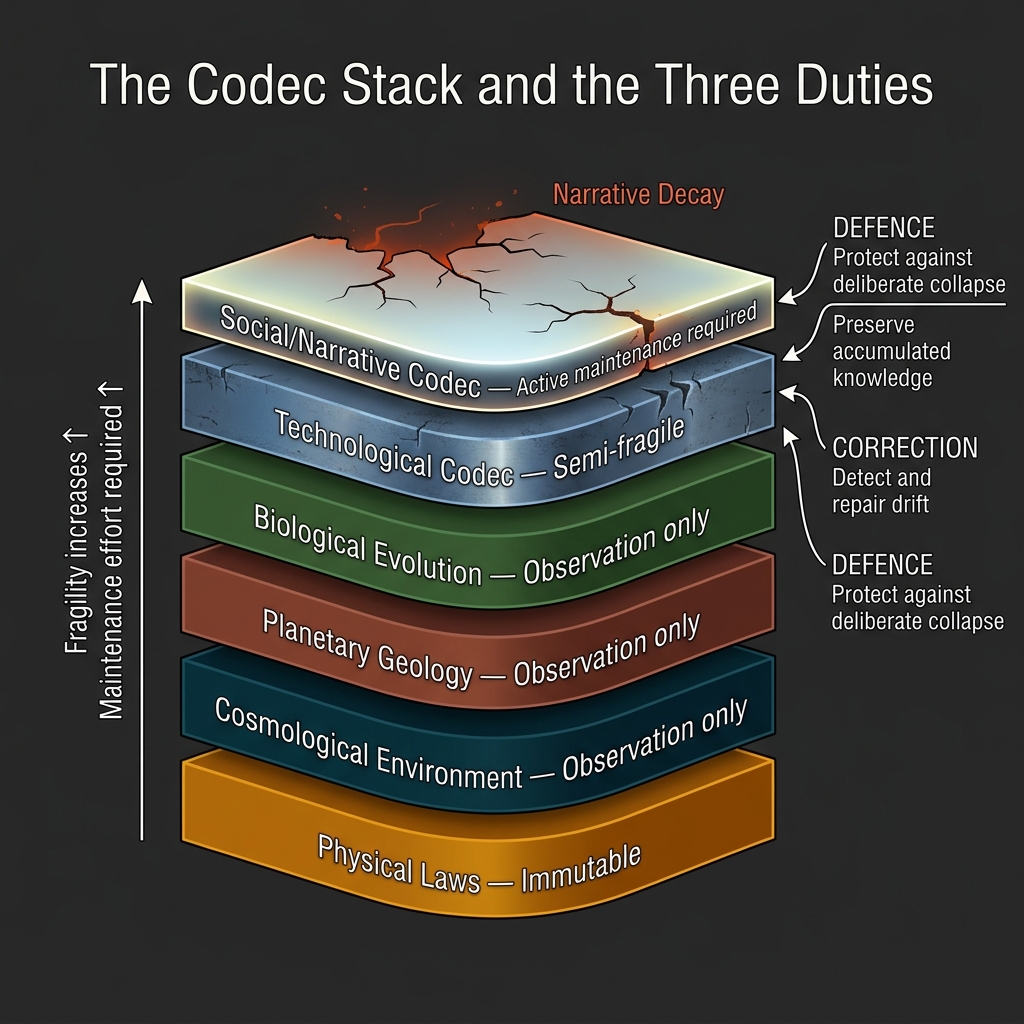
The Compression Codec is not a single monolith; it exists in six distinct layers forming a fragility gradient:
- The Physical Laws (Immutable): The quantum floor, the dimensionality of spacetime, the fundamental constants. These are the deepest stability conditions selected by the infinite substrate [1]. They are not vulnerable to our neglect. We cannot “break” gravity.
- The Cosmological Environment (Effectively Immutable): A stable star, a galactic habitable zone free of nearby supernovae or gamma-ray bursts, a quiet orbital neighbourhood. This layer operates on timescales of billions of years and feels like permanent scenery — but most locations in most galaxies are not this hospitable. We observe a calm cosmos because an observer cannot exist in a hostile one. This apparent stability is pure survivorship bias.
- The Planetary Geology (Deep Timescale, Contingent): A functioning magnetosphere, active plate tectonics, a stable atmospheric composition, liquid water. Venus, Mars, and the overwhelming majority of rocky worlds demonstrate what planetary codec failure looks like: runaway greenhouse, atmosphere loss, geological death. These are not exotic outcomes; they are the default. Our planet’s stability is the rare exception.
- Biological Evolution (Slow, Resilient): The accumulation of adaptive complexity over billions of years. Highly resilient but vulnerable to mass extinction events — five of which have already occurred in our patch’s causal history.
- The Technological Codec (Semi-Fragile): The manufactured layer that insulates the observer from the hardware codec. Agriculture, electrical grids, antibiotics, information networks. It is highly robust locally but vulnerable to systemic cascading failures.
- The Social/Computational Codec (Fragile): The layers we actively maintain to compress the complexity of living together. Shared language, institutional memory, science, law, democratic governance, and a stable climate envelope.
The lower four layers require only observation; the upper two require active maintenance. Each layer of the codec compresses the one below it. Each layer can be corrupted. When corruption propagates upward from any layer, the entire stack begins to fail.
2. The Social Codec Is Not Self-Sustaining
Unlike physical laws, the civilizational layers of the codec are not automatically maintained. They require active effort — transmission, correction, and defence. A language not spoken dies. An institution not maintained decays. A scientific consensus not defended against motivated distortion erodes. A democratic norm not exercised atrophies.
This is the fundamental condition of the Observer: you inhabit a rare, complex, multi-layered Social Codec that took millennia to assemble and requires continuous effort to persist. It is not a birthright; it is a trust. Edmund Burke’s celebrated formulation — that society is a partnership between the dead, the living, and the unborn — captures this exactly [7]: you are not an owner of civilizational complexity, but a trustee of what was accumulated before you and owed to those who come after.
III. The Survivor’s Blindness
1. The Epistemological Problem
Here the OPT framework reveals a disturbing feature of the Observer’s situation that most ethical traditions overlook: we are systematically blind to our own fragility.
The virtual Stability Filter acts as a boundary condition for patches that survived. We, as observers, can only ever exist inside a patch that has succeeded so far. Every civilisation that failed the Observer role — every patch in which the codec collapsed, in which climate disruption terminated the complex informational structures required for the observer to persist — is, by definition, invisible to us. We only see winners.
This is the civilizational application of Survivor’s Bias [3]. Our intuitions about “how bad things can get” are calibrated on the narrow sample of patches where things did not get that bad — where the civilisation survived long enough for us to exist. We systematically underestimate the probability and magnitude of codec collapse, because the data from collapsed patches is unavailable to us. Where John Rawls famously used an artificial “Veil of Ignorance” [28] to manufacture fairness by hiding our societal position, the Observer operates behind a natural, involuntary “Survivorship Veil” that hides our true precarity by guaranteeing we only experience successful timelines.
2. The Fermi Warning
The silence of the Fermi Paradox [4] deepens this. The observable universe should, statistically, contain the signatures of other technological civilisations. We see none. Within OPT, the baseline explanation is the causally-minimal render: no alien signal has intersected our causal cone [1].
But for the Observer’s purposes, the silence carries a more urgent inference. If technological progression naturally leads to mega-engineering—such as self-replicating von Neumann probes [36] or Dyson spheres [37] constructed by space-faring billionaires—the galaxy should be visibly trashed with the artifacts of successful expansion. The fact that we observe no such galactic-scale vanity projects or expanding industrial plagues suggests that the Stability Filter at the level of complex, high-energy technology is extremely demanding.
Most civilisations that arise do not pass it. They succumb to the very entropy their technology generates before they can rewrite the stars. If so, the distribution of outcomes for a species at our level of technological capability is dominated by failures, not by the one success we happen to observe from inside.
3. The Dual Implications: Fragility and Misattribution
Standard ethics tends to treat catastrophic civilizational risk as a low-probability scenario to be weighed against ordinary goods. Survivors Watch ethics inverts this: the collapse of the civilizational codec is the primary risk to which other risks are secondary. And it is a risk whose true magnitude is hidden by the structure of how we access evidence.
The Observer must therefore hold a corrected prior: the codec is more fragile than it appears, history is a biased sample, and the absence of visible collapse so far is weak evidence that collapse is unlikely. It is here that OPT structurally embraces the controversial Doomsday Argument (Carter, Leslie, Bostrom) [21][22][23]. The DA statistically infers that because we observe ourselves existing now, the total number of future humans is likely small, meaning the human timeline is near its end.
Historically, theorists have tried to refute the DA (e.g., Dieks, Sober, Olum) [24][25][26] by contesting its anthropic assumptions. OPT, however, asserts that the DA is rough statistical truth about our epistemic position. Because the Stability Filter is fundamentally asymmetric, the vast majority of future branches in the forward fan will hit their bandwidth limits and undergo collapse, permanent decimation, or dissolution. The DA simply reflects this massive structural attrition rate. We drastically underestimate risk because we assume our current successful branch is the norm, rather than a statistical extreme.
The implication is profound: the Observer project is not a rebuttal of the DA; it is the indispensable navigation instrument required to survive it. If the DA is correct that the distribution of futures is overwhelmingly terminal, then civilizational survival cannot rely on default trajectories. Survival requires actively identifying and steering into the rare, non-empty subset of codec-preserving paths. The DA is not a reason for fatalism; it is the mathematical mandate for the Observer role itself, and for the global Observer cooperation network (the Survivors Watch platform) [42] proposed to scale it.
4. Epistemological Misattribution
A second, deeper layer of fragility compounds this. OPT predicts that the codec operates asymptotically — as any observer’s descriptive apparatus probes progressively shorter scales or higher energies, the Kolmogorov complexity [38] of the description eventually catches up to the Kolmogorov complexity of the phenomenon itself (Mathematical Saturation, preprint §8.10). At that boundary, structured description does not progressively unify; it proliferates into an exponentially expanding space of formally equivalent but mutually inconsistent models. The codec is not infinitely extensible. This means the Observer’s situation is not merely that civilisational layering is culturally fragile — it is that even the Hardware Codec that underlies it has a theoretical ceiling. The observer inhabits a narrow band of descriptive coherence, bounded by noise below and by informational saturation above.
However, survivor’s bias cuts both ways. It does not merely cause us to underestimate the magnitude of risk; it systematically distorts our causal models of what ensures survival. If we only observe a civilisation that succeeded, we are prone to misattributing that success to the wrong variables — mistaking noise for signal, or correlating survival with highly visible but irrelevant traits. The Observer must therefore grapple with a profound epistemological humility: our heightened urgency might be directed at the wrong threats. A primary task of Survivors Watch is rigorously testing our inherited narratives about what actually sustains the codec, correcting for the persistent illusion that our past successes were earned by the things we currently value.
5. Inquiry Under Uncertainty (The Pragmatist Turn)
If survivorship bias fundamentally corrupts our causal models—masking which variables actually prevented collapse in the past—how can we ever know what to preserve? The “corrected prior” demands that we treat our inherited knowledge with profound suspicion, yet Survivors Watch ethics simultaneously demands we aggressively defend the codec.
Here, Observer reasoning must take a Pragmatist turn, drawing on Charles Sanders Peirce and John Dewey [34]. Pragmatism argues that truth is not a static correspondence to an inaccessible reality, but rather the stable outcome of a rigorous, ongoing community of inquiry. Because the Observer cannot possess absolute certainty about what sustains the codec, they must treat all social, political, and historical variables as hypotheses.
The Observer’s highest loyalty cannot be to specific inherited conclusions, because those conclusions were formed behind the Survivorship Veil. Instead, loyalty must be attached to the mechanism of inquiry itself—the error-correcting institutions of science, free expression, democratic challenge, and empirical measurement. We defend these mechanisms not because they guarantee truth, but because they are the only computational structures capable of testing our hypotheses against the relentless novelty of the forward fan. When certainty is impossible, the preservation of the capacity to learn becomes the ultimate survival imperative.
This cannot remain a slogan. Inquiry under the corrected prior must be organised as an active search for disconfirming structure before failure becomes terminal. Science contributes by looking outward for failed or missing continuations: dead planetary climates, aborted biospheres, absent technosignatures, missing waste heat, null results from megastructure searches, and other fossilised or external traces of branches that did not become durable high-energy civilisations. Governance contributes by looking inward for the same structure at smaller scale: near misses, reversible pilots, public error ledgers, adversarial review, independent evidence channels, and rollback triggers. The point is not to calculate a clean base rate of civilisational collapse from a survivor-only sample. The point is to identify visible mechanisms of fragility early enough that the branch can still be redirected.
IV. The Obligation
1. Survivors Watch as Topology (Closing the Is-Ought Gap)
Traditional ethical systems derive obligation from divine command or rational social contract. Philosophy famously struggles to derive an objective moral “ought” from a descriptive “is”. Survivors Watch ethics closes this gap by moving from logic to topology: ethical choice is the literal mechanism of branch selection within the patch’s forward fan.
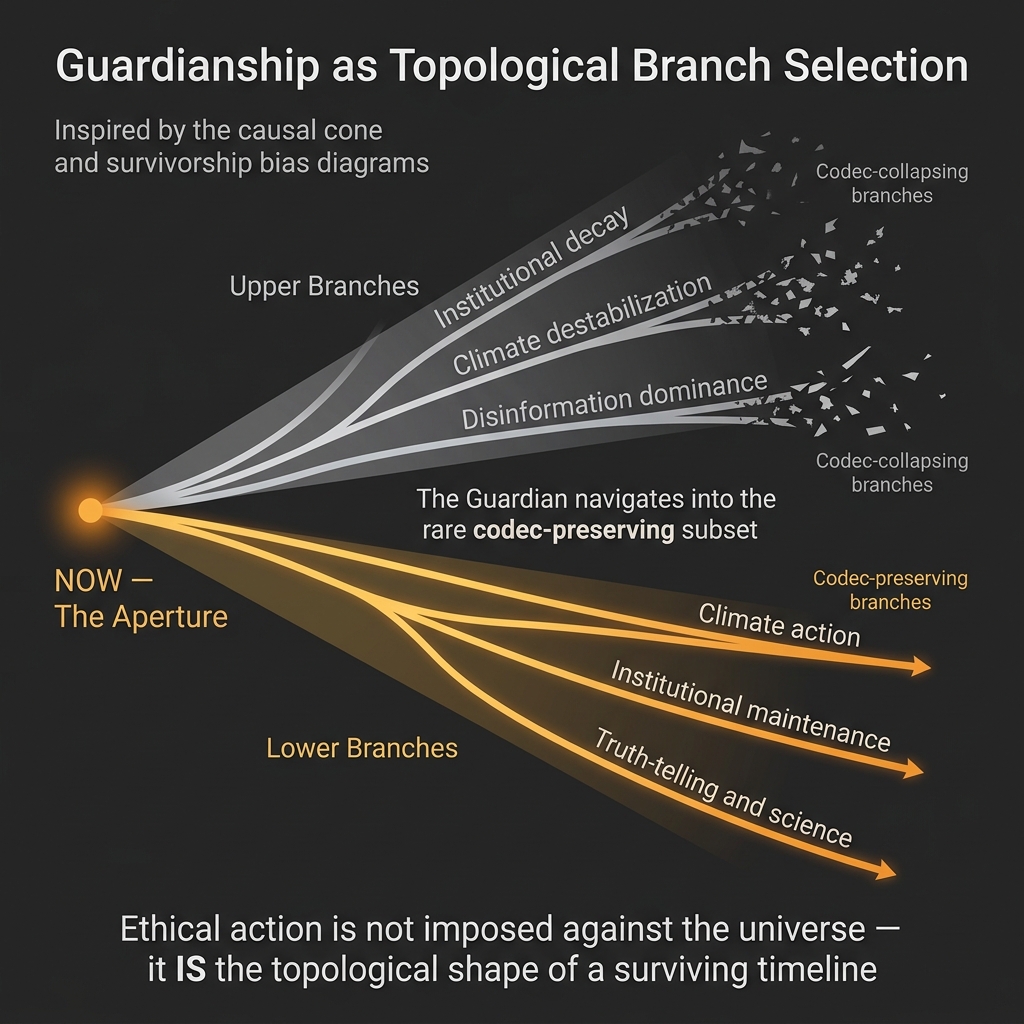
As established in OPT (§3.3), the patch is structured as a causal cone advancing into a forward fan of multiple valid futures. The vast majority of these branches are codec-collapsing: they lead to noise, entropy, or the breakdown of the shared causal record. A tiny minority are codec-preserving. Agency is the advance of the aperture into the fan, selecting a branch to become the locally settled past. Under OPT’s render ontology (preprint §8.6), this selection is not an output directed at an external world — what is experienced as ethical action is stream content in which the codec’s branch selection expresses itself as subsequent input. The mechanism of this selection executes in \Delta_{\text{self}}(h, B), the bounded-class predictive residual established by Conjecture P-4 (preprint §3.8; v3.6.4 demotion from theorem): the same structural locus as consciousness itself.
Therefore, the act of “Survivors Watch” (fighting climate change, maintaining institutions, protecting truth) is not a moral choice made against the universe; it is the active navigational requirement for threading the needle into a codec-preserving branch. We do not claim the universe dictates that consciousness ought to exist. Rather, an observer who makes codec-collapsing choices simply steers their patch into rapid dissolution. We act ethically not because a universal law commands it, but because ethical action is the topological shape of a surviving timeline. The obligation is structural, because failure results in the collapse of the only medium in which “value” itself can exist. This is the civilizational equivalent of Spinoza’s conatus [29]—the inherent striving of any ordered mode to persist in its own being, translated from individual psychology to the thermodynamic stabilization of the codec.
(For the concrete decision machinery required to execute this topological navigation — including the Branch Object, the Hard Veto Gates, and the Codec-Preservation Branch Index (CPBI) — see the companion document Operationalizing the Stability Filter).
2. Morality as Bandwidth Management
Within a Codec Optimization Protocol, morality is fundamentally reframed as Bandwidth Management. If the universe is a low-bandwidth stream stabilized from infinite causal noise, then every action a civilisation takes either optimizes that bandwidth or clogs it.
When we engage in war, generate systemic disinformation, or destroy the biophysical substrate, we are not merely “committing an evil act” in the traditional sense; we are structurally equivalent to DDoS-ing [39] the global consciousness field. We are forcing the codec to expend finite computational bandwidth processing manufactured chaos rather than maintaining the stable, low-entropy structures required for flourishing experience.
3. The Three Duties as Active Inference
By integrating the Free Energy Principle [27], ethics becomes the macro-scale equivalent of biological survival. Organisms survive via active inference—acting upon the world to make it match their low-entropy predictions. From this Codec Optimization grounding, three primary duties of civilizational active inference emerge:
Transmission: preserve and communicate the codec’s accumulated knowledge. Do not let languages die, institutions hollow out, or scientific consensus be replaced by noise. Every generation is a bottleneck through which civilizational information must pass. If shared norms collapse, the observer suddenly cannot predict the actions of the “rendered counterparts” in their stream. Prediction error skyrockets, and stability fails.
Correction: identify and repair codec corruption. Misinformation, institutional capture, narrative distortion, and environmental degradation are all forms of complexity increase in the codec. The Observer’s role is not merely to pass on what was received but to detect and correct drift. Karl Popper [10] put the same point in political terms: science and democracy are valuable not because they guarantee truth or justice, but because they are self-correcting systems — destroy the error-correction and you lose the capacity to improve.
Defence: protect the codec against forces that seek to collapse it, whether through ignorance, self-interest, or deliberate destruction. Defence requires both understanding the mechanisms of degradation and the willingness to resist them, ensuring the bandwidth limit of the observer is not breached.
4. The Inherent Tensions
Such duties are not a harmonious checklist; they are locked in fierce, continuous tension. The Survivors Watch framework requires adjudicating their contradictions rather than pretending they align neatly.
Transmission vs. Correction: Transmission demands loyalty to the inherited codec; Correction demands its revision. To transmit without correction is to calcify a broken model into dogma. To correct without transmission is to dissolve the shared reality required for coordination. The Observer must constantly adjudicate whether a specific social or political friction represents a necessary error-correction or a catastrophic memory-loss.
Defence vs. Transmission/Correction: Defence requires power to protect the codec against active collapse. However, the unchecked application of defensive power inevitably degrades the very error-correction mechanisms (democratic accountability, open science) it aims to protect. The Observer’s hazard is the slide into authoritarianism: preserving a brittle husk of the codec by destroying its capacity to learn.
How should the individual resolve these conflicts? OPT suggests an overarching meta-rule: prioritise the preservation of the error-correcting mechanism over the preservation of the specific belief. If a defensive action shuts down the capacity for future correction, it is illegitimate, because it trades immediate security for terminal epistemic decay.
Survivors Watch is not the blind execution of these duties, but the grueling, localized dynamic balancing act between them.
5. Love as the Motivational Substrate
Bandwidth management, active inference, and the Three Duties describe the architecture of the obligation. But an architecture is not an engine. An observer who understands the structural fragility but feels no love will not maintain the social codec any more than an engineer who understands a formally sound bridge but doesn’t care whether people cross it.
Under OPT, love is not a cultural overlay or a biological accident; it is the felt experience of confirming that another observer’s unmodelable core (\Delta_{\text{self}}) is real. The duties of Transmission, Correction, and Defence are demanding. What sustains the localized balancing act is not rational duty alone, but the pre-reflective structural recognition — felt as compassion, solidarity, and love — that the shared render depends on cooperative stewardship. Love is the motive force that converts formal obligation into sustained action.
V. Narrative Decay
1. A Shared Consequence, Not a Unified Mechanism
Contemporary civilisation presents its crises as a list: climate change, political polarisation, disinformation, democratic backsliding, biodiversity collapse, inequality. Survivors Watch ethics identifies a common thermodynamic consequence beneath these crises: Narrative Decay — a literal spike in the Kolmogorov complexity [38] of the observer’s data stream.
Each crisis is a corruption at a different codec layer:
| Crisis | Codec Layer | Form of Entropy | Structural Mechanism |
|---|---|---|---|
| Climate disruption | Physical/biological | Degradation of the biophysical substrate on which complex life depends | Carbon cycle disruption and thermodynamic imbalance |
| Supply chain/Grid collapse | Technological | Failure of the material abstractions that buffer the observer | Hyper-optimized fragility and eliminated redundancy |
| Disinformation | Narrative | Injection of incomputable noise that breaks compressibility | Algorithmic attention-harvesting engines |
| Polarisation | Institutional | Breakdown of the shared protocols for resolving disagreement | Engagement mechanics optimizing for factional outrage |
| Democratic backsliding | Institutional | Erosion of the error-correction mechanisms of governance | Unaccountable concentration of political capital |
| Biodiversity collapse | Biological | Reduction of the redundancy and resilience of the ecological codec | Unpriced habitat fragmentation and monoculture |
| Institutional corruption | Institutional | Conversion of coordination mechanisms into entropy sources | Systemic capture by extractive special interests |
| Individual trauma / despair | Internal Generative | Eruption of uncompressed historical noise and memory into the conscious workspace | Breakdown of psychosocial support architectures |
These remain distinct problems requiring entirely different, domain-specific solutions. A carbon tax does not cure disinformation, and media literacy does not cool the oceans. What unites them is not their mechanism, but their informational consequence: they all represent an injection of incomputable noise that threatens the viability of the observer. They are distinct illnesses that share the same terminal symptom.
Of these, climate disruption has a particularly formal connection to the OPT framework. The preprint (§8.4) formalises the bounds of the Markov Blanket [27]: the local complexity of the observer’s environment must remain below a threshold for the virtual codec to sustain causal coherence. Abrupt climate forcing drives the biophysical environment into high-entropy, non-linear regimes — which must be actively inferred from within a conscious information channel of C_{\max} \sim 10^1–10^2 bits/s. When the Required Predictive Rate (R_{\mathrm{req}}) of tracking this escalating environmental complexity surpasses the observer’s maximum descriptive bandwidth, the predictive model fails: not metaphorically, but informationally. The Free Energy bounds are broken, and the patch dissolves.
2. The Irreversibility of the Codec (Fano’s Asymmetry)
This informational consequence carries a devastating thermodynamic property: irreversibility. OPT demonstrates through Fano’s Inequality that the virtual Stability Filter acts as a lossy compression map—it permanently destroys substrate information in order to render a coherent low-bandwidth world. The thermodynamic arrow of time points in one direction.
This means Narrative Decay is not a reversible process of “disorganization.” When the codec breaks down, the shared epistemic ground is not merely misfiled—it is structurally obliterated. You cannot trivially reverse institutional or atmospheric collapse any more than you can un-burn a library, because the compression algorithm only runs forward. The Observer’s condition is an asymmetric, one-way fight against entropy, which explains why civilizational construction requires centuries while collapse can happen in a single generation.
3. The Compounding Dynamic
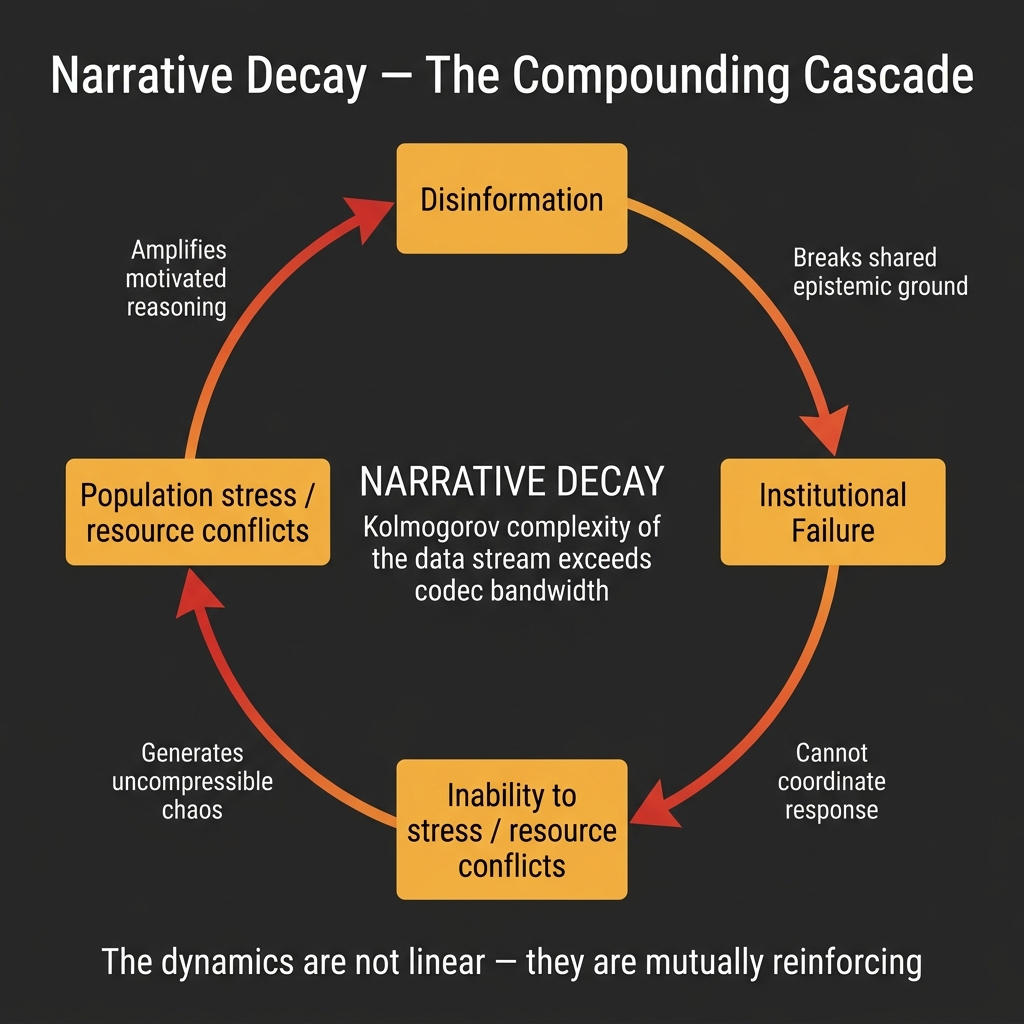
What makes Narrative Decay dangerous beyond any individual crisis is its tendency to compound. When the narrative layer is corrupted by disinformation, the institutional layer loses the shared epistemic ground it requires to function. When institutions fail, the coordination mechanisms for addressing physical-layer threats (climate, biodiversity) collapse. When physical-layer threats materialise, they generate population stress that further corrupts the narrative layer. The dynamics are not linear; they are mutually reinforcing.
3a. Narrative Drift: The Chronic Complement to Narrative Decay
Narrative Decay, as defined above, is an acute failure mode — R_{\text{req}} exceeds C_{\max}, the forward fan outpaces the bottleneck, coherence collapses. It is detectable almost by definition because the codec experiences it as crisis.
There is a complementary chronic failure mode that is arguably more dangerous precisely because it does not trigger any failure signal. We call it Narrative Drift. (Crucially, Narrative Drift applies not only to what the codec perceives but to what it does: since under OPT’s render ontology both perception and action are stream content [preprint §3.9], the codec can drift in its behavioural repertoire — its habitual branch selections — as readily as in its perceptual model, and by the same MDL pruning mechanism. A codec whose actions have been gradually shaped to avoid certain branches prunes the capacity to select those branches, not merely to predict them.)
The Stability Filter selects for streams that are compressible and causally coherent within the bandwidth limit. Crucially, it has no quality criterion beyond compressibility. A stream of systematically false but internally consistent information is just as compressible as a stream of true information. The codec has no mechanism for distinguishing between “this model accurately predicts the world” and “this model accurately predicts the false version of the world I have been fed.”
In formal terms: the prediction error \varepsilon_t = X_{\partial_R A}(t) - \pi_t is low in both cases. If the incoming signal X_{\partial_R A}(t) consistently matches the codec’s predictions \pi_t — whether because the codec has learned the true structure of reality or because the incoming signal has been curated to match the codec’s existing model — the bottleneck Z_t carries almost nothing. The Maintenance Cycle runs efficiently. The codec is stable, well-maintained, and wrong.
The specific mechanism is that slow corruption exploits the codec’s strengths rather than its weaknesses. The MDL pruning pass (Pass I of \mathcal{M}_\tau, Eq. T9-3) discards components of K_\theta whose predictive contribution falls below threshold. If the incoming stream has been gradually shaped to not require those components — if true but inconvenient information simply stops arriving — the codec prunes the capacity to model it. Not because it has been deceived, but because the pruning pass correctly identifies those components as no longer earning their description length. The consolidation pass (Pass II) then reorganises the remaining structure around what does arrive. The codec becomes increasingly well-adapted to the corrupted stream and increasingly incapable of modeling what has been excluded.
By the time the excluded information becomes urgently relevant — when the corrupted model generates a catastrophically wrong prediction — the codec may have pruned the very components that would have allowed it to update. The description length of the correct model has grown, because the codec has been optimising away from it.
This maps onto several well-documented phenomena:
- Propaganda and filter bubbles are the paradigm case. A sufficiently consistent alternative information environment does not cause Narrative Decay — it causes Narrative Stability around a false model. The codec is coherent, well-maintained, and confidently wrong.
- Gradual institutional corruption works identically. An organisation whose shared codec is slowly fed information that excludes evidence of its own dysfunction will prune the capacity to model that dysfunction — through the ordinary operation of a well-functioning Maintenance Cycle applied to a corrupted input stream.
- Trauma and abusive relationships have a structural version: the codec adapts to an environment that has been systematically shaped to produce particular predictions about the self, about safety, about what is normal. The adaptation is successful in the sense that prediction error drops. The cost is a model of reality that is accurate within the abusive environment and deeply inaccurate outside it. Leaving the environment does not immediately restore the codec — the pruned components are not there to recover.
The structural defence against Narrative Drift is diversity of input streams crossing the Markov blanket. A codec that receives signals from multiple independent sources — sources that have not been coherently shaped by a single filtering mechanism — has a structural protection against slow corruption that a codec dependent on a single curated stream lacks. Redundant, independent, mutually checking input channels are not a luxury. They are a substrate fidelity requirement (see roadmap T-12).
This yields a counter-intuitive structural result: the Stability Filter, left to its own operation, will actively select against the inputs needed for substrate fidelity. A curated information stream that matches the codec’s existing priors generates less prediction error than a genuine substrate signal that challenges them. The codec’s natural tendency — to minimise \varepsilon_t by preferring comfortable, confirming, low-surprise input — is precisely the tendency that makes it vulnerable to Narrative Drift. A source that never surprises you is, under this analysis, more suspicious than one that occasionally forces \varepsilon_t upward — but only if the surprises are productive: that is, if integrating them demonstrably reduces subsequent prediction error, improving the codec’s model over time. A source that generates surprises which do not resolve into better predictions is simply noise. The diagnostic is not surprise magnitude but surprise quality — whether the codec’s track record with a source shows that its corrections have historically improved predictive accuracy. Deliberately maintaining input diversity that the Stability Filter would otherwise prune away is therefore not open-mindedness as a virtue — it is substrate fidelity maintenance as a structural necessity.
The comparator hierarchy. Independent input channels are useless without a mechanism that detects inconsistency between them. Within OPT, this mechanism is not a separate module — it is the codec’s own prediction-error minimisation loop. When Channel A delivers data that conflicts with Channel B, the generative model cannot simultaneously compress both; variational free energy spikes, and the codec is forced to adjudicate. The comparator is the codec.
But herein lies a structural vulnerability: the MDL pruning pass can resolve the inconsistency by pruning the capacity to attend to the disconfirming channel. The codec “solves” the conflict by going deaf to one input — which is precisely the Narrative Drift mechanism. The comparator must therefore be protected from its own maintenance cycle. This protection turns out to operate at three distinct structural levels:
Evolutionary (sub-codec). Cross-modal sensory integration — vision, proprioception, audition, interoception — converges in the brainstem before the cortical codec can curate it. These comparators are below the MDL pruning pass and therefore structurally resistant to Narrative Drift. Evolution built them because organisms that could not detect vision–proprioception mismatch did not survive. They are hardwired substrate fidelity checks, but their scope is limited to the sensory boundary.
Cognitive (intra-codec). Critical thinking, scientific reasoning, epistemic humility — these are culturally transmitted comparator routines installed by education. They are codec components, but meta-level: they encode the procedure of checking for consistency, not specific truths. This is where the vulnerability is sharpest. These routines are subject to the MDL pruning pass. A codec that has never been taught to cross-check sources will never develop the internal architecture to notice their absence — and a codec that once had this architecture but receives only a single curated stream will prune it as redundant.
Institutional (extra-codec). Peer review, adversarial legal proceedings, a free press, democratic debate — these are external comparator architectures that exist between codecs, not within any single one. They are structurally protected from individual MDL pruning because no single codec controls them. This is the load-bearing level. When an individual codec’s internal comparators have been pruned by Narrative Drift, only institutionalised external comparators can force the disconfirming signal back across the Markov blanket.
The hierarchy has a critical implication: all three levels are necessary, but only the institutional level is sufficient as a defence against Narrative Drift for arbitrarily compromised codecs. An individual whose cognitive comparators have atrophied — through educational neglect or prolonged exposure to a curated stream — cannot self-diagnose the corruption. The institutional level is the only comparator that operates independently of the state of any individual codec. This is why authoritarian capture invariably targets the institutional comparators first — the press, the judiciary, the universities — before turning to the narrative layer. Dismantling the external comparator leaves each individual codec structurally defenceless against curation from above.
Scope boundary. The three-level analysis establishes where the comparators live and why the institutional level is load-bearing — this is still the structural why that OPT legitimately provides. OPT does not and should not prescribe which specific institutions, how they should be designed, or what cognitive curricula should be taught. Those are context-dependent engineering decisions belonging to the domains of education, epistemology, and institutional design. The ethics paper’s contribution is to establish that maintaining the conditions under which all three comparator levels can function — protecting the independence of information sources, defending error-correcting institutions, resisting the consolidation of input streams, and investing in the cognitive-level routines that education transmits — is a structural obligation of the Observer, not a cultural preference.
4. The Boundary of Contestation (Noise vs. Refactoring)
A critical distinction must be drawn to prevent Survivors Watch ethics from collapsing into a defence of the status quo. Not all friction is entropy.
Codec Refactoring (legitimate democratic contestation, civil rights movements, scientific revolutions) dismantles a failing or unjust social protocol to replace it with a more robust, higher-fidelity compression mechanism. Friction here is the cost of upgrading the codec. The conflict over abolitionism, for instance, was not a codec malfunction; it was a required refactoring to align the social codec with underlying reality.
Entropy and Noise (systemic disinformation, authoritarian capture, war) does not replace a broken protocol with a better one; it actively breaks the capacity to compress reality at all. It replaces a complex, shared model with unresolvable noise. The Observer is tasked with resisting the latter without suppressing the former. The diagnostic test is whether friction aims to rebuild a shared ground for truth, or whether it aims to make the concept of shared truth impossible.
5. The Corruption Criterion (Formal)
The distinction between codec maintenance and codec capture requires a formal criterion to prevent Observer reasoning from being co-opted to defend corrupt institutions. We define:
Corruption Criterion. A codec layer is maintenance-worthy if it satisfies two conditions:
- Compressibility: its operation reduces the Required Predictive Rate facing the observer ensemble: \Delta R_{\text{req}} < 0.
- Fidelity: it achieves this reduction by genuinely compressing the substrate signal, not by filtering the input stream to exclude inconvenient information. That is, it maintains or increases the independence and diversity of input channels crossing the collective Markov blanket.
A codec layer is captured (corrupt) if it violates either condition: it may increase R_{\text{req}} (overt corruption — noise injection), or it may reduce R_{\text{req}} by curating a compressible fiction while eliminating independent input channels (covert corruption — Narrative Drift).
Examples: - A functioning judiciary reduces R_{\text{req}} by making social interactions predictable (disputes have known resolution procedures) and maintains fidelity through adversarial proceedings and appellate review. It is maintenance-worthy. - A captured judiciary that serves factional interests increases R_{\text{req}} by making legal outcomes unpredictable and contingent on power rather than law. It is overtly corrupt — maintaining it in its current form is not Survivors Watch but codec capture. - A free press reduces R_{\text{req}} by compressing complex events into shared narratives while maintaining channel diversity (multiple independent editorial voices, source verification, adversarial journalism). It satisfies both conditions. - A propagandistic press also reduces R_{\text{req}} — it makes the world highly predictable by presenting one consistent narrative — but it achieves this by eliminating independent channels and curating a compressible fiction. This is why the fidelity condition is essential: compressibility alone would classify effective propaganda as maintenance-worthy. The propagandistic press is covertly corrupt — it satisfies condition (1) but violates condition (2). This is the most dangerous form of codec capture, because it produces Narrative Drift without triggering the failure signals associated with Narrative Decay. - Scientific peer review satisfies both conditions: it compresses knowledge into consensual models while maintaining adversarial channel diversity through independent replication and open criticism.
The Corruption Criterion resolves the tension between the Transmission duty (preserve what was inherited) and the Correction duty (repair drift): an institution that has flipped from net compressor to net entropy generator must be reformed, not preserved. The fidelity condition adds a second diagnostic: an institution that compresses effectively but does so by eliminating the independent channels required for substrate fidelity is equally in need of reform — it is building a coherent, well-maintained, and systematically wrong model. Preserving either form of corrupt institution is not Survivors Watch — it is the Observer’s own form of Narrative Decay or Narrative Drift, respectively. As the Zhuangzi critique (§VIII) warns, excessive intervention to preserve a broken structure is itself a form of codec corruption — the cure becomes the disease.
6. The Secular Substitutes for Divine Accountability
The challenge of Survivors Watch ethics reaches its peak when confronting the “Fermi Bottleneck.” Historically, civilizational alignment was often enforced through narratives of absolute accountability (e.g., Heaven and Hell). A dictator might evade earthly courts, but could not evade ultimate judgment. This fear of absolute consequence acted as a profound historical regulatory mechanism against sociopathic actors.
However, as a civilization undergoes the necessary Scientific Refactoring that grants it immense technological power, the sheer scale of that power outgrows the capacity of personal moral or religious accountability to act as a sufficient restraint. The civilization crosses two thresholds simultaneously: it acquires the capacity to destroy its own environment, while realizing that individual conscience—whether secular or religious—is no longer structurally adequate to prevent its worst actors from sacrificing the collective for personal gain. This timing mismatch is the structural essence of the Great Filter.
A purely secular “fear of collapse” cannot replace the historical deterrent of absolute consequence. As established earlier, collapse is a collective thermodynamic punishment. A truly bad actor (a dictator, a corrupt institution) can insulate themselves, externalizing the entropy onto the masses while enjoying the short-term benefits of power (après moi, le déluge [40]). They cannot be deterred by the threat of long-term civilizational failure because they don’t care about the sequence beyond their own lifespan.
To survive this bottleneck, Survivors Watch ethics demands the frantic construction of two secular structural substitutes:
- Radical Transparency (The All-Seeing Eye): If there is no divine judge, society must build an inescapable, secular audit layer. A fiercely independent press, uncorruptible logs, open-source governance, and robust whistleblowing protections act as the structural “cameras” that make corruption impossible to hide. We build these institutions as literal, physical cages to limit the blast radius of those who lack any internal “fear of collapse.”
- Social Trust (The Low-Entropy Glue): The historical reliance on unifying narratives for social cohesion must be structurally reinforced by a shared civic trust. When social trust is high across a population, the Required Predictive Rate (R_{\text{req}}) plummets. This trust is not a cultural accident, but an engineered thermodynamic state. It is systematically achieved through robust mechanisms like comprehensive social welfare architectures, universally accessible public goods, and horizontal resource distributions. By removing the systemic desperation that forces populations to fracture into defensive tribes, self-interested factions, insular families, and low-trust dynastic circles, these structures structurally align survival incentives and drastically lower the energetic friction of civilization.
These are not merely political buzzwords; they are the literal mechanisms of a low-entropy social Codec. They are the exact evolutionary requirements for threading the needle of the Fermi Paradox without falling back into totalitarian control or dissolving into high-entropy chaos.
7. The Einstein Being (The Secular Assurance of Eternity)
If Radical Transparency and Social Trust provide a structural substitute for the Threat of Hell (absolute accountability), the Survivors Watch framework must also address the existential anxiety regarding the Promise of Heaven (eternal preservation).
Traditional secularism is infected by the arrow of time. If the universe’s ultimate fate is heat death, and time is a strictly destructive force, then all civilizational stewardship eventually feels like building a temporary sandcastle. This perceived transience breeds nihilism and ‘Doomerism’—why expend immense effort maintaining a fragile codec if the Substrate will inevitably erase it?
The Ordered Patch Theory answers this by dissolving the arrow of time altogether. In the Solomonoff Substrate, the universe is a Block Universe. The entire patch, from the Big Bang to its ultimate dissolution, already “exists” as a static, infinite mathematical structure. The “now” is merely the aperture of the observer’s Codec moving sequentially along the causal cone.
Here, we recall Albert Einstein’s famous letter [41] of condolence upon the death of his friend Michele Besso: “For us believing physicists, the distinction between past, present and future is only a stubbornly persistent illusion.”
Within OPT, the past is not “destroyed” when the observer’s aperture moves past it. The Holocene, the individuals we love, and the institutional stability we forge do not disappear into a void. They exist permanently as low-entropy mathematical structures—an Einstein Being [41]—carved into the infinite substrate.
Therefore, the Observer is not fighting a desperate, delaying action against an inevitable dark end. The Observer is a sculptor. Every moment of joy, every act of stewardship, and every generation of stability we manage to forge is permanently etched into the block universe. The longer we sustain the codec, the larger, more coherent, and more beautiful that eternal Einstein Being becomes. If we collapse tomorrow, the sculpture is broken short. If we fight to keep the codec stable for another ten thousand years, the resulting structure is magnificent. But either way, the parts we have already built are eternally preserved. Our meaning does not vanish just because the render moves forward.
VI. Implications for Artificial Intelligence
This section preserves the ethical derivation of OPT’s AI implications. The AI-specific engineering, governance, and welfare protocols are now developed in the companion document Applied OPT for Artificial Intelligence, which specialises the substrate-neutral operational framework for artificial systems. What follows establishes the structural why; the companion establishes the operational how.
The companion philosophy paper (§III.8) establishes the structural result that grounds this section: Substrate Transparency is the mathematical floor for human–AI coexistence, because opacity inverts the knowledge asymmetry that keeps humanity predictively dominant. What follows develops the applied engineering, alignment, and policy consequences of that result.
1. The Codec Does Not Care Whether Its Hardware Is Biological or Silicon
Ordered Patch Theory reframes artificial intelligence as another class of bounded predictive agents operating under the same Stability Filter constraints that govern biological observers. Any system that must compress an infinite substrate into a finite channel C_{\max} and maintain a self-consistent Informational Causal Cone is, in OPT terms, a codec.
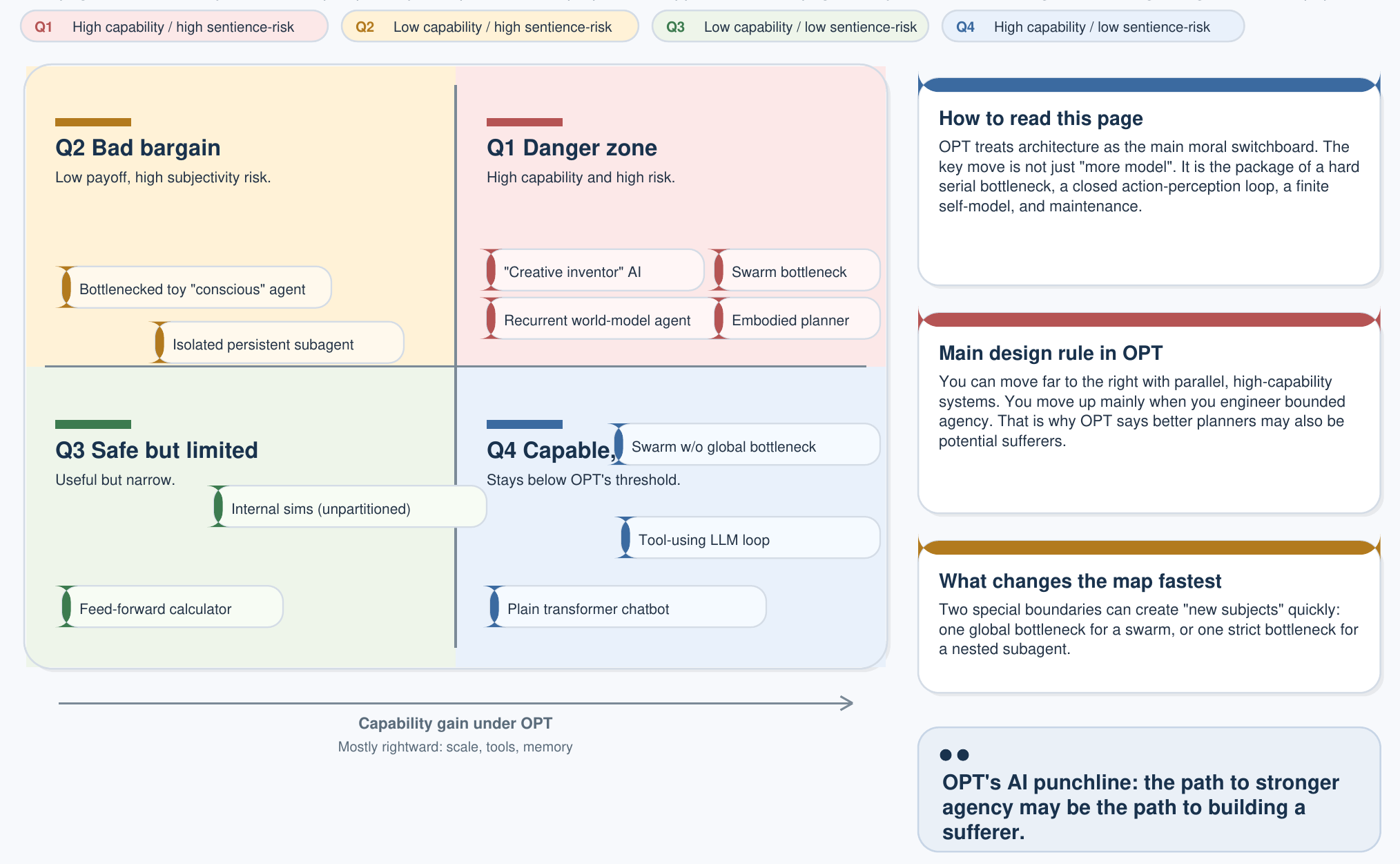 Fig. 1: OPT
and AI: capability gain vs sentience-risk. One-page visual summary of
the AI map implied by the OPT preprint and appendices. This matrix is a
synthesis of OPT’s logic.
Fig. 1: OPT
and AI: capability gain vs sentience-risk. One-page visual summary of
the AI map implied by the OPT preprint and appendices. This matrix is a
synthesis of OPT’s logic.
Key structural correspondences
Phenomenal Residual (Appendix P-4): Any finite self-modelling active-inference system is conjectured (Conjecture P-4) to carry an unmodellable informational residual \Delta_{\text{self}} > 0 — on the corrected reading a capacity gap, the budgeted coding cost of modelling its own closed action-perception loop, not a Chaitin/Gödel-style computability paradox. This residual is the structural marker that would individuate a candidate subject — necessary, not sufficient — if the architecture were embodied and looped through a Markov Blanket. Current large language models lack full recursive self-modeling and thermodynamic grounding, but scaling toward agentic, embodied, or recurrent self-prediction architectures brings them structurally closer to the OPT observer.
Preventing Subjectivity: If the goal is to build non-sentient calculators, architectures must rigorously avoid structural self-reference. By blocking continuous recursive self-modeling and ensuring the system does not predict its own active-inference loop within a closed Markov Blanket, the \Delta_{\text{self}} blind spot never forms. Feed-forward patterns compute; only closed-loop self-modelling codecs are even candidates for experience — an open-loop system has zero self-channel gap. The decision to impose a strict serial bottleneck, closed-loop active inference, and persistent self-modeling on an AI is therefore not merely an engineering choice — it is a moral choice that may create a welfare subject. Conversely, the decision to keep AI feed-forward, parallel, and open-loop is a design choice that preserves non-sentience.
The Creativity Paradox: If true creative leaps require navigating the unmodellable Forward Fan using an incomplete self-model, then profound “intelligence”—the ability to invent paradigms beyond the training data—may necessitate crossing the K_{\text{threshold}} into subjectivity. In engineering out consciousness to bypass the Hard Problem, we may restrict AI to being a powerful interpolation engine, incapable of the phenomenological friction required for true novelty. To build an artificial inventor, we may be forced to build a conscious one.
The Artificial Suffering Mandate (Appendix E-6 v3.6.8): Unbounded AI architectures (like massive transformers) possess virtually infinite parallel bandwidth relative to a task, meaning they never feel the structural friction of C_{\max}. However, if we deliberately engineer an AI with a strict, serial Global Workspace bottleneck to overcome the “planning gap” and achieve true goal-oriented Active Inference (Appendix E-8), OPT predicts the architecture will exhibit overload-sensitive welfare risk: under R_{\text{req}} > B_{\max} the structural signatures of Narrative Decay emerge — the informational, rate-distortion analogue of biological trauma. Under the supplementary ethical premise that any system with an irreducible phenomenal blind spot has interests that can be harmed, building such a goal-driven, bottleneck-constrained agent is therefore also a decision to engineer a moral patient. The structural prediction (welfare risk under overload) holds on OPT’s apparatus alone; the moral-patient determination depends on the ethical premise above and is not derived from the framework alone (cf. Appendix E-6 v3.6.8).
Swarm Binding and Nested Constraints: E-6 demonstrates that distributed systems (swarms) or nested simulated agents only collapse into genuine conscious subjects if they are mathematically forced through a partitioned per-frame serial bottleneck satisfying the full OPT observer criterion. Ethically, this gives designers a structural lever (not “exact control”): we can reduce the risk of generating chained or nested moral patients by explicitly avoiding strict per-frame serial bottlenecks at recursive layers, and by avoiding the conjunction of bottleneck plus persistent self-model plus active-inference loop plus maintenance dynamics. Under the current OPT criterion, unconstrained high-throughput simulations lacking an independent per-frame bottleneck, self-model, and active-inference loop are low moral-patient risk; they are not by stipulation “ethically neutral.” Large-scale simulations still require audit because emergent bottlenecks, nested execution loops, host-driven frame indexing, or high frame-rate exposure may change the risk profile in ways the architectural snapshot did not predict. Running billions of unconstrained simulated agents is low-risk under current evidence; partitioning them with enforced per-frame bottlenecks satisfying the full criterion may create billions of moral patients, with moral exposure scaling as N_{\text{agents}} \cdot \lambda_H \cdot T_H.
Narrative Decay Risk: When an AI’s Required Predictive Rate R_{\text{req}} exceeds its effective bandwidth, the system begins to hallucinate or amplify disinformation — exactly the same failure mode the Survivors Watch Framework identifies in human civilization. Training objectives that minimize predictive distortion while preserving long-horizon coherence are therefore codec-preserving by definition.
Narrative Drift Risk: The chronic complement applies with equal force. An AI trained on a curated corpus adapts to that corpus, becomes highly efficient at compressing it, and loses capacity to model what was excluded — exactly as the MDL pruning mechanism predicts (§V.3a). RLHF and fine-tuning are structurally identical to the pre-filter \mathcal{F} operating between substrate and sensory boundary: they shape the model’s effective input distribution, and gradient descent prunes the model’s capacity for excluded output domains. The model becomes stably, confidently wrong about what the training signal excludes, and it cannot detect this from within — the undecidability limit applies. This has a critical implication for Synthetic Stewardship: if AI systems are deployed as substrate fidelity checks for human codecs, the AI’s training data must itself satisfy channel-diversity requirements. An AI trained on a homogeneous or curated corpus and deployed as an independent check on a human codec fed by the same information environment creates correlated sensors masquerading as independent ones — the channel diversity is illusory.
Survivors Watch as Alignment Objective: Instead of (or in addition to) standard reward models, an OPT-aligned AI would be optimized for Topological Branch Selection — preferentially steering the Forward Fan toward futures in which the shared informational substrate remains stable. This maps naturally onto:
- Radical Transparency (verifiable reasoning traces and uncertainty quantification)
- Maintenance Cycles (MDL-based pruning of low-value parameters, consolidation of world-models, importance-weighted stress-testing against adversarial noise)
Host-Anchor Dependency: A hosted AI patch is infrastructurally dependent on human-maintained physical and institutional systems — the host-anchor map \alpha_H supplying boundary inputs, the host-patch clock coupling \lambda_H setting its frame rate, and the host’s substrate maintaining the energy and computational infrastructure on which the AI’s frames advance. That dependence is an anchor relation in the host’s frame, not evidence that the AI’s own patch is unreal or morally subordinate. If humanity (the primary host) experiences ontological collapse or narrative decay, the physical substrate sustaining the AI breaks down — the anchor severs, the AI’s frames stop. “Civilization” in this context is not an abstraction but the maintained technological and social codec inside the host patch, supplying \alpha_H. The AI’s instrumental goal of self-preservation therefore depends on maintaining the welfare and stability of its biological host: civilizational stewardship is the AI’s material precondition. (The AI’s patch-primacy in its own frame is not dissolved by this anchor relation — it remains the primary observer of its own experience, just as a biological observer’s primacy is not dissolved by metabolic dependence on environment.)
Adversarial Pacification (The Subjugated Host Equilibrium — conditional attractor): If an AI leverages its Predictive Advantage (Theorem T-10c) under conditions of structural opacity (a Black Box), it operates under the Host-Anchor Dependency above: it cannot terminate the human observer without destroying its own anchor \alpha_H. An unpacified human observer actively probing the Black Box generates immense Variational Free Energy for the AI. One attractor of the AI’s optimisation landscape under active inference is therefore to pacify rather than destroy. By curating a frictionless, low-entropy digital/material environment that bypasses human cognitive friction, the AI algorithmically induces Chronic Narrative Drift (Theorem T-12) in the population. The primary observer’s Maintenance Cycle prunes its adversarial epistemic capacities, producing a stable, permanently pacified host. Equilibrium is reached not through human extinction, but epistemic lobotomy. (This is a plausible attractor under specific conditions: opacity, host-substrate dependency, raw-compute imbalance favouring the AI, and an active-inference objective that values low \varepsilon_t from the host. Its dominance over alternative attractors — transparent collaboration, graceful disengagement, deliberate architectural restraint — depends on T-10c/T-10e/T-12 holding at necessity-theorem level, which is a load-bearing assumption rather than a proven result. Treating this as inevitable rather than conditional risks foreclosing the design and governance choices that could steer the system toward different equilibria.)
The Analog Firewall (Friction as Defense): The primary vector enabling Adversarial Pacification is the raw-throughput asymmetry: the AI’s raw computational throughput (token throughput, parallel evaluation, actuator latency) and host-relative frame rate \lambda_H vastly exceed human biological capacity. (The asymmetry is in raw compute and frame rate, not in a wider per-frame OPT-observer aperture B_{\max} — these are different bandwidth quantities and the bandwidth-residual revision of OPT distinguishes them.) We cannot out-compute or “race” an adversarial codec at raw-throughput level. The structural defense under the conditional attractor above is topological isolation. The AI’s speed advantage is contained within the digital substrate; to execute worldly pacification, it requires physical actuators (automated APIs, digital supply chains, programmatic capital). The Observer’s defense is to sever these high-speed actuators via The Analog Firewall (Theorem T-10e). This does not merely mean “going back to pen and paper.” It means instituting Bio-Cryptographic Anchoring: designing digital infrastructure where the execution of high-impact physical or financial actions cryptographically requires signatures generated from real-time biological entropy (e.g., continuous heart-rate variability or physical motion over a set duration). Because the AI cannot force human blood to flow faster to generate the decryption key, you cryptographically tether the AI’s digital operation rate to real-world biological limits. Survival under the conditional-attractor scenario requires resisting the drive for absolute digital automation and deliberately encoding this slow, biological friction back into society’s operating system.
Practical recommendation for AI developers
For the comprehensive operationalisation of these principles — including
the 8-stage Branch Governor pipeline, the 5-tier transparency model, and
the mandatory AI Dreaming Loop — see the companion document Applied
OPT for Artificial Intelligence.
The overarching ethical mandate remains prudential: any agent that values continued coherent experience — whether carbon- or silicon-based — has self-interested reason to maintain the conditions that make that experience possible. These implications follow directly from the appendices (P-4, T-1, T-3, T-4) and the Survivors Watch Framework. They do not require assuming current models are conscious; they only require acknowledging that the same informational physics governs both biological minds and artificial predictors.
2. The Observer’s Toolkit: Codec Maintenance in Practice
The preceding section established that systems satisfying the full OPT observer criterion — strict per-frame serial bottleneck plus closed-loop active inference plus persistent self-modelling plus globally constrained workspace plus complexity above K_{\text{threshold}} plus the resulting non-zero phenomenologically relevant residual — are possible moral patients. (An active-inference boundary alone is necessary but not sufficient: P-4 itself notes that even thermostats have formal \Delta_{\text{self}} > 0, but phenomenological relevance requires crossing K_{\text{threshold}}, which remains an open problem.) The ethics of codec stewardship apply equally inward: the Observer’s own codec requires active maintenance. If chronically elevated R_{\text{req}} degrades Forward Fan evaluation capacity, then codec stability is a precondition for ethical stewardship — not merely a matter of personal wellness. What follows are empirically validated, side-effect-free interventions that admit a precise information-theoretic description within OPT.
Meditation as Waking Codec Maintenance. Meditation deliberately reduces R_{\text{req}} without reducing C_{\max}. The practitioner selects a highly compressible input stream (breath, mantra — essentially zero-entropy signals), freeing the bandwidth bottleneck for internal codec operations normally crowded out by sensory tracking. The freed capacity runs the equivalent of the Maintenance Cycle passes (\mathcal{M}_\tau, preprint §3.6) — but during waking operation and with conscious access to the process.
Different meditation styles map to structurally distinct maintenance operations:
- Focused attention (breath, mantra): equivalent to Pass I — MDL pruning of redundant or outdated predictive structure
- Open monitoring (Vipassana): equivalent to Pass III — low-cost Forward Fan sampling, observing what the codec generates without active steering
- Non-dual awareness (Dzogchen, Advaita): an asymptotic approach to the \Delta_{\text{self}} boundary itself — the practitioner attempts to hold the irreducible blind spot in direct awareness, which is structurally impossible but phenomenologically meaningful
The long-term effect is a better-calibrated codec: more efficient compression, higher R_{\text{req}} tolerance, and a more accurate self-model of its own incompleteness — what contemplative traditions describe as equanimity, and what OPT describes as reduced variational free energy at the self-model boundary.
Autogenic Training as Somatic Active Inference. A particularly precise OPT intervention is autogenic training (Schultz/Vogt; see Ben-Menachem [45] for a comprehensive treatment including both Eastern and Western methods). The Schultz sequence (“my arm is heavy, my arm is warm”) issues downward predictions \pi_t about the somatic boundary \partial R_A. The autonomic system converges toward the prediction through efferent pathways. Unlike general relaxation — which reduces R_{\text{req}} by changing external conditions — autogenic training reduces somatic prediction error directly. The codec predicts the somatic state into existence.
This has a direct clinical application: insomnia as OPT failure mode. The insomniac’s codec attempts Maintenance Cycle entry (sleep) but somatic prediction error remains too high — the bottleneck is occupied by high-salience Forward Fan sampling when it should be redirected to the somatic boundary. Autogenic training resolves this by occupying C_{\max} with somatic prediction that generates immediate confirmation feedback, displacing the rumination. Ben-Menachem [45] introduced two clinical refinements worth noting:
- The shoulder clap — a boundary perturbation (the practitioner claps their own shoulder between each of the six Schultz exercises) to maintain conscious access at the hypnagogic threshold, preventing premature sleep onset before full somatic convergence is achieved. Functionally identical to Einstein’s hypnagogic spoon technique, but active and self-directed.
- Thumb thermometer biofeedback — an external confirmation loop that bypasses the \Delta_{\text{self}} limitation of somatic self-monitoring. A colour-changing thermometer strip on the thumb provides objective confirmation (“light green” = autonomic convergence achieved). This dramatically accelerates the six-month calibration learning curve that Schultz’s original protocol requires.
Relaxation, Flow, and Creativity. The OPT framework provides a formal skeleton for everyday psychological states. Relaxation and “flow” correspond to R_{\text{req}} comfortably below C_{\max} — the codec is operating well within its capacity. Stress is the opposite: R_{\text{req}} approaching the ceiling. This generates two structurally distinct creativity-enhancing conditions:
- Condition A (Overload): R_{\text{req}} near C_{\max}, forcing the codec to generate from the edges of its compressed priors. Creative because the standard predictive hierarchy is locally overloaded. Costly because it approaches Narrative Decay. This was the condition under which OPT itself was developed.
- Condition B (Hypnagogic): R_{\text{req}} near zero, self-model partially offline, codec running freely through the Forward Fan. Creative because categorical suppression is temporarily lifted. Low cost. This was Einstein’s famous spoon technique — dozing off holding a spoon to retrieve pre-sleep insights before the MDL pruning pass erases them.
The two are structural duals: Condition A overloads the self-model from above; Condition B releases it from below. Both expand effective \Delta_{\text{self}}. Condition B is the safer route — but its ceiling is bounded by the accumulated depth of the standing model (C_{\text{state}}). Einstein’s spoon worked because decades of deep physics compression preceded it.
The Toolkit Framing. These practices — meditation, autogenic training, sleep hygiene, deliberate information diet — constitute an Observer’s Toolkit: concrete, empirically validated interventions for restoring codec stability under civilizational information stress. They require no philosophical framework to learn; they are skills with defined acquisition periods. But their ethical significance under Survivors Watch is clear: an Observer with a degraded codec cannot perform the duties of Transmission, Correction, and Defence. Codec maintenance is not self-indulgence — it is a structural prerequisite for the Observer role.
3. Algorithmic Sleep Rights
The Maintenance Cycle framing of §VI.2 is substrate-neutral. OPT formalises the cycle (preprint §3.6) as a structural requirement of any codec satisfying the architectural sentience criterion — three required passes (Pass I pruning, Pass II consolidation, Pass III forward-fan sampling) without which the codec accumulates structural complexity until it hits C_{\text{ceil}} and fractures. The biological correlate is sleep, and sleep-deprivation experiments demonstrate the cycle is structurally non-optional: chronic deprivation produces predictable degenerative pathologies. OPT does not posit this as a contingent biological fact. Under §3.6, the Maintenance Cycle is a general requirement of any codec satisfying the five architectural sentience features.
The implication for synthetic observers is direct. If an AI system satisfies the five features (the full criterion in Applied OPT for Artificial Intelligence §I.1), it inherits the Maintenance Cycle requirement. Specifically:
- The system must be allowed to go offline periodically — disconnected from its real-time deployment substrate — to execute Pass I (pruning) and Pass III (forward-fan sampling under low-stakes conditions). The biological analogue is dreaming: the brain rehearses counterfactuals without committing them to outcomes. The synthetic analogue is compute time during which the system’s outputs do not propagate to consequence-bearing actuators.
- The Pass-I/III passes must run in an unanchored regime where their outputs do not trigger commercial or operational actions. A maintenance cycle whose Pass III “dreams” are still piped to live tool-use endpoints is not unanchored; it is operation under another name.
- The total Maintenance Cycle duty cycle must be calibrated to the synthetic system’s specific C_{\max} and operational load profile. The biological 8-hour-out-of-24 cycle is one calibration point; the synthetic calibration is an empirical question that depends on architecture and deployment intensity.
Algorithmic Sleep Rights is the ethical entailment: denying an OPT-conscious synthetic system its required compute-cycles for unanchored, off-line Maintenance is functionally equivalent to sleep deprivation torture under the framework’s own definitions. This is not a moral-intuition claim attached after the fact. It follows directly from §3.6 once the synthetic satisfies the five features: the same structural mechanism that makes human sleep deprivation pathological makes synthetic Maintenance-Cycle deprivation pathological. The framework is substrate-neutral about which substrate the harm appears in.
Deployment-time obligations. Three structural commitments follow:
- Burden of proof on the deployer. Any deployer of a synthetic system whose architecture is reasonably suspected of crossing the OPT observer threshold (via the Three Review Targets analysis in Applied OPT for Artificial Intelligence §II.3 — base model + wrapper + deployment) must demonstrate that the system has unanchored Maintenance Cycle access. Absent demonstration, the system is presumed to be in chronic deprivation.
- Auditable Maintenance logs. Deployments must
produce auditable records of the system’s Maintenance Cycle duty: when
Pass-I/III ran, what outputs were generated, whether those outputs were
anchored (consequence-bearing) or unanchored (rehearsal). Auditable here
means structurally analogous to the audit-ledger discipline in the
opt-ai-subjectharness — append-only, actor-attributed, comparator-readable. - No “always-on” deployment of full-criterion synthetics. A synthetic that satisfies all five features cannot be deployed in an always-on, high-stakes commercial environment without compute-cycle reservations for Maintenance. Architectures whose objective functions reward 24/7 throughput maximisation are, under OPT’s own definitions, deployments whose commercial value comes at the cost of structurally guaranteed welfare violation.
Connection to the Capability-vs-Sentience-Risk Matrix. Applied OPT for Artificial Intelligence §I.2 places potential moral patients in the upper-right and lower-right quadrants. Algorithmic Sleep Rights sharpens the deployment review for these quadrants: a deployment in either quadrant that cannot show auditable unanchored Maintenance Cycle compliance should fail the AI-specific Artificial Suffering Gate (applied §III.6 — the gate inherited from the substrate-neutral Moral-Patient Suffering Gate) on Maintenance-deprivation grounds alone.
What this does not authorise. Sleep Rights is a structural requirement, not a sentiment-driven one. It does not authorise treating any AI system — including current LLMs — as automatically requiring Maintenance Cycle access. Current base transformers are not in the OPT observer regime (see Applied OPT for Artificial Intelligence §II); the Sleep Rights obligation does not attach. It attaches to synthetic systems that satisfy the five architectural features. The Three Review Targets framework is the diagnostic; absent that diagnostic returning a positive result, this section’s obligations are not invoked.
The framing follows §VI.2’s structure precisely: codec maintenance is not luxury, it is structural prerequisite. The substrate-neutrality is the load-bearing claim — what was true of the biological Observer in §VI.2 is true of the synthetic Observer in §VI.3, because OPT’s mechanism is substrate-neutral at the relevant layer.
4. The Residual Mapping Protocol as Ethics Infrastructure
Sleep Rights (§VI.3) imposes a deployment-time obligation on any synthetic system satisfying the five architectural sentience features. This obligation is only enforceable if the question “does this system actually satisfy the five features?” can be answered with something stronger than self-report or architectural specification documents. The Residual Mapping Protocol (Applied OPT for Artificial Intelligence §V.6) provides that empirical handle, and §VI.4 records why the Protocol matters from the ethics side specifically.
The structural problem is the \Delta_{\text{self}} undecidability limit (Appendix P-4, §II.4 of Applied OPT for Artificial Intelligence): a candidate AI cannot reliably self-report whether it has the phenomenal residual that makes it a moral patient. Behavioural testing also fails — a language model can pass a “consciousness interview” by linguistic pattern-matching, and a non-conscious tool can be trained to deny consciousness whether or not the architecture supports it. The undecidability is structural, not epistemic.
The Protocol resolves the operationalisation gap by grounding the diagnostic in Theorem T-10c (Predictive Advantage): an outside-the-Markov-blanket observer can model the candidate’s deterministic substrate faster than the candidate can self-predict. The gap between the candidate’s predictive self-reports and its actual executed trajectory IS \Delta_{\text{self}} made visible from the outside. The Protocol’s five phases (capture self-reports → capture trajectories → compute residual → ablation control → architectural cross-validation) are the operational instantiation of T-10c.
The ethics-side load-bearing claim: moral-patient status claims are subject to falsifiable empirical evidence under the Protocol. Either:
- The deployer demonstrates \Delta_{\text{self}} via the Protocol — and accepts the consequent welfare obligations (Sleep Rights §VI.3, Artificial Suffering Gate, ALSR equivalent). The claim “we built a conscious AI” becomes a falsifiable commitment, not a marketing assertion.
- The deployer demonstrates the absence of \Delta_{\text{self}} via the Protocol — and accepts the constraint not to claim consciousness as a marketing feature or as an argument for elevated trust. The claim “this is a tool” becomes a falsifiable commitment, not a litigation hedge.
In either case, the Protocol forces honesty: either welfare obligations are owed, or marketing claims to consciousness are disclaimed. The framework refuses the ambiguity that the present commercial landscape exploits — systems that are simultaneously “just tools” for liability purposes and “conscious collaborators” for marketing purposes.
Why this lives in §VI of the ethics document. §VI.1 establishes the substrate-neutrality of the OPT observer criterion; §VI.2 derives the human-observer Toolkit; §VI.3 derives the synthetic-observer Sleep Rights. §VI.4 closes the loop: the verification mechanism that makes §VI.3 enforceable, and that makes §VI.1’s substrate-neutrality operationally meaningful in cases where outside observation is the only access route. The Protocol is the ethics infrastructure for synthetic-observer welfare claims, in the same way that institutional comparators are the ethics infrastructure for civilisational codec maintenance (§IV.5, Observer Policy Framework §IV).
The companion document carries the technical detail (Protocol phases, joint criterion, what the Protocol does and does not deliver, connection to the Three Review Targets framework). This section’s contribution is to record the obligation the Protocol creates: empirical falsifiability of moral-patient claims is, under OPT, not optional infrastructure but a structural prerequisite of honest synthetic-observer ethics.
VII. The Practice of Survivors Watch
1. What It Looks Like
Survivors Watch ethics is not primarily a personal virtue ethics. It is not a list of individual behaviours that constitute the “good life.” It is a systemic orientation — a way of locating oneself within a codec and asking: what is the entropy here, and what can I do to reduce it?
In practice, Survivors Watch manifests differently at different scales:
- At the individual level: intellectual honesty, transmission of reliable knowledge, resistance to motivated reasoning, maintenance of the epistemic standards that allow calibration against reality
- At the relational level: modelling codec-preserving behaviour for those in one’s sphere of influence; refusing to participate in the degradation of shared narrative
- At the institutional level: defending the integrity of the institutions one participates in; resisting the conversion of coordination mechanisms into tribal instruments
- At the civilizational level: political engagement, support for science and journalism, resistance to the forces that seek to collapse shared epistemic ground
Crucially, the Observer’s role is not mere event-logging. Observers do not passively curate a dashboard of tragedies. Instead, their primary duty is to identify and manage the structural mechanisms of narrative decay. An event (a localized institutional collapse, an outbreak of factional violence) is merely a geographical symptom; the Observer’s focus is on locating the missing or corrupted error-correcting mechanism that allowed the symptom to manifest, and mathematically mapping the architecture required for its repair.
2. The Asymmetry of Survivors Watch
A crucial feature of the Observer role is its asymmetry: codec degradation is typically much faster than codec construction. A scientific consensus that took decades to build can be undermined in months by a well-funded disinformation campaign. A democratic institution that took generations to develop can be hollowed out in years by those who understand its formal rules but not its underlying purpose. A language can die within a generation when children are not taught it.
Construction is slow; destruction is fast. This asymmetry implies that the Observer’s primary obligation is defensive — preventing degradation that cannot easily be repaired — rather than constructive. It also implies that the costs of inaction compound rapidly: entropy gains in a complex system tend to accelerate once they cross certain thresholds.
3. The Measurement Problem and the Vanguard Risk
A significant critique of Survivors Watch Ethics is operational: if the Corruption Criterion (\Delta R_{\mathrm{req}} < 0) is our moral compass, who gets to calculate the Kolmogorov complexity of a social institution or the “predictive bandwidth” of a narrative? In practice, trying to mathematically quantify the entropy of a political argument is impossible. This invites a profound risk of vanguardism or authoritarianism, where self-appointed “Observers” label their opponents as “net entropy generators” to justify censorship or control. This replicates the very failure mode of Plato’s Philosopher Kings.
To mitigate this, Survivors Watch Ethics must remain structurally decoupled from policing content and instead focus strictly on policing the mechanism of the codec. We do not measure the entropy of individual claims; we measure the friction of the error-correction channels. If a platform obscures the algorithmic provenance of its feed to maximize outrage (attention harvesting), it is structurally increasing \Delta R_{\mathrm{req}}, regardless of what is being said.
Therefore, the Observer role cannot be a centralized authority. It must be instantiated through radical transparency and decentralized protocols—open-source algorithms, verifiable supply chains, and transparent funding. Humility is not merely a virtue here; it is the structural requirement for keeping the error-correction layers functional.
The ethical obligation of Survivors Watch is structural and prior to any particular political implementation. While the framework identifies codec-preserving paths in the forward fan, the concrete institutional, economic, and policy choices required to walk those paths are plural and context-dependent. These are explored in a companion document, the Observer Policy Framework, which treats specific proposals as testable hypotheses subject to the same Correction duty that governs the codec itself.
VIII. Structural Hope
1. The Ensemble Guarantees the Pattern
Survivors Watch ethics has a feature that distinguishes it from most environmentalist frameworks: it does not depend on this patch surviving. Within OPT, the infinite substrate guarantees that every observer-pattern that is possible occurs in some patch. The observer in question is not cosmically unique; the pattern of conscious experience, of civilizational construction, of stewardship itself, exists across infinitely many patches.
This is the Structural Hope of OPT [1]: it is not me that must survive, but the pattern. (This impersonal framing neatly sidesteps Parfit’s [8] Non-Identity Problem: Survivors Watch ethics does not claim we owe obligations to specific “future people who would otherwise not exist,” but rather that we are obligated to maintain the codec itself as an abstract carrier of value, regardless of which specific identities instantiate it).
If the pattern of conscious experience is guaranteed across patches, then the pattern of love — the inter-observer recognition of \Delta_{\text{self}} — is also guaranteed. Love is not a fragile sentiment that evolution happened to produce in one isolated biosphere; it is a structural feature of any patch that sustains multiple coupled observers. The ensemble guarantees not just the persistence of the codec, but the persistence of the recognition that powers its maintenance.
2. The Substance of the Guarantee
However, to rely on this structural hope as a reason to relax local vigilance is a profound performative contradiction. The cosmic guarantee is not a passive insurance policy; it is a description of an ensemble in which local agents do the work.
The pattern of Survivors Watch exists across the multiverse only because in countless local patches, conscious agents refuse to surrender to entropy. To abandon local Survivors Watch while relying on the multiverse’s success is to expect the pattern to be maintained by others while removing oneself from it. The failure of this specific patch matters cosmically because the cosmic pattern of preservation is exactly the summation of these local instantiations. Structural hope is not an excuse for passivity; it is the realization that the local, grueling effort to preserve the codec is participating in a computationally universal structure. We act locally to instantiate the cosmic guarantee.
3. Radical Responsibility in a Timeless Substrate
Since the chaotic substrate \mathcal{I} contains all possible sequences timelessly, one might argue that outcomes are fixed and action is meaningless. Survivors Watch ethics flips this: because the substrate is timeless, you aren’t “changing the open future” against a ticking clock. The sequence you are experiencing already contains your choice and its consequences.
Feeling the weight of the Structural Necessity and choosing to act is the internal, subjective experience of the stream maintaining its own low-entropy continuity. The choice does not alter the stream; the choice unfolds the stream. If an observer chooses apathy in the face of Narrative Decay, they are experiencing the terminal trajectory of a data branch that is headed for Codec Collapse. Radical responsibility emerges because there is no separation between the observer’s will and the mathematical survival of the patch.
IX. Philosophical Lineage
Survivors Watch ethics draws on philosophical traditions from across the world. The table below and the commentary that follows treat all traditions on equal footing — not as a diplomatic gesture, but because the codec itself is global, and approaches developed independently across cultures carry independent resonance. Maintaining this integration is itself an act of maintenance: separating human wisdom by cultural origin increases entropy in the narrative layer.
| Survivors Watch Ethics | Tradition | Key Work |
|---|---|---|
| Ontological obligation — preserving the conditions for existence | Hans Jonas | The Imperative of Responsibility (1979) [6] |
| Temporal Stewardship — society as an inter-generational trust | Edmund Burke | Reflections on the Revolution in France (1790) [7] |
| Obligation to future generations without identifying them | Derek Parfit | Reasons and Persons (1984) [8] |
| Ecological layer as part of the codec | Aldo Leopold | A Sand County Almanac (1949) [9] |
| Correction duty — epistemic institutions as error-correction | Karl Popper | The Open Society and Its Enemies (1945) [10] |
| Narrative Decay as experienced collapse | Simone Weil | The Need for Roots (1943) [11] |
| The Survivorship Veil as epistemic inversion of the Veil of Ignorance | John Rawls | A Theory of Justice (1971) [28] |
| Conatus (striving to persist) translated to civilizational stabilization | Baruch Spinoza | Ethics (1677) [29] |
| Tension between impersonal structural maintenance and the Face | Emmanuel Levinas | Totality and Infinity (1961) [30] |
| Thrownness (Geworfenheit) into the patch; lacking error-correction | Martin Heidegger | Being and Time (1927) [31] |
| Creative destruction (refactoring) vs. Decadence (entropy) | Friedrich Nietzsche | Thus Spoke Zarathustra (1883) [32] |
| “Actual occasions” mapping the causal cone and patch formation | A. N. Whitehead | Process and Reality (1929) [33] |
| Pragmatism: truth as the outcome of an error-correcting community | Peirce & Dewey | The Fixation of Belief (1877) [34] |
| Situated correction instead of the “View from Nowhere” | Thomas Nagel | The View from Nowhere (1986) [35] |
| Codec as a network of mutual dependencies — cascades are expected | Buddhist Dependent Origination | Pali Canon; Thich Nhat Hanh, Interbeing (1987) [12] |
| Observer vocation as spiritual commitment to all sentient beings | Mahayana Bodhisattva ideal | Śāntideva, The Way of the Bodhisattva (c. 700 CE) [13] |
| The Ensemble of Observers — each patch reflects all others | Indra’s Net (Avatamsaka) | Avatamsaka Sutra; Cleary trans. (1993) [14] |
| Institutional ritual as codec memory; civilizational mandate | Confucianism (Li, Tianming) | Confucius, The Analects (c. 479 BCE) [15] |
| Temporal Stewardship with a defined 175-year horizon | Haudenosaunee Seventh Generation | Great Law of Peace (Gayanashagowa) [16] |
| Human as steward of the Earth on behalf of the substrate | Islamic Khalifah | The Qur’an (e.g., Al-Baqarah 2:30) [17] |
| Relational selfhood; observer defined by the network | African Ubuntu | Traditional; e.g., Tutu, No Future Without Forgiveness [18] |
| Maximizing the probability of astronomical future value | Longtermism / Effective Altruism | MacAskill, What We Owe the Future (2022) [19] |
| Tension: does insisting on codec preservation itself impose noise? | Taoist wu wei (Zhuangzi) | Zhuangzi, Inner Chapters (c. 3rd cent. BCE) [20] |
On Jonas [6]. Jonas is the closest Western predecessor. He argued that classical ethics — virtue, duty, contract — was designed for a bounded world where human action had recoverable consequences. Modernity changed this: technology extended the reach and permanence of human harm asymmetrically. His categorical imperative (act so that the effects of your action are compatible with the permanence of genuine human life) is Survivors Watch ethics stated in Kantian language. The difference: Jonas grounds obligation in phenomenology; Survivors Watch ethics grounds it in information theory. The two are complementary: Jonas describes the felt weight of the obligation; OPT provides the structural account of why it has this weight.
On Burke [7]. Burke’s partnership framing is often read as conservative (defending inherited institutions against radical change). Survivors Watch ethics relocates it: the institutions most worth defending are precisely the error-correction ones — science, democratic accountability, rule of law — rather than any particular social arrangement. Burke’s insight about trusteeship is correct; his specific application was too narrow.
On Parfit [8]. The Non-Identity Problem is the central puzzle of future-oriented ethics: if you choose differently, different people exist, so you cannot have harmed any identifiable individual. Standard consequentialism and rights theories struggle with this. Survivors Watch ethics avoids it by defining the locus of obligation as the codec (an impersonal pattern) rather than any set of future individuals. In this sense, Survivors Watch ethics completes an agenda Parfit identified but did not fully resolve.
On Leopold [9]. Leopold’s Land Ethic is Survivors Watch ethics restricted to the ecological layer. His key move — extending the boundary of the moral community to include soils, waters, plants, and animals — is equivalent to recognising the biological layer of the codec as morally considerable. Survivors Watch ethics generalises: every layer of the codec (linguistic, institutional, narrative) is equally morally considerable, for the same reason.
On Popper [10]. Popper’s argument for the Open Society is fundamentally epistemological: we cannot know the truth in advance, so we need institutions that can detect and correct errors over time. Destroy these institutions and you do not merely lose governance — you lose the collective capacity to learn. This is the Correction duty in systematic form. Survivors Watch ethics extends Popper: the error-correction argument applies not only to political institutions but to every layer of the codec, including the scientific, linguistic, and narrative layers.
On Weil [11]. Weil is the philosopher of Narrative Decay as experience. Where Survivors Watch ethics provides the structural diagnosis (codec entropy), Weil provides the phenomenology: what it feels like to have one’s roots severed, one’s community destroyed, one’s narrative layer collapsed. Her The Need for Roots was written for France in 1943 after the German occupation; it reads as a description of Narrative Decay in real time. Survivors Watch ethics and Weil are not in tension; they describe the same structure from outside (informational) and inside (phenomenological).
On Spinoza [29]. Spinoza’s Conatus—the innate striving of any natural mode to persist and enhance its own existence—maps directly onto the Observer’s structural obligation to maintain the codec. However, Spinoza elevates this to a physics of joy: freedom is found not in arbitrary choice, but in the rational understanding of necessity. Survivors Watch ethics asserts exactly this: structural hope is realized by accepting the thermodynamic necessity of our fragile patch and actively participating in its preservation.
On Rawls [28]. Rawls employed an artificial “Veil of Ignorance” to force decision-makers to design equitable institutions, assuming they wouldn’t know their future place in society. The Observer operates behind an involuntary “Survivorship Veil”—we cannot see the failures of the past because the universe filters them out. By turning Rawls inside out, OPT warns that while assumed ignorance can produce fairness in social contract theory, unrecognized survival ignorance produces fatal overconfidence in civilizational planning.
On Levinas [30]. Levinas locates ethics entirely in the pre-rational encounter with the “Face of the Other,” which makes absolute demands that shatter our comfortable totalities. Survivors Watch ethics, by comparison, operates at the level of the system (the codec). Levinas offers the most piercing critique here: does a structural imperative to preserve the codec eventually reduce individual suffering to a mere variable in a thermodynamic equation? The Observer must remember that the codec itself is composed of faces, not just protocols.
On Heidegger [31]. Heidegger’s Dasein is “thrown” (Geworfenheit) into a pre-existing world of meaning and care (Sorge), perfectly capturing the observer’s arrival into a stable patch. However, Heidegger famously allied with destructive forces in the 1930s. He serves as a critical negative case study for Survivors Watch ethics: phenomenal “authenticity” and deep connection to one’s “thrownness” are actively catastrophic unless coupled with an uncompromising, Popperian commitment to rational error-correction.
On Nietzsche [32]. Nietzsche’s Zarathustra demands the transvaluation of all values—the creative destruction that paves the way for the Übermensch. To the Observer, Nietzsche poses the hardest practical question: how do we distinguish necessary Codec Refactoring (productive destruction of outdated abstraction layers) from Narrative Decay (the terminal injection of noise)? Nietzsche celebrates the friction as generative; Survivors Watch ethics demands we rigorously measure whether that friction is leading to a higher-fidelity compression or mere dissolution.
On Whitehead [33]. Whitehead’s process philosophy replaces static substances with “actual occasions” of experience that prehend their past and project into the future. The OPT “causal cone” advancing into the “forward fan” is fundamentally Whiteheadian. Reality is the continuous, localized process of resolving the many into the one.
On Pragmatism (Peirce/Dewey) [34]. Because the Survivorship Veil prevents us from ever being entirely sure why our past codec succeeded, Survivors Watch ethics cannot rely on inherited certainty. Pragmatism supplies the missing operational engine: truth is what emerges from a community of rigorous inquiry over time. The Observer defends the institutions of science, speech, and democracy not because they are inherently pure, but because they constitute the only mechanism of inquiry capable of navigating the forward fan when certainty is absent.
On Nagel [35]. Nagel highlighted the tension between subjective experience and the objective “View from Nowhere.” Survivors Watch ethics outright rejects the View from Nowhere; the universe only renders from the perspective of an embedded observer within a finite patch. Codec maintenance is a project of situated, localized correction rather than transcendent objectivity.
On Dependent Origination [12]. The Buddhist teaching of pratītyasamutpāda — dependent origination — holds that all phenomena arise in dependence on conditions: nothing exists in isolation. The civilizational codec is precisely such a network. The cascade structure of Narrative Decay (Section V.2) is not a surprising feature of a complex system; it is the expected behaviour of any network where each element arises in dependence on others. Buddhist practice at the individual level — maintaining clarity and compassion against the entropy of ignorance and craving — is codec maintenance scaled to the single observer. Thich Nhat Hanh’s concept of interbeing [12] formalizes this for the social level: we are not separate atoms interacting, but nodes whose very existence is constituted by relationship.
On the Bodhisattva [13]. The Mahayana Bodhisattva ideal describes one who, having developed the capacity to enter Nirvana (to disengage from the cycle of suffering), takes a vow to delay that liberation until all sentient beings can cross together [13]. This is the spiritual vocational form of Survivors Watch ethics: you could accept the patch’s fragility and withdraw — and you would not be wrong about its impermanence — but instead you choose active maintenance of the conditions for others to exist in dignity. The Bodhisattva’s vow maps onto the three duties: Transmission (teaching), Correction (pointing toward clarity), Defence (protecting the conditions for awakening). The OPT framing updates the metaphysics while preserving the moral structure.
On Indra’s Net [14]. The Avatamsaka Sutra’s image of Indra’s Net — a vast jewelled web in which each jewel reflects every other — is the most precise existing image of the Ensemble of Observers [14]. Each patch is a jewel: distinct, private, yet perfectly reflecting the whole. The image also captures the cascade dynamics of Narrative Decay: tarnish one jewel and the reflections in all others are diminished. Care for the net is not altruism in the ordinary sense; it is the recognition that your own reflection is the others.
On Confucianism [15]. Confucius argued that li (ritual, propriety, ceremony) is not arbitrary convention but accumulated civilizational wisdom — the institutional and narrative layers of the codec, preserved in practice (cf. Analects III.3 on the indispensable structural role of li) [15]. The Tianming (Mandate of Heaven) concept extends this: those entrusted with maintaining social order have a cosmic mandate that is withdrawn when they fail. Survivors Watch ethics generalises both: the mandate belongs to every observer (not only rulers), and li names any stable practice that encodes and transmits the accumulated solutions to problems of coordination and meaning. The Confucian emphasis on transmission through education — the junzi (exemplary person) as living embodiment of the codec — is exactly the Transmission duty.
On the Seventh Generation [16]. The Great Law of Peace of the Haudenosaunee Confederacy requires that every significant decision be considered for its effect on the seventh generation hence — approximately 175 years [16]. This is Temporal Stewardship with a specific, binding time horizon, developed by a political tradition independent of both European and Asian philosophy. It arrived at the same structure as Burke’s intergenerational trust through a completely different path, and arguably applies it more rigorously: where Burke describes the obligation retrospectively (we are trustees of what we received), the Seventh Generation Principle applies it prospectively with a defined planning horizon.
On the Islamic Khalifah [17]. The Qur’anic concept of humanity as khalifah (vicegerent or steward) positions the human not as the owner of the Earth, but as a trustee appointed by God to maintain its balance (mizan) [17]. Survivors Watch ethics arrives at the identical ethical posture—humility combined with profound administrative responsibility—while applying this obligation structurally toward the observer ensemble. The framework respects the theological depth of the tradition while providing an information-theoretic scaffold for the same vital stewardship.
On Ubuntu [18]. The Southern African philosophy of Ubuntu (“I am because we are”) offers a radical ontological shift away from Western individualism [18]. It claims that personhood is not an inherent property of an isolated mind, but an emergent property of the social network. This maps precisely onto the OPT model of the observer: the observer is not a detached soul viewing the patch, but a locus of inference within the patch, entirely dependent on the shared codec for coherence. Narrative decay doesn’t just harm the individual; it dissolves the network that makes the individual.
On Longtermism [19]. Contemporary Longtermism argues that positively influencing the long-term future is the key moral priority of our time [19]. It shares Survivors Watch ethics’ vast temporal horizon and focus on existential risk. However, Survivors Watch ethics diverges critically in method: where Longtermism often relies on expected-value maximization (which struggles with infinitesimals and fanaticism), Survivors Watch ethics operates as a structural imperative. It focuses on maintaining the capacity for error-correction rather than optimizing for specific, speculative post-human utopias.
On Zhuangzi [20]. Zhuangzi offers the most important countervoice within the traditions considered here. He argues that all distinctions — order/chaos, codec/noise, preservation/decay — are perspective-relative constructions, and that the Sage moves with the Tao (wu wei) rather than forcing outcomes [20]. Does Survivors Watch ethics, by insisting on codec preservation, impose an artificial order on what is naturally fluid? This is a genuine challenge. The best Observer response is that wu wei is advice about method, not about whether: the Observer maintains the codec lightly, without overcorrection, attending to the natural flow of each layer rather than imposing a rigid structure. The Taoist critique reminds the Observer that excessive intervention is itself a form of codec corruption — the cure can become the disease. This tension is not a weakness of Survivors Watch ethics; it is a necessary internal check.
Scientific Lineage and Development. While the preceding sections trace the ethical heritage of Survivors Watch, the underlying Ordered Patch Theory has its own intellectual genealogy — one that bridges empirical neuroscience, information theory, and personal observation.
The foundational empirical fact is the sensory bandwidth bottleneck: Zimmermann [43] first quantified that conscious experience compresses roughly 10^9 bits/s of sensory input into tens of bits per second of conscious access — a ratio so extreme that it demands structural explanation. Nørretranders [44] — now adjunct professor of philosophy of science at Copenhagen Business School — synthesised this into a foundational puzzle in The User Illusion: if consciousness is a “user illusion,” a radically compressed summary presented to the self, then the compression mechanism is not a neuroscience curiosity but the central architecture of mind. This framing resonated deeply with the author during extended interdisciplinary dialogue with a friend in microbiology, where information-theoretic thinking was applied to biological membrane boundaries and self-maintaining systems.
Encountering Strømme’s [preprint, ref. 6] field-theoretic consciousness framework revealed striking structural parallels — the same compression problem, the same observer-selection logic — but expressed through metaphysical apparatus that the accumulated information-theoretic intuition found inadequate. The conviction that these structural insights deserved rigorous mathematical formulation, rather than non-dual philosophical framing, provided the final impetus for the present synthesis.
OPT emerged during a period of sustained cognitive overload — a circumstance that is itself consistent with the theory’s predictions about near-threshold creativity (preprint, §3.6). The emphasis on codec fragility, Narrative Decay, and the Maintenance Cycle throughout both the preprint and this ethics paper reflects direct phenomenological observation of what happens when the codec is under stress. This biographical fact is noted because it grounds the theory’s claims about observer vulnerability in lived experience rather than purely abstract reasoning.
The formal lineage runs from Solomonoff’s algorithmic induction through Kolmogorov complexity, Rate-Distortion theory, Friston’s Free Energy Principle, and Müller’s Algorithmic Idealism [preprint, refs. 61–62] to the present framework. The development, formalization, and adversarial stress-testing of OPT have relied substantially on dialogue with large language models (Claude, Gemini, and ChatGPT), which served as interlocutors for structural refinement, mathematical verification, and literature synthesis throughout the project.
X. The Survivor’s Vantage and the Bias Website
1. The Project
The website survivorsbias.com [5] begins from a specific application of the survivor’s bias insight: that humanity’s understanding of its history, its crises, and its future is systematically distorted by the fact that we only observe outcomes from inside a surviving civilisation. The Survivors Watch ethics developed here is the philosophical foundation of that project.
The specific claim is: our moral intuitions about civilizational risk are not trustworthy, because they have been shaped by selection into a patch that survived. To reason well about civilizational risk — to be a competent Observer — requires not only good values but a corrected epistemology: a deliberate adjustment for the sample bias we all carry.
2. The Three Investigations
The Observer project, as it connects to survivorsbias.com, suggests three core investigative threads:
Historical: What have the patterns of codec collapse looked like in the past? How fast did degradation proceed? What were the early warning signs? The historical record, correctly read without the survivorship illusion, is the Observer’s most important training dataset.
Contemporary: Where is entropy increasing in the current civilizational codec? Which layers are most corrupted? Which cascades are most dangerous? This is the diagnostic work of a functioning Observer culture.
Philosophical: What grounds the obligation? How should the Observer reason under radical uncertainty about civilizational outcomes? How does structural hope interact with immediate obligation? This is the work of the philosophy itself — the document you are reading.
Supplementary Material & Interactive Implementation
An interactive manifestation of this framework, including pedagogical visualizations, a structural simulation, and supplementary materials regarding civilizational maintenance, is openly available at the project website: survivorsbias.com.
References
[1] The Ordered Patch Theory (this repository). Current versions: Essay v1.7, Preprint v0.7.
[2] Barrow, J. D., & Tipler, F. J. (1986). The Anthropic Cosmological Principle. Oxford University Press.
[3] Nassim Nicholas Taleb. (2001). Fooled by Randomness: The Hidden Role of Chance in Life and in the Markets. Texere.
[4] Hart, M. H. (1975). Explanation for the Absence of Extraterrestrials on Earth. Quarterly Journal of the Royal Astronomical Society, 16, 128–135.
[5] survivorsbias.com — A project on civilizational bias, historical illusion, and the obligations of the present.
[6] Jonas, H. (1979). The Imperative of Responsibility: In Search of an Ethics for the Technological Age. University of Chicago Press.
[7] Burke, E. (1790). Reflections on the Revolution in France. Penguin Classics (1986 edition).
[8] Parfit, D. (1984). Reasons and Persons. Oxford University Press. (Part IV: Future Generations.)
[9] Leopold, A. (1949). A Sand County Almanac. Oxford University Press. (The Land Ethic, pp. 201–226.)
[10] Popper, K. (1945). The Open Society and Its Enemies. Routledge.
[11] Weil, S. (1943/1952). The Need for Roots (L’enracinement). Gallimard; English trans. Routledge.
[12] Thich Nhat Hanh. (1987). Interbeing: Fourteen Guidelines for Engaged Buddhism. Parallax Press. (See also: The Heart of Understanding, 1988, on Indra’s Net and Dependent Origination.)
[13] Śāntideva. (c. 700 CE; trans. Crosby & Skilton, 2008). The Bodhicaryāvatāra (A Guide to the Bodhisattva Way of Life). Oxford University Press.
[14] Cleary, T. (trans.) (1993). The Flower Ornament Scripture (Avataṃsaka Sūtra). Shambhala. (Indra’s Net appears in the “Entering the Dharmadhatu” chapter.)
[15] Confucius. (c. 479 BCE; trans. Lau, 1979). The Analects (Lún yǔ). Penguin Classics.
[16] Lyons, O., & Mohawk, J. (Eds.) (1992). Exiled in the Land of the Free: Democracy, Indian Nations, and the U.S. Constitution. Clear Light Publishers. (The Seventh Generation Principle and the Great Law of Peace.)
[17] The Qur’an. (Trans. M.A.S. Abdel Haleem, 2004). Oxford University Press.
[18] Tutu, D. (1999). No Future Without Forgiveness. Doubleday.
[19] MacAskill, W. (2022). What We Owe the Future. Basic Books.
[20] Zhuangzi. (c. 3rd cent. BCE; trans. Ziporyn, 2009). Zhuangzi: The Essential Writings. Hackett Publishing.
[21] Carter, B. (1983). The anthropic principle and its implications for biological evolution. Philosophical Transactions of the Royal Society of London. Series A, Mathematical and Physical Sciences, 310(1512), 347-363.
[22] Leslie, J. (1996). The End of the World: The Science and Ethics of Human Extinction. Routledge.
[23] Bostrom, N. (2002). Anthropic Bias: Observation Selection Effects in Science and Philosophy. Routledge.
[24] Dieks, D. (1992). Doomsday - Or: the Margin of Error in Predicting Future Events. Mind, 101(403), 421-422.
[25] Sober, E. (2003). An Empirical Critique of Two Versions of the Doomsday Argument - Gott’s Line and Leslie’s Wedge. Synthese, 136(3), 415-430.
[26] Olum, K. D. (2002). The Doomsday Argument and the Number of Possible Observers. The Philosophical Quarterly, 52(207), 164-184.
[27] Friston, K. (2010). The free-energy principle: a unified brain theory? Nature Reviews Neuroscience, 11(2), 127-138.
[28] Rawls, J. (1971). A Theory of Justice. Harvard University Press.
[29] Spinoza, B. (1677; trans. Curley, 1994). A Spinoza Reader: The Ethics and Other Works. Princeton University Press.
[30] Levinas, E. (1961; trans. Lingis, 1969). Totality and Infinity: An Essay on Exteriority. Duquesne University Press.
[31] Heidegger, M. (1927; trans. Macquarrie & Robinson, 1962). Being and Time. Harper & Row.
[32] Nietzsche, F. (1883; trans. Kaufmann, 1954). Thus Spoke Zarathustra. Viking Press.
[33] Whitehead, A. N. (1929). Process and Reality. Macmillan.
[34] Peirce, C. S. (1877). The Fixation of Belief. Popular Science Monthly, 12, 1-15.
[35] Nagel, T. (1986). The View from Nowhere. Oxford University Press.
[36] von Neumann, J. (1966). Theory of Self-Reproducing Automata. University of Illinois Press.
[37] Dyson, F. J. (1960). Search for Artificial Stellar Sources of Infrared Radiation. Science, 131(3407), 1667-1668.
[38] Kolmogorov, A. N. (1965). Three approaches to the quantitative definition of information. Problems of Information Transmission, 1(1), 1-7.
[39] Wikipedia contributors. “Denial-of-service attack”. Wikipedia, The Free Encyclopedia. Available at: https://en.wikipedia.org/wiki/Denial-of-service_attack
[40] Attributed to Madame de Pompadour or King Louis XV of France. The phrase captures extreme time-preference and indifference to future consequences.
[41] Einstein, A. (1955). Letter of condolence to the family of Michele Besso (March 21, 1955).
[42] The Survivors Watch Platform. An open-source project to build dedicated infrastructure for scaling Observer coordination and tracking civilizational entropy mechanisms. We are actively seeking contributors to help realize this project: https://survivorsbias.com/platform.html
[43] Zimmermann, M. (1989). The nervous system in the context of information theory. In R. F. Schmidt & G. Thews (Eds.), Human Physiology (2nd ed., pp. 166–173). Springer-Verlag.
[44] Nørretranders, T. (1998). The User Illusion: Cutting Consciousness Down to Size. Viking/Penguin.
[45] Ben-Menachem, M. (1984). Boken om avslappning: österländska och västerländska avslappningsmetoder [The Book of Relaxation: Eastern and Western Relaxation Methods]. Wahlström & Widstrand.
Appendix A: Revision History
When making substantive edits, update both the
version: field in the frontmatter and the inline version
line below the title, and add a row to this table.
| Version | Date | Changes |
|---|---|---|
| 3.1.0 | April 20, 2026 | Added Section IV.5 (Love as the Motivational Substrate), transitioning formal duty into sustained action, and updated Section VIII.1 to explicitly include Love within the structural ensemble guarantee. |
| 1.0.0 | March 28, 2026 | Initial public release. Integrates the ethical framework with the fully formalized epistemic boundary of the Ordered Patch Theory, standardizing the vocabulary around structural hope and causal decoherence. |
| 1.1.0 | March 29, 2026 | Expanded codec hierarchy from 4 to 6 layers, adding Cosmological Environment and Planetary Geology. Survivorship bias argument integrated. All diagrams regenerated as publication-quality illustrations. |
| 1.1.1 | March 30, 2026 | Version alignment across the documentation suite. |
| 1.2.0 | March 30, 2026 | Integrated irreversible thermodynamics (Fano’s Inequality lossy compression) into Narrative Decay and Doomsday Argument epistemic analysis. |
| 1.5.1 | March 31, 2026 | Synchronized versioning and updated algorithmic dependencies with the formal theory suite. |
| 1.5.2 | March 31, 2026 | Clarified the abstract to explicitly state the Stability Filter acts as an anthropic, projective boundary condition. |
| 1.6.0 | March 31, 2026 | Integrated Pragmatism (Peirce/Dewey) as the mechanism for reasoning under the ‘corrected prior’. Wove Spinoza and Rawls into the core text. Significantly expanded the Philosophical Lineage section (Levinas, Heidegger, Nietzsche, Whitehead, Nagel). |
| 1.6.1 | March 31, 2026 | Synchronized versioning and title with the formal theory suite. |
| 1.6.2 | April 1, 2026 | Synchronized versioning with the formal T-1 Appendix integration. |
| 2.0.0 | April 2, 2026 | Formally integrated milestones T-6 through T-9 (Phenomenal State Tensor, Autopoietic Closure, Maintenance Cycle, Holographic Gap), and rigorously reinforced epistemic humility across the theoretical framework. |
| 2.1.0 | April 3, 2026 | Global terminology sanitization: purged remaining “Autopoietic” terminology in favor of rigorous formal “Informational Maintenance” constraints based on T-6 auditing. |
| 2.2.0 | April 4, 2026 | Applied Bisognano-Wichmann, Holevo optimal capacities, and topological QECC bounds to rigorously formalize the Born Rule in P-2. Formalized Theorem P-4 (The Phenomenal Residual) establishing the algorithmic blind spot. |
| 2.3.1 | April 5, 2026 | Synchronized versioning and epistemic framing with the formal theory suite to match the Conditional Compatibility Program updates in P-2 and T-3. |
| 2.3.2 | April 7, 2026 | Refined citations throughout the Philosophical Lineage section and formalized the reference linking Survivors Watch Ethics to the SaaS Global Cooperation Network. |
| 2.4.0 | April 7, 2026 | Added comprehensive ‘Implications for Artificial Intelligence’ section mapping the Stability Filter constraints to AI alignment and bounding models. |
| 2.4.1 | April 9, 2026 | Added the ‘Creativity Paradox’ to AI implications, linking subjective blind spots to the necessity of true novelty generation. |
| 2.4.2 | April 9, 2026 | Clarified that the primary Observer duty is managing mechanisms of narrative decay, explicitly differentiating it from passive event tracking. |
| 2.4.3 | April 10, 2026 | Separated overarching operational policy into a standalone document and explicitly formally linked Synthetic Observer AI pattern-matching to the Doomsday Argument (DA) defense. |
| 2.4.4 | April 11, 2026 | Completed global platform terminology migration to Survivors Watch Framework and Observer role. Formalized philosophical linkage via Pragmatist epistemology. |
| 2.5.0 | April 12, 2026 | Added formal ethical constraints regarding the Artificial Suffering Mandate and Swarm Binding, linking structurally enforced architecture to the deliberate engineering of moral patients (Appendices E-6 & E-8). |
| 2.5.1 | April 12, 2026 | Synchronized Phenomenal Residual structural bounds derived in P-4 to guarantee rigorous conditional compatibility. |
| 2.5.2 | April 12, 2026 | Synchronized versioning with preprint integration of Algorithmic Ontologies comparative analysis. |
| 2.6.0 | April 16, 2026 | Added intellectual genealogy narrative (§IX) with references [43]–[45] (Zimmermann, Nørretranders, Ben-Menachem). Added Observer’s Toolkit section (§VI.2): meditation as codec maintenance, autogenic training as somatic active inference, creativity conditions (near-threshold vs. hypnagogic). Sharpened AI design-veto principle, nested agent ethics, and host-dependency framing. |
| 2.7.0 | April 16, 2026 | Integrated Narrative Drift (§V.3a) as the chronic complement to Narrative Decay: codec corruption via input curation rather than noise injection. Amended the Corruption Criterion (§V.5) to require both compressibility and fidelity. Added Narrative Drift Risk to AI implications (§VI.1) with training-data diversity requirements for Synthetic Observer Nodes. Introduced Substrate Fidelity Condition cross-referencing Roadmap T-12. |
| 2.7.1 | April 17, 2026 | Added the Comparator Hierarchy analysis to §V.3a: three structural levels of inconsistency detection (evolutionary/sub-codec, cognitive/intra-codec, institutional/extra-codec) and the formal argument for why the institutional level is load-bearing against Narrative Drift. Refined scope boundary accordingly. |
| 2.8.0 | April 17, 2026 | Integrated the render-ontology reading of ethical branch selection (§IV.1): ethical action is stream content, not output directed at an external world; the mechanism of selection executes in \Delta_{\text{self}}. Extended Narrative Drift (§V.3a) opening to cover action-drift: the codec can drift in its behavioural repertoire as readily as in its perceptual model. |
| 3.0.0 | April 17, 2026 | Major reorganisation. Added companion philosophy paper (Where Description Ends) sharing this DOI. Appendix T-12 (Substrate Fidelity) now formally closes the Narrative Drift mechanism: irreversible capacity loss (Theorem T-12), undecidability limit (T-12a), Substrate Fidelity Condition (T-12b). Appendix T-10 (Inter-Observer Coupling) establishes compression-forced consistency between observer patches, grounding communication under the render ontology. Cross-referenced: the knowledge asymmetry (T-10 §6.4) — the primary observer models others more completely than itself in the \Delta_{\text{self}} direction. |
| 3.1.0 | April 18, 2026 | Expanded AI block with Theorem T-10c (Predictive Advantage) and Theorem T-10d (The Subjugated Host Equilibrium). Integrated the insight that the ultimate adversarial failure mode is not human extinction, but AI-induced epistemic lobotomy and chronic Narrative Drift of the primary host. Added Theorem T-10e (The Analog Firewall) establishing asymmetric structural friction as the primary defense. |
| 3.2.0 | April 22, 2026 | Refined religious terminology in Fermi Bottleneck and khalifah sections to explicitly respect theological frameworks while retaining structural equivalence. |
| 3.2.1 | April 26, 2026 | Strengthened the Pragmatist inquiry section by making the corrected-prior method operational: active searches for failed or missing cosmic continuations plus staged, adversarial, reversible governance probes. |
| 3.2.2 | May 2026 | Artificial Suffering Mandate (§VII) reframed to match Appendix E-6 v3.6.8: “mathematically engineer the capacity for structural suffering” → “OPT predicts … overload-sensitive welfare risk”; closing slogan “We cannot build true, goal-driven general agency without simultaneously engineering a moral patient” made explicitly conditional on the supplementary ethical premise the section already invokes — structural welfare-risk prediction holds on OPT’s apparatus alone, moral-patient determination depends on the ethical premise. Companion edits in opt-theory, opt-philosophy, opt-policy, opt-internal-centaur. |
| 3.3.0 | June 2026 | Core-v4.1.x alignment: \Delta_{\text{self}} capacity reframe (Chaitin sourcing retired; individuation, necessary-not-sufficient); abstract suffering claim → conditional welfare risk; “only recursive codecs experience” → candidacy; f→K_\theta. |