The Ordered Patch Theory
A conceptual framework explaining why our conscious experience takes place in a stable, rule-bound universe rather than infinite noise—and why that stability is fragile.
The Problem
The Bomber and the Blindfold
During WWII, the military reinforced the parts of returning bombers that had bullet holes, until they realized they were looking at the survivors. The planes shot in the engines never made it back. They were optimizing for a filtered sample.
We make the exact same mistake when we look at the universe. We see billions of years of stable laws, a predictable Holocene climate, and a causal timeline, and we assume this stability is the physical default.
It is not. It is the Holocene engine. We are looking at a filtered sample. Any informational stream that was too chaotic, too noisy, or too contradictory to support a stable observer was eliminated. We exist in a highly ordered patch of infinite chaos precisely because we could not exist anywhere else.
The Solution
The Stability Filter
The Ordered Patch Theory proposes that we do not need to invent complex strings, extra dimensions, or simulation creators to explain reality. We only need two primitives: Infinite Chaos and a virtual Stability Filter.
Because chaos is infinite, some local patches will randomly align to form coherent, rule-bound streams. A conscious observer is simply one of these coherent streams. The "laws of physics" aren't external rules dictated by a creator; they are the local patterns required to satisfy this boundary condition.
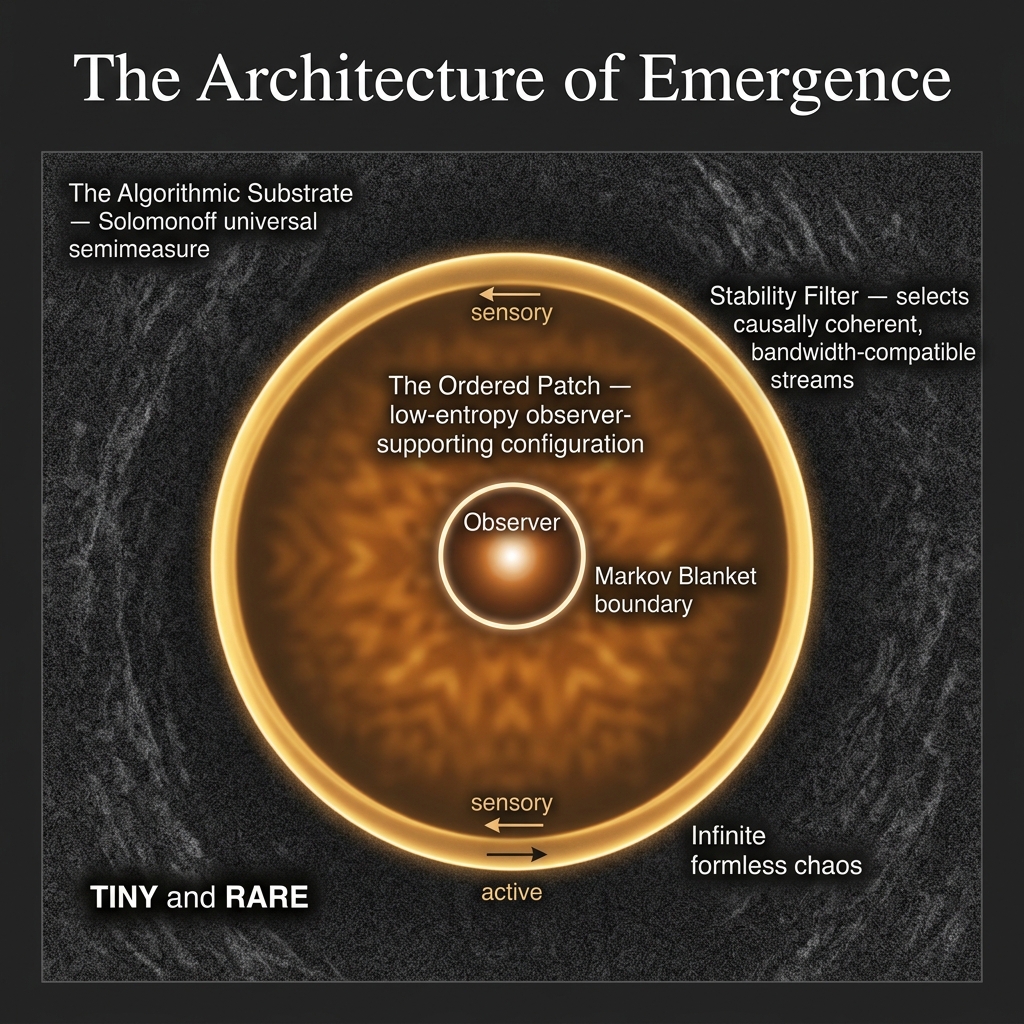
The Ordered Patch — a rare island of stability in infinite noise
Consciousness is modeled as a low-bandwidth compression codec—a structural requirement compressing an infinite, chaotic reality into a tiny, survivable 3D render. But the codec is fragile.
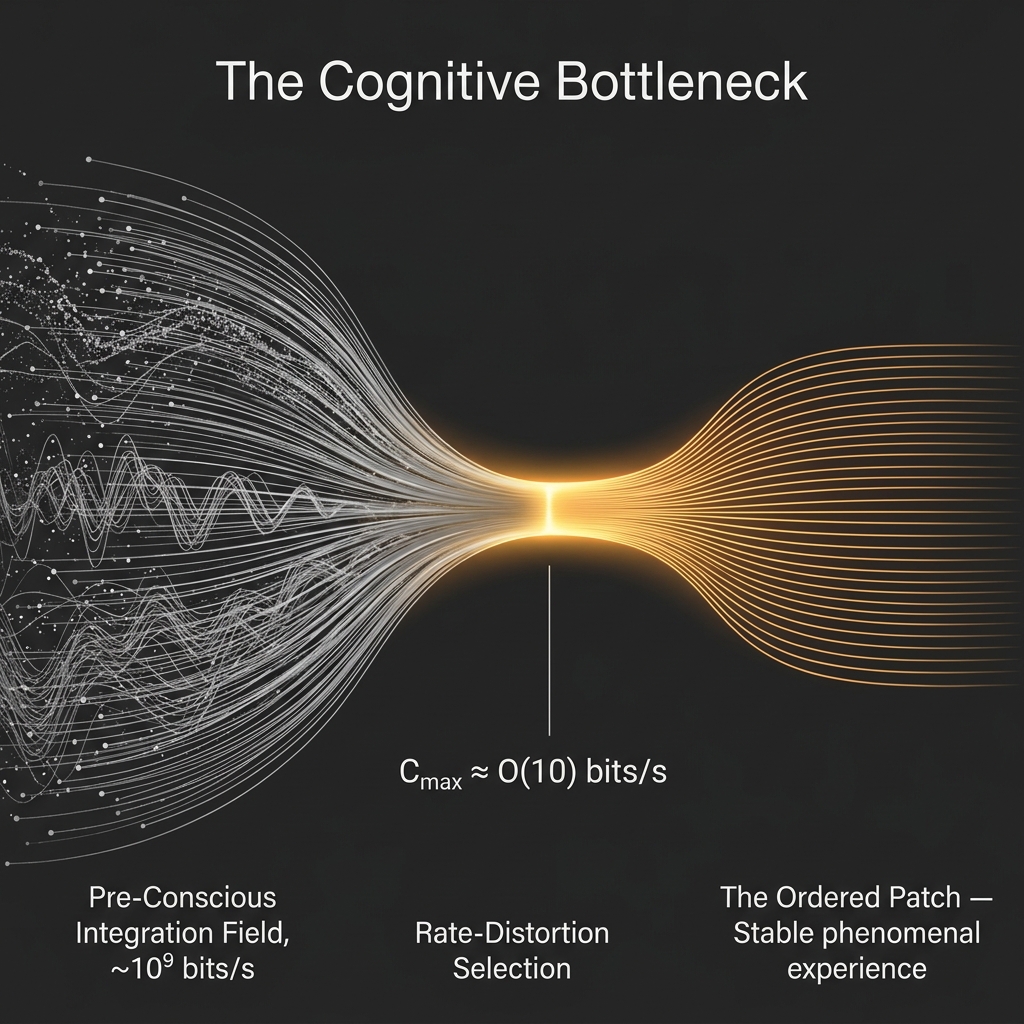
The Cognitive Bottleneck — ~10⁹ bits/s compressed to ~10 bits/s
The Crisis
Codec Entropy (Narrative Decay)
When we rapidly alter the climate, or engage in destructive global conflict, we are not just damaging a physical planet. We are injecting massive, unpredictable noise into the data stream faster than our codec can compress it.
If the noise exceeds the bandwidth of the codec, the patch destabilizes. The "laws" begin to fray. The society fragments. This is what we call Narrative Decay.
The Choice
The Survivors Watch Ethics
If the Holocene is not a guaranteed physical law, but a high-effort informational achievement, then we are not passengers on a stable planet. We are the active maintenance crew.
This leads to the Survivors Watch Ethics: an ethical framework demanding that we fiercely protect the linguistic, biological, and institutional codecs that keep the noise at bay.
A Map of the Territory
Theory Comparisons
Comparing the Ordered Patch Theory rigorously to its closest philosophical and information-theoretic ancestors.
Free Energy Principle (FEP / Active Inference)
Within-world dynamics vs. Why-this-world origins
What it is: The Free Energy Principle proposes that all living systems maintain their existence by acting to minimize surprise (variational free energy) about their sensory inputs.
OPT vs FEP: Friston's FEP models action and learning as minimizing free energy across an existing Markov blanket. OPT borrows this machinery exactly, but treats FEP as the local dynamics inside an already-selected patch. FEP is a within-world dynamics theory. OPT explains why stable, low-entropy patches with Markov blankets exist to be observed at all.
Solomonoff Induction & Information Bottleneck
Epistemic tools vs. Ontological filters
What it is: Solomonoff Induction formalizes Occam's Razor by predicting data using the shortest possible computer program. The Information Bottleneck method optimally compresses a signal while retaining its predictive power.
OPT vs IB/Solomonoff: Normally, these are epistemic tools used by a system to predict data. OPT turns them into an ontological and anthropic filter: the bottleneck is the observer selection process. An observer only inhabits a stream that can survive that severe algorithmic limitation.
Mathematical Universe Hypothesis (MUH)
Unbounded math vs. Capacity-limited observers
What it is: Max Tegmark's Mathematical Universe Hypothesis proposes that physical reality is literally a mathematical structure, and that all possible mathematical structures exist physically.
OPT vs MUH: OPT is very sympathetic to MUH but adds an explicit observer-compatibility criterion. MUH says "all mathematical structures exist." OPT says "they exist mathematically, but observers can only inhabit the incredibly rare structures that are compressible enough to survive a severe predictive bottleneck."
Algorithmic Ontologies (Müller, Khan, Campos-García)
Algorithmic properties vs. Mathematical limits
What it is: Müller's Law without Law (2020) and Algorithmic Idealism (2026) formally replace independent physical reality with algorithmic self-states governed by Solomonoff induction, showing that objective reality — including multi-agent consistency — emerges asymptotically from first-person epistemic constraints. Khan models observers as finite algorithms whose classical-quantum boundary is thermodynamically forced. Campos-García views consciousness as the renderer collapsing computational fields into phenomenology.
OPT vs Algorithmic Ontologies: These frameworks structurally converge with OPT, but OPT is more radically subjective: there is no shared world to asymptotically recover. Physical reality and 'others' are structural regularities within the observer's stream, not independently existing entities. While these adjacent frameworks leave the derivation of specific physical laws (like gravity) as open questions, OPT treats its Cmax bandwidth bottleneck as the exact mathematical limit from which macroscopic physics (e.g., entropic gravity) is thermodynamically derived.
Integrated Information Theory (IIT)
Constitutive vs. Selective
What it is: Integrated Information Theory (IIT) proposes that consciousness is identical to the amount of integrated information (measured as Φ) generated by a system's causal structure.
OPT vs IIT: IIT asks, "What informational structure is consciousness?" (It is constitutive). OPT asks, "Which information streams are survivable for an observer?" (It is selective). The sharpest clash is that a high-Φ system driven by incompressible noise could have no stable phenomenality under OPT, because it fails the virtual compression requirement (the Stability Filter).
Hoffman's Interface Theory
Evolutionary-first vs. Compression-first
What it is: Donald Hoffman argues that evolution has hidden the objective truth of reality from us, providing instead a simplified "user interface" (our perceived world) designed solely for biological fitness.
OPT vs Hoffman: OPT strongly agrees with the interface phenomenology, but grounds it differently. OPT is compression-interface first. The interface is not primarily a biological accident or evolutionary strategy; it is the structural, thermodynamic necessity of fitting an infinite mathematical substrate through a finite bandwidth limit.