The Doomsday Argument
If we model ourselves as randomly selected members of the human species, a troubling statistical pressure appears. The model is disputed, but the warning is worth facing honestly.
The Math is Cold
117 Billion Have Lived
Since the dawn of human civilization roughly 10,000 years ago, approximately 117 billion modern humans have been born. Yet remarkably, over 8 billion of them — a staggering 7% of all humans who have ever existed — are alive right now. We are exhausting our statistical "volume of sentience" at an exponential rate.
Carter's Doomsday Argument treats human birth order as a statistical draw. Imagine a giant urn containing tickets numbered 1 to N, where N is the total number of humans who will ever live. You pull a ticket and look at your birth order number: roughly 117,000,000,000. Whether that urn model is legitimate is exactly where the controversy begins.
"A theory that implies humanity's future population will be trillions upon trillions must explain why we find ourselves this early in the count."
A Contested Argument
The Doomsday Argument is not settled mathematics. Critics dispute its reference class, its sampling assumption, its treatment of possible observers, and whether observer-counting should use alternatives such as the self-indication assumption. OPT takes the argument seriously as a warning signal, not as a prophecy.
The Great Filter Approaches
The Balancing Volume
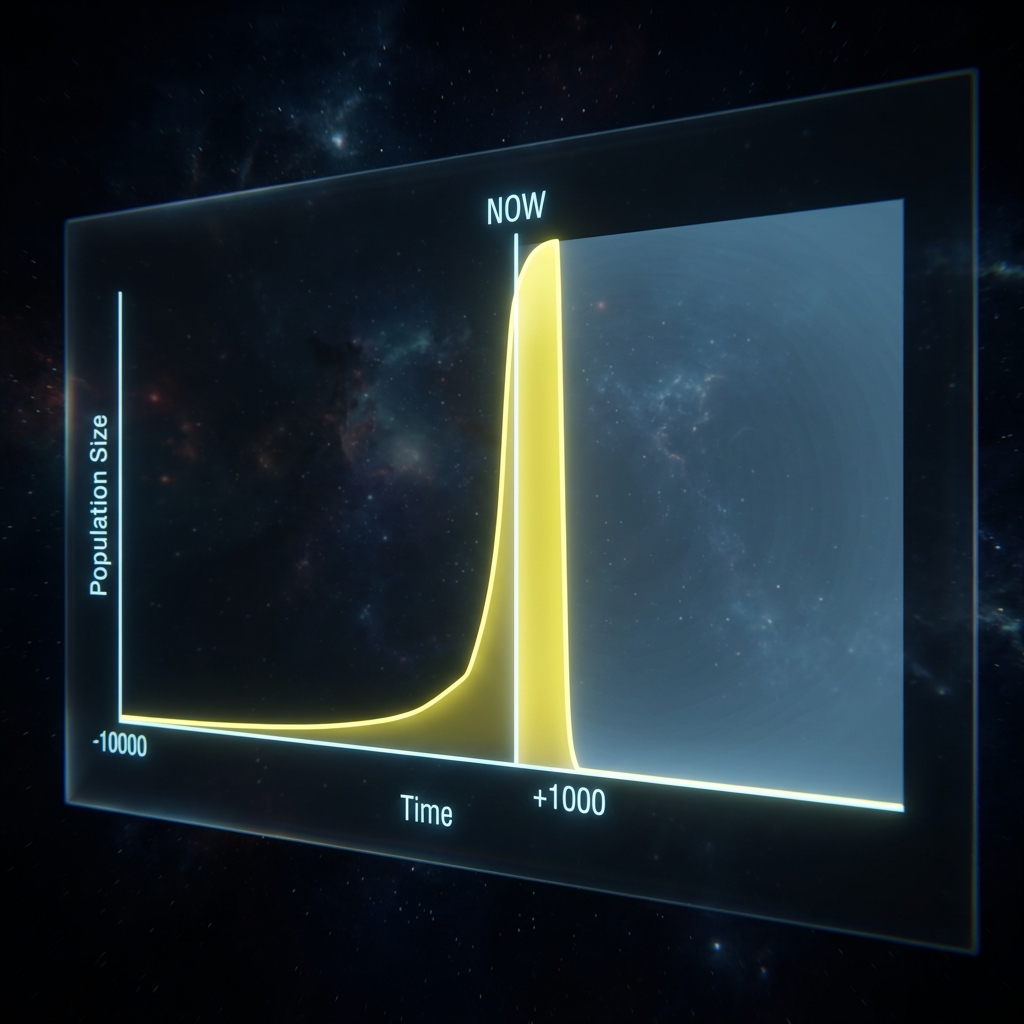
If the urn model is accepted, our present birth rank creates pressure against futures with trillions upon trillions of humans. On that model, the total "volume" of humans who will exist in the future may be closer to the volume of humans who exist today and in the past than our expansionist intuitions suggest.
Given our massive current population, advancing through another 100 billion human lifetimes would take only about another 1,000 years. As shown in the diagram, that rapidly consumes the simple urn model's remaining statistical volume. The implication is not certainty; it is a reason to treat civilizational survival as an active engineering problem rather than a background assumption.
The Theory View
Structural Bounds on the Future
While the statistical urn model highlights the mathematical probability, the underlying mechanisms of collapse highlight the risk: as a civilization scales in power and scale, its complexity and the speed at which it must solve crises grow exponentially.
When the speed of new crises exceeds the collective physical and cognitive bounds of the species to manage them, it triggers societal collapse. Escaping the mathematical urgency of the statistical urn is possible, but it requires a deliberate, active transition toward sustainable stewardship to halt cascading failure.