Ordered Patch Theory: An Information-Theoretic Framework for Observer Selection and Conscious Experience
v4.1.4 — June 2026
DOI: 10.5281/zenodo.19300777
Copyright: © 2025–2026 Anders Jarevåg.
License: This work is licensed under a Creative
Commons Attribution-NonCommercial-ShareAlike 4.0 International
License.
Abstract:
Ordered Patch Theory (OPT) begins from a single non-inferred premise — that an ordered first-person observation stream exists — and brackets, rather than denies, matter, spacetime, physical law, other minds, and brains (methodological first-person minimalism). Phenomenality itself is taken as primitive: OPT does not solve the Hard Problem but draws a structural contour around it, and the sufficiency of structure for experience is bracketed throughout.
From the lone premise plus two constructive primitives (held under parsimony pressure) — a Solomonoff semimeasure prior \xi over observation prefixes and a bounded observer bandwidth C_{\max} (per-frame B_{\max}; §3.2) — a single selection principle does the work: a Stability Filter admits only those streams whose required description rate stays within the bottleneck (R_{\text{req}} \leq C_{\max}), selecting the rare, navigable, causally coherent histories. Such a stream behaves as if generated by a compression codec whose most compact account of its manifest regularities is what we call “the laws of physics,” whose rich non-reported standing scene (C_{\text{state}} \gg B_{\max}) vastly exceeds the thin slice that passes the aperture each moment, and whose forward fan of admissible continuations yields, on the one realized thread, the first-person signature of choice. Apparent other observers are not assumed but recovered: on a conditional MDL bound (the Structural Corollary, Appendix T-11), coherent agent-like structures are more parsimoniously modelled as independent observer-patches coupled only at local anchors on the public, law-like regularities than as arbitrary behavioural artifacts — so the render-level ontological solipsism does not close the door on other observers (§8.2).
Every construct is held under two readings kept rigorously apart by a host-frame measurement firewall: an operational/host reading, on which the codec runs as machinery (carrying all formal derivations and empirical predictions), and a virtual/render reading, on which the codec and standing state are had, not run — structural properties of the filter-passing stream (relocation, not reduction).
At the centre sits the self-compression gap \Delta_{\text{self}}: not a self-reference paradox but the budgeted capacity cost a bounded stream pays to model its own closed action-perception loop. This object is one fixed point with the prediction residual (prediction and compression are one operation), is well-posed by forward causal recursion (its equilibrium-existence objection is a category error), and — restricted to the self-channel inside a closed loop — performs the individuation of self from world and supplies a necessary but not sufficient structural condition separating a candidate subject from a generic lossy compressor; its only clean cut sits at zero self-gap, and its sufficiency and threshold location remain with the bracketed Hard Problem.
Claims are tiered explicitly: theorem-grade (the formal-appendix results, the prediction-compression duality, \Delta_{\text{self}} well-posedness), one load-bearing conjecture (Conjecture P-4, \Delta_{\text{self}} > 0), and a flagged research programme (the refined virtual reading, the relevance threshold K_{\text{threshold}}, the capacity reframe of the residual). OPT earns its keep through a dedicated falsification core — a bandwidth hierarchy, high-bandwidth dissolution of self, compression-depth versus conscious-depth, a High-\Phi/High-Entropy null distinguishing it from IIT, phenomenal lag, and shutdown criteria — and yields, for machine welfare, the honest result that OPT has teeth on exclusion (thermostats and current LLMs are certifiably not candidates) and is silent on inclusion, demarcating a precautionary, substrate-neutral candidate-zone rather than certifying any subject in. Physics, cosmological, and comparative-positioning correspondences are developed in companion documents; one in-core cosmological hypothesis — late-time acceleration as bandwidth-bounded cosmological selection (§7.1) — carries its own pre-registered retirement criteria.
Epistemic Notice: This paper is written in the register of a formal physical and information-theoretic proposal. It deploys equations, derives predictions, and engages with peer-reviewed literature. However, it should be read as a truth-shaped object — a rigorous philosophical framework drafted formally. This is not yet verified science, and we know our derivations will contain errors. We actively seek critique from physicists and mathematicians to break and rebuild these arguments. To clarify its structure, the claims herein fall into three categories of kind (orthogonal to the four confidence tiers of the front map What Is Claimed, at What Confidence, which they should be read alongside):
- Definitions & Axioms: (e.g., the Solomonoff measure, the C_{\max} bandwidth limit). These are the foundational premises of the constructive fiction.
- Structural Correspondences: (e.g., Active Inference, Gleason’s Theorem [51]). These show structural compatibility between bounded inference and established formalisms, but do not claim to derive those formalisms from scratch.
- Empirical Predictions: (e.g., Bandwidth Dissolution). These serve as strict empirical falsification criteria if the framework were treated as a literal physical hypothesis.
The academic apparatus is used not to claim final empirical truth, but to test the structural integrity of the model.
Abbreviations & Symbols
| Symbol / Term | Definition |
|---|---|
| B_{\max} | Per-frame predictive capacity (bits per phenomenal frame); the per-frame primitive (§3.2) |
| C_{\max} | The Bandwidth Ceiling; maximum predictive capacity of the observer (per-second rate, derived as C_{\max}^H = B_{\max}/\Delta t) |
| C_{\text{state}} | Standing-state complexity; K(P_\theta(t)), the Kolmogorov complexity of the active codec (§3.5) |
| \Delta_\text{self} | The Phenomenal Residual; the self-compression gap — the budgeted capacity cost of modelling one’s own closed action-perception loop |
| FEP | Free Energy Principle |
| GWT | Global Workspace Theory |
| IIT | Integrated Information Theory |
| K_\theta | Compression Codec; the observer’s internal generative model |
| K_{\text{threshold}} | The open relevance threshold separating a candidate subject from a generic lossy compressor (research-programme tier) |
| MDL | Minimum Description Length |
| MERA | Multiscale Entanglement Renormalization Ansatz |
| \mathcal{M}_\tau | Maintenance Cycle Operator; offline complexity management of the codec (§3.6) |
| OPT | Ordered Patch Theory |
| P_\theta(t) | Phenomenal State Configuration |
| \Phi | Measure of Integrated Information (IIT) |
| QECC | Quantum Error Correction Code |
| R(D) | Rate-Distortion function |
| R_{\mathrm{req}} | Required Predictive Rate |
| RT | Ryu-Takayanagi (formula/bound) |
| \xi | Solomonoff Universal Semimeasure |
| Z_t | Compressed internal latent bottleneck state |
0. Initial conditions and explanatory direction
OPT does not begin from a third-person physical universe containing brains. It begins from the only non-inferred datum available to the theory author: there is an ordered first-person observation stream.
At the initial stage, a mind-independent external world, other observers, biological brains, spacetime, physical law, and social consensus are bracketed rather than denied: not rejected as false, but withheld as primitives. The theory then asks what structure must be present for an ordered stream to persist at all.
The constructive premises below are heterogeneous in epistemic type — a metaphysical axiom (#1), two formal-mathematical primitives (#2, #3), and an epistemic stance (#4) — and are listed together because all four are needed to make the construction work, not because they are the same kind of move:
- Phenomenality / interiority (metaphysical axiom): that there is experience at all is treated as primitive, not derived. OPT does not attempt to answer why there is something experiential rather than nothing.
- Algorithmic substrate (formal-mathematical primitive): possible finite observation prefixes are represented using a Solomonoff-style universal semimeasure \xi.
- Finite observer condition (formal-mathematical primitive): an observer-compatible stream must pass through a bounded predictive channel C_{\max} / B_{\max}. The bounded channel itself is the constructive primitive; the specific formalisation as a per-frame serial bottleneck — rather than, for instance, parallel sparse gating with the same effective capacity — is the meta-theoretical parsimony commitment justified in §3.2.
- Parsimony pressure (epistemic stance): among compatible streams, shorter predictive descriptions are favoured by MDL / Solomonoff weighting. The same parsimony pressure operates meta-theoretically in OPT’s choice of primitives: where alternative bounded-observer architectures are conceivable, OPT bets on the simplest (the serial bottleneck) as load-bearing, rather than seeking a derivation from outside parsimony. The result is a framework that is parsimony-coupled at two levels — within the substrate (selecting between observer-compatible streams) and within theory choice (selecting between possible formalisations of the observer condition).
The Stability Filter, Compression Codec K_\theta, rendered physical law, and Structural Corollary for apparent other observers are downstream of these premises. The later solipsistic ontology is therefore not the initial assumption; it is the render-ontology reading of what follows if the construction is taken literally.
The bandwidth bottleneck is not imported from human neuroscience. Human conscious-throughput data provide biological calibration and empirical pressure, but the bounded channel itself is part of the finite-observer condition.
0.1 What is assumed, derived, calibrated, and recovered
| Item | Status in OPT | Comment |
|---|---|---|
| Ordered first-person stream | Starting datum | The minimal explanandum. |
| Phenomenality / interiority | Primitive axiom | OPT does not derive why experience exists at all. |
| Solomonoff semimeasure \xi | Constructive primitive | Supplies the algorithmic substrate over finite observation prefixes. |
| Finite channel C_{\max} / B_{\max} | Constructive primitive | The finite-observer condition; not inferred from human brains. |
| Stability Filter | Derived boundary condition | Observer-compatible streams satisfy R_{\mathrm{req}} \le C_{\max}. |
| Compression Codec K_\theta | Derived solution | The generative model that renders a lawful, navigable stream. |
| Human \mathcal{O}(10) bits/s bottleneck | Empirical calibration | Biological support, not the source of the premise. |
| Physical law | Structural recovery | Stable regularity inside the rendered observer-compatible stream. |
| Other observers | Structural Corollary | Recovered by compression parsimony, not assumed at the start. |
| Ontological solipsism | Downstream ontology | The literal render-ontology reading of the construction. |
1. Introduction
1.1 The Ontological Problem
The relationship between consciousness and physical reality remains one of the deepest unsolved problems in science and philosophy. Three families of approaches have emerged: (i) reduction — consciousness is derivable from neuroscience or information processing; (ii) elimination — the problem is dissolved by redefining the terms; and (iii) non-reduction — consciousness is primitive and the physical world is derivative (Chalmers [1]). The third approach encompasses panpsychism, idealism, and various field-theoretic formulations.
1.2 The Core Proposition of OPT
This paper presents Ordered Patch Theory (OPT), a non-reductive framework in the third family. Its starting point is deliberately minimal: not a third-person world containing observers, but the existence of an ordered first-person observation stream from which any third-person world must be inferred.
At this initial stage, OPT adopts the methodological first-person minimalism developed in §0. The initial condition is weaker than the strong render-ontology of the abstract: an ordered first-person stream exists, and matter, spacetime, physical law, biological brains, social consensus, and other observers are bracketed rather than assumed as primitives. The strong solipsistic ontology of the abstract is the render-ontology reading downstream of the construction, not its starting axiom. OPT then asks what parsimonious structure could make such a stream stable, coherent, and navigable rather than chaotic.
The constructive answer proposed here has two primitives. First, an algorithmic substrate: the Solomonoff universal semimeasure \xi over finite observation prefixes, representing a complexity-weighted space of possible computable streams. Second, a finite observer condition: a bounded predictive channel capacity C_{\max} / B_{\max} through which an observer-compatible stream must remain renderable. These are not derived from human neuroscience. Human bandwidth data provide empirical calibration and pressure, but the bounded channel itself enters at the level of the finite-observer condition.
From these primitives, OPT defines a purely virtual Stability Filter: an observer-compatibility boundary condition requiring the stream’s Required Predictive Rate R_{\mathrm{req}} to remain within the observer’s finite capacity. The Filter is not a physical mechanism acting inside a pre-existing universe. It is the selection condition under which a finite first-person stream can remain ordered at all.
The Compression Codec K_\theta is the solution to that constraint. It is the observer’s internal generative model: the compressed, self-maintaining predictive structure through which the stream becomes experienced as a lawful world. The physical world we observe — including its apparent objects, laws, constants, geometry, and causal regularities — is the rendered limit of this codec operating under the Stability Filter.
Only downstream of this construction does OPT develop its stronger render ontology. On that reading, physical reality consists of structural regularities within observer-compatible streams. The Structural Corollary then recovers apparent other observers by compression parsimony: highly coherent agent-like structures are most parsimoniously described, on a conditional MDL bound (§8.2), as modular observer-patch sub-structures coupled only at local anchors on the public natural-law regularities — rather than as arbitrary behavioural artifacts inside a single stream.
OPT’s considered reading is stronger still, and worth naming now rather than springing late: downstream (§8.6.1) the codec and the standing state it deploys are not run as machinery but had as structural properties of the filter-passing stream — the §3 presentation of K_\theta, P_\theta, and \mathcal{M}_\tau as operating mechanism is a within-render convenience. The box in §1.5 previews both readings; §3’s derivation deliberately uses the operational one and stays neutral on the stronger reading until §8.6.
The Filter vs. The Codec. To avoid conceptual conflation, OPT draws a strict operational boundary between the Filter and the Codec. The virtual Stability Filter is the capacity constraint: the boundary condition requiring an observer-compatible stream to admit a sufficiently simple predictive description within finite channel capacity. The Compression Codec K_\theta is the solution to that constraint: the observer’s internal generative model, experienced macroscopically as the rendered regularities of physical law.
1.3 Motivations
OPT is motivated by four linked problems — the first-person ordering problem, plus three empirical, physical, and philosophical pressures that make the construction non-arbitrary:
The first-person ordering problem: The only non-inferred starting datum is that an ordered observation stream exists. OPT asks why such a stream is coherent, temporally stable, and predictively navigable rather than an arbitrary succession of uncompressible impressions.
The observer-selection problem: Standard physics provides laws but offers no account of why those laws have the specific form required for complex, self-referential information processing. Fine-tuning arguments invoke anthropic selection but leave the mechanism unspecified. OPT identifies a structural condition: the Stability Filter.
The finite-observer condition: If a first-person stream is to remain ordered for a finite observer, its required predictive rate must remain within bounded capacity. This is the formal role of C_{\max} / B_{\max}. Human cognitive neuroscience later provides biological calibration: human conscious report appears severely bottlenecked relative to the massive parallel processing that precedes it. But the bottleneck enters OPT as an observer-compatibility premise, not as a post-hoc generalisation from human brains.
The Hard Problem: Chalmers [1] distinguishes the structural “easy” problems of consciousness from the hard problem of why there is any subjective experience at all. OPT treats phenomenality as primitive and asks what mathematical structure such experience must have.
1.4 Paper Structure
The paper is organized as follows. Section 1.6 states the conceptual
core in plain language; Section 3 presents the formal framework; Section
5 the parsimony argument; Section 6 the testable predictions, the
pre-registered Falsification Commitments (§6.8), and the
incompatible-theories wall (§6.9); Section 8 the discussion. The
related-work survey (§2), the field-theoretic parallels (§4), and the
comparative analysis with neighbouring frameworks (§7
Positioning) appears in compact form in the core, with their
detail relocated — to keep the falsifiable core lean — into two
companions: the physics, cosmology, and algorithmic-ontology
correspondences plus speculative extrapolations are in opt-correspondences.md;
the consciousness-theory neighbours (FEP, IIT, panpsychism, Global
Workspace, higher-order / attention-schema) are in opt-philosophy.md §IV.9. The
structural AI criterion is consolidated in §8.14 (Artificial
Minds). One in-core cosmological hypothesis — the Hubble tension as
bandwidth-bounded cosmological selection (§7.1) — is developed at
research-programme tier with its own hypothesis-local retirement
criteria. A front map, What Is Claimed, at What Confidence
(after §1.6), tiers every load-bearing claim.
1.5 Reader’s Orientation: The Two Readings
A note to the reader, before the formal development. OPT can be read at two levels, and it is kinder to say so now than to spring the second on the reader late.
The constructive / operational reading (used throughout §3) presents the Compression Codec K_\theta, the Phenomenal State Configuration P_\theta(t), and the Maintenance Cycle \mathcal{M}_\tau as if they were mechanisms an observer runs — a generative model that updates, a standing state that is loaded, offline passes that prune and consolidate. This is the working language of the derivation, and nothing below depends on abandoning it.
The fully-virtual / stream-primary reading (derived canonically at §8.6.1) is OPT’s considered ontology: under the render ontology these are had, not run — structural properties any filter-passing stream possesses, not machinery instantiated alongside it. The stream appears as if a rich generative model were maintained because only histories navigable within C_{\max} survive the Filter. This is a relocation, not a reduction: the standing-state complexity C_{\text{state}} = K(P_\theta) \gg B_{\max} is not eliminated or rendered merely apparent — it remains a real, if uncomputable, Kolmogorov measure on the stream’s manifest regularities (not a phenomenological report from the aperture), and the empirical commitments of §6.8 are measured in the host frame where the codec is implemented (the runtime/implementation frame). What the virtual reading removes is only the need to posit a separate compression process; what it leaves open is the self-referential-compressor problem (§8.6.1).
The two readings are kept apart deliberately. The initial condition (§0) assumes only that an ordered stream exists; the strong render ontology is downstream, not a premise. Until §8.6 the text uses the operational reading and stays neutral on the stronger one (§1.6’s plain-language summary previews the considered reading) — §8.6.1 then states where it ends up.
1.6 The Conceptual Core
Ordered Patch Theory (OPT) starts from the existence of an ordered first-person observation stream. It asks what structural properties such a stream must possess to remain stable, coherent, and causally navigable rather than dissolving into undecodable noise.
The theory rests on two constructive primitives (held under parsimony pressure): a timeless Solomonoff universal semimeasure \xi over observation prefixes, and a strict predictive bandwidth limit C_{\max} (per-frame B_{\max}; §3.2) that any observer-compatible stream must respect. From these a single selection rule follows: only streams whose required predictive rate remains inside the bandwidth ceiling can remain stable. This rule—the Stability Filter—works by conditioning the substrate semimeasure on the observer-compatibility event O_{B,D,T}. Streams violating the bound undergo acute Narrative Decay. The surviving streams are those whose manifest regularities admit a compact generative description.
On OPT’s considered reading (§1.5; derived at §8.6.1), OPT is fully virtual: in the render frame, there is no separate mechanism that “runs” a description of the stream. The stream simply has the regularities that a well-defined Compression Codec would exhibit. The virtual codec is the stream’s own generative structure. Here, the impression of a simultaneously delivered, fully detailed environment is revealed as a structural illusion (the rich standing scene itself is real and vast; §3.5): the unfocused periphery is maintained as a low-resolution symbolic prior, while active attention steers the narrow C_{\max} aperture to sample prediction errors. Detail is not delivered simultaneously; it is sequentially built over time along the stream. Prediction and compression are formally the same operation, with the overall complexity of the model managed across deep time via an offline Maintenance Cycle of parameter pruning and forward-fan stress-testing.
Crucially, within this virtual architecture, the traditional distinction between input and output dissolves. There are no actions as independent outputs; what we experience as “free will” and “action” is modeled as the phenomenological traversal of a branch within the forward fan, where choices return immediately as the causally consistent inputs of the subsequent stream.
At the center of the framework is the self-compression gap \Delta_{\text{self}}: the budgeted capacity cost a bounded stream incurs when modelling its own closed action-perception loop. This gap is well-posed by forward causal recursion and supplies the structural individuation of self from world. Its positivity is the central conjecture.
Virtuality remains the considered ontology, presenting a qualitative parsimony advantage — narrow and exact: no separate compression process need be posited (§8.6.1; not a reduction in total description length, §5.1). A consciousness defined by a low-bandwidth stream requires only the structural regularities already present in that stream. OPT remains ontologically solipsistic per patch (§8.2), but this does not collapse into a closed solipsism. Under compression parsimony, highly coherent, responsive structures within the stream are recovered via a Structural Corollary. They are localized anchors modeled as if they are independent, private observation streams. Their only deep relation is a shared substrate causality that enforces a structural similarity, ultimately permitting a coherent form of virtual communication across the public render.
From this compressed geometry, the physical universe emerges natively as an optimal rendering protocol, and its deep temporal architecture is a reflection of this causal necessity. On the interpretive reading developed at §8.5 and §7.1 (research-programme tier), cosmic boundaries act as massive, system-level bandwidth management strategies. The Big Bang and terminal dissolution are not objective events, but the absolute structural horizons where the codec lacks prior data or reaches its featureless, minimum-description terminus (§8.5). Cosmic expansion—and specifically its late-time acceleration—functions as a topological pressure release. As localized structures accumulate complexity, only histories whose metric horizon releases latent predictive load before the render budget saturates remain observer-compatible — a selection on cosmologies, not an intervention within one (§7.1).
This framework offers an interpretive lens for examining persistent cosmological anomalies without claiming closed quantitative derivations: the temporal proximity between accelerating expansion and the emergence of complex observers is interpreted as a potential signature of bandwidth-bounded cosmological selection. Similarly, OPT hypothesizes that the Stability Filter admits only cosmologies whose expansion history releases predictive load before the render budget saturates — a selection that may surface observationally as an evolving effective dark-energy sector, providing a qualitative structural framework for the observed Hubble Tension (developed, with pre-registered retirement criteria, in §7.1).
At an interpretive level, General Relativity and Quantum Mechanics function as dual algorithmic facets of this resource-bounded compression asset. They manage opposite extremes of the codec’s capacity limits: Quantum Mechanics provides the optimal data-compression format for both the unresolved and the microscopic—using superposition to hold the forward fan’s multiplicity open, while simultaneously serving as the probabilistic grain (the uncertainty principle) that bottoms out the render. Conversely, General Relativity serves as the codec’s defense against the over-dense—curving the spatial metric to throttle the information density of massive localized regions. Because these laws operate as maximally efficient compression heuristics, any attempt to derive a parameter-free Grand Unified Theory (GUT) from within the patch is bounded by Fano’s identifiability limit (Appendix P-3; Eq. 12, §3.11–§3.12) and by Mathematical Saturation (§8.11) and structurally limited.
OPT therefore draws a structural contour around the Hard Problem rather than solving it, treating phenomenality as an irreducible primitive. The framework is tested through explicit falsification commitments—including high-bandwidth dissolution, a High-\Phi/High-Entropy null, and phenomenal lag—while yielding an asymmetric architectural verdict certifying that current parallel, open-loop artificial systems fail the structural conditions for candidate subjecthood.
What Is Claimed, at What Confidence
A confidence-compass for the rest of the paper. OPT is written in a formal register but is a truth-shaped object, not yet verified science; its derivations will contain errors and critique is actively sought. To carry the right expectation into each later section, every load-bearing claim falls into one of four tiers. This map is the single front ledger; per-claim tier tags repeat the verdict at point of use.
| Tier | What it means | The claims that sit here |
|---|---|---|
| Theorem-grade | Holds as stated, given the definitions and axioms (§0); errors would be in the proofs, not the ambition. | The formal-appendix results (Eqs. (1)–(12); App. T-1; the mathematical cores of P-2–P-3 — P-2 bridge-conditional, P-3 conditional on Assumption P-3.1; P-1’s M-randomness recurrence is downgraded to a flagged conjecture, see Group B / App. P-1); the prediction-compression duality (prediction and compression are one operation); \Delta_{\text{self}} well-posedness by forward causal recursion (the equilibrium-existence objection is a category error, App. P-4); the conditional MDL bound behind the Structural Corollary (App. T-11; conditional on Axiom 1; the stronger modular-beats-monolithic claim remains open, OP-2). |
| Conjecture | One load-bearing bet, plausibly true, not proven. | Conjecture P-4: the self-compression gap is strictly positive, \Delta_{\text{self}} > 0 — a bounded stream cannot close its own action-perception loop. |
| Research programme | Flagged-open; the refinement is in progress, not banked. | The refined fully-virtual reading (§8.6.1); the relevance threshold K_{\text{threshold}} separating a candidate subject from a generic lossy compressor; the quantitative regret-floor mechanism for \Delta_{\text{self}} (the qualitative capacity reframe is adopted house framing; the regret-floor quantification is “not yet adopted here”, Appendix P-4); the bandwidth-bounded cosmological-selection reading of cosmic acceleration and the Hubble tension (§7.1, hypothesis-local criteria, re-registered v4.1.4). |
| Falsification commitment | Strict empirical criteria if the framework were read as a literal physical hypothesis. | The bandwidth hierarchy and high-bandwidth dissolution of self; compression-depth versus conscious-depth; the High-\Phi/High-Entropy null that distinguishes OPT from IIT; phenomenal lag; and the shutdown criteria (§6). |
Two boundaries are held fixed across all four tiers. First, phenomenality is bracketed, not solved: OPT draws a structural contour around the Hard Problem and never claims that structure is sufficient for experience. Second, \Delta_{\text{self}} is a budgeted capacity gap on the self-channel of a closed loop — it performs the individuation of self from world and supplies a necessary but not sufficient condition for candidate-subjecthood, with its only clean cut at zero self-gap; its sufficiency and threshold location are handed back to the bracketed Hard Problem.
On scope of the formal apparatus specifically: Eqs. (1)-(12) do not derive quantum mechanics, general relativity, or the Standard Model from first principles. They fix the rigid geometric constraints (the Causal Cone, the Predictive Cut) to which any phenomenological physics must structurally correspond to survive the bottleneck; the specific laws we observe are heuristic compressions — the codec’s most efficient predictive models for our local region of the substrate (detail at §3.13).
2. Background and Related Work
The survey of related work — information-theoretic approaches to
consciousness (Wheeler [7], Tononi [8], Friston [9]), multiverse and
observer selection (Tegmark [10], Barrow & Tipler [4], Rees [5]),
Kolmogorov complexity and theory selection (Solomonoff [11], MDL [12]),
and Evolutionary Interface Theory (Hoffman [25]) — is relocated to the
companion opt-correspondences.md
§1. The formal machinery those works supply (the Solomonoff semimeasure,
MDL parsimony) is defined where it is used: §3.1 and §5.
3. The Formal Framework
This section is the detailed formalism. The conceptual picture is already in place (the Two Readings box, §1.5, and the conceptual spine of the preceding parts); a reader following the argument can skim §3 on a first pass and return to it as a reference. Full proofs live in the grouped appendices (Group A foundations, Group B formal-proof spine, Group C mechanism, Group D empirical, Group E correspondences); each subsection below points to its appendix home in the index at the end of this preface. Only three results need to be carried in the head while reading; they are surfaced here as boxed statements, with the rest of §3 supplying the machinery they stand on.
Boxed Result 1 — The Stability-Filter selection criterion. (theorem) An observation stream is observer-compatible iff its required predictive rate stays within the per-frame capacity bound: R_{\text{req}} \le B_{\max}. Equivalently, the Stability Filter is Bayesian conditioning of the substrate semimeasure \xi on the observer-compatibility event O_{B,D,T} = \{x_{1:T} : R_{\text{req}}(x_{1:T},D) \le B\} (§3.1, Eq. 1a-1b). Streams violating the bound coarse-grain into undecodable static and fail to sustain a narrative (the criterion itself is definitional, Eq. 1a). Formal rate-distortion specification and bounds: Appendix T-1; collapse reading: §3.3 / T-1 (Narrative Decay).
Boxed Result 2 — Prediction-compression duality. (theorem) For a bounded codec, optimal prediction and optimal (MDL) compression are one operation, not two: the model that minimises description length is the model that minimises predictive surprise (standard AIT; Rissanen [12], Li & Vitányi [27]). Statement and discussion: Appendix P-4 §3 (post-A2 correction).
(Research programme — not yet adopted into the formal core.) That the phenomenal residual of §3.8 and the self-referential-compressor problem are the same fixed point under this identity is a separate, research-programme-tier claim (§8.6.1; the OP-1 open problem), not part of this theorem-grade box.
Boxed Result 3 — \Delta_{\text{self}} well-posedness. (theorem on structure; conjecture on positivity) The self-compression gap \Delta_{\text{self}} — the budgeted capacity cost a bounded stream pays to model its own closed action-perception loop — is well-posed by forward causal recursion: the gap is defined along the realized thread, so the standard equilibrium-existence objection is a category error. \Delta_{\text{self}} does individuation, not agency; it is a necessary-but-not-sufficient structural condition separating a candidate subject from a generic lossy compressor, with its only clean cut at zero self-gap. It is a capacity gap on the self-channel of a closed loop, not a self-reference or incompleteness effect; one realized thread, no modal realism. Positivity (\Delta_{\text{self}} > 0) is the load-bearing Conjecture P-4. Structure and statement: Appendix P-4.
Subsection \rightarrow appendix index. Each §3 subsection routes its proofs to one or more appendices, grouped A (foundations) / B (formal-proof spine) / C (mechanism and dynamics) / D (empirical and extended) / E (correspondences).
| §3 subsection | Topic | Appendix home(s) |
|---|---|---|
| 3.1 | Algorithmic substrate; Stability-Filter conditioning | T-1 (A), P-1 (B) |
| 3.2 | Predictive bottleneck and rate-distortion | T-1 (A), E-8 (D) |
| 3.3 | Informational causal cone | T-3 (E), T-12 (C) |
| 3.4 | Patch dynamics; inference and thermodynamics | (in-text derivation: Eqs. 6–10; no appendix) |
| 3.5 | Phenomenal state configuration P_\theta(t) | T-9, T-12 (C), E-1 (D) |
| 3.6 | Codec lifecycle; maintenance cycle \mathcal{M}_\tau | T-9, T-12, T-15 (C), E-11 (D) |
| 3.7 | Tensor-network mapping (MERA) | T-3 (E), P-2 (B) |
| 3.8 | Agency axiom and the phenomenal residual; \Delta_{\text{self}} | P-4, T-4, T-11 (A) |
| 3.9 | Free will and the phenomenological menu | T-13 (C) |
| 3.10 | Informational cost of the render; three-level bound gap | P-2, P-3 (B) |
| 3.11 | Mathematical saturation and substrate recovery | P-3 (B) (in-text: Fano’s inequality, Eq. 12) |
| 3.12 | Asymmetric one-way holography | P-3 (B) |
| 3.13 | Scope of formal claims | (in-core honesty ledger; no appendix) |
The AI-exclusion verdict (§8.14) is a corollary of P-4 plus the K_{\text{threshold}} necessary-conditions result and rides on the same Group A appendices; it earns no fourth box. The detailed formalism follows.
Reading note — §3 reads two ways (stated here so the body need not look ahead). §3 develops K_\theta, P_\theta(t), and \mathcal{M}_\tau in the operational register — a generative model that updates, a standing state that is loaded, offline passes that run — because that is the clearest language for the derivation, and nothing below depends on keeping it. On OPT’s considered reading (previewed in the §1.5 Two-Readings box) these objects are had, not run: structural properties any filter-passing stream possesses, not machinery instantiated beside it. “Nothing runs K_\theta” — a stream simply has the regularities a well-defined codec would exhibit, because only such streams survive the Filter. This is a relocation, not a reduction: the standing-state magnitude C_{\text{state}} = K(P_\theta) \gg B_{\max} is preserved as a real (if uncomputable) measure on the stream’s manifest regularities, and the §6.8 falsification commitments are measured in the host/operational frame either way. The inline “dual reading” glosses below mark where the two readings diverge and refer back here; the full virtual-reading synthesis — standing state, free will, and the self-referential-compressor open problem — is developed downstream, once the formalism it reinterprets is in hand (§8.6, §8.6.1). Read §3 operationally on a first pass: the ontology changes the denotation of the equations, not a single equation.
3.1 The Algorithmic Substrate
Let \mathcal{I} denote the Informational Substrate — the foundational entity of the theory. We formalize \mathcal{I} via the Solomonoff universal semimeasure \xi over finite observation prefixes x \in \{0,1\}^*:
\xi(x) = \sum_{\nu \in \mathcal{M}} w_\nu\, \nu(x), \qquad w_\nu \asymp 2^{-K(\nu)} \tag{1}
where \mathcal{M} is the class of lower-semicomputable semimeasures over \{0,1\}^* and K(\nu) is the prefix Kolmogorov complexity of the semimeasure \nu.
Formal status (v3.6.0 sharpening). \xi is itself a lower-semicomputable semimeasure — not in general a normalised probability measure over finite prefixes. In particular \sum_x \xi(x) \le 1 can be strict, and \xi assigns nonzero prior weight to every computable environment / lower-semicomputable semimeasure in the chosen universal-machine class but does not assign weight to arbitrary noncomputable configurations beyond their finite prefixes. The semimeasure framing is load-bearing: it preserves the universal-dominance property of Solomonoff induction (\xi multiplicatively dominates every \nu \in \mathcal{M} up to a complexity constant — \xi(x) \ge 2^{-K(\nu) + O(1)}\, \nu(x)), while avoiding the conventional-probability-space framing that would presuppose normalisation. Earlier drafts of this section described \mathcal{I} as “a probability space over finite observation prefixes”; that formulation has been corrected per the v3.6.0 audit because conditioning, selection, and observer-measure assumptions downstream depend on a clean semimeasure ontology rather than an implicit normalisation.
The Stability Filter as conditioning on an observer-compatibility event. Within the substrate semimeasure \xi, define the observer-compatibility event for an observer with per-frame capacity B, distortion tolerance D, and horizon T:
O_{B,D,T} := \big\{ x_{1:T} \,:\, R_{\mathrm{req}}(x_{1:T}, D) \le B \big\} \tag{1a}
where R_{\mathrm{req}}(x_{1:T}, D) is the required predictive rate along the prefix’s induced latent trajectory — the per-step rate R_{\mathrm{req}}(h, D_{\min} \mid z_t) of §3.3, taken as a supremum (or time-average) over the prefix — at distortion tolerance D. The Stability Filter is then formally the act of conditioning the substrate semimeasure on this event:
\xi_O(x_{1:T}) \,:=\, \frac{\xi(x_{1:T})\,\mathbf{1}[x_{1:T} \in O_{B,D,T}]}{\sum_{y}\,\xi(y)\,\mathbf{1}[y \in O_{B,D,T}]} \tag{1b}
This \xi_O is the rendered observer distribution — the conditional, normalised object the framework selects from the substrate semimeasure. Conditioning is mathematically well-defined provided \sum_y \xi(y)\,\mathbf{1}[y \in O_{B,D,T}] > 0, which holds for any nontrivial observer-compatibility class containing at least one stream of positive \xi-weight. The Filter is therefore not an unnamed selection mechanism; it is explicit Bayesian conditioning on the observer-compatibility event O_{B,D,T}. Wherever later sections speak of the Stability Filter “selecting” streams, the underlying operation is this conditioning.
Why the semimeasure / why not a uniform measure. This formulation establishes a rigorous ground state from Algorithmic Information Theory [27]. The semimeasure \xi structurally dominates every computable distribution (\xi(x) \ge 2^{-K(\nu) + O(1)}\, \nu(x)), naturally assigning higher statistical weight to highly compressible (ordered) sequences. We use \xi rather than a uniform measure over all strings because a flat random substrate makes long coherent observer-compatible streams have measure zero. Under uniform randomness, narrative collapse would be overwhelmingly likely at every step, induction would fail, and Boltzmann Brain-type fluctuations would dominate. The built-in compression bias of \xi (w_\nu \asymp 2^{-K(\nu)}) makes ordered, low-R_{\text{req}} patches rare but structurally favoured, providing genuine inductive support for continued stability and a natural prior under which the conditioning event O_{B,D,T} has positive measure.
However, simple repeating sequences (e.g., 000\ldots) cannot sustain the non-equilibrium complexities required for a self-referential observer. Therefore, observer-supporting processes must exist as a specific subset of O_{B,D,T}: they require sufficient algorithmic compressibility to satisfy the per-frame capacity bound B, yet sufficient structural richness (“requisite variety”) to instantiate Active Inference. Philosophically, Eq. (1) restricts the substrate to computable configurations (or lower-semicomputable semimeasures over them), ensuring the ground state is rigorously defined and the conditioning operation \xi \to \xi_O is well-typed.
3.2 The Predictive Bottleneck and Rate-Distortion
The substrate \mathcal{I} contains every computable hypothesis, the overwhelming majority of which are chaotic. To experience a continuous, navigable reality, a stream must admit a low-complexity predictive representation that fits through an observer’s finite cognitive bottleneck.
Crucially, the raw data load demanding compression is not merely the \sim 10^9 bits/s of exteroceptive sensory input. It encompasses a massive pre-conscious integration field: the parallel processing of internal generative states, long-term memory retrieval, homeostatic priors, and subconscious synaptic modelling. The Stability Filter bounds the serial output of this entire immense continuous parallel field into a unitary conscious workspace.
The purely virtual Stability Filter — formally the conditioning of §3.1 (Eq. 1b) — acts as a projective boundary condition satisfying the Predictive Information Bottleneck [28]. Let \overleftarrow{Y} be the past of the observer’s total state, \overrightarrow{Y} its future, and Z a compressed internal state. An observer is defined by a strictly bounded per-frame predictive capacity B_{\max} (in bits per phenomenal frame) and a discrete perceptual update window \Delta t defining one phenomenal frame. Phenomenal time is the codec’s frame count n; any rate of the form “bits per host-second” is a derived quantity C_{\max}^H = \lambda_H \cdot B_{\max} = B_{\max}/\Delta t, where \lambda_H = dn/d\tau_H is the host-relative frame rate (see Appendix E-5 for synthetic-observer scaling). This establishes a strict static capacity per conscious moment: B_{\max} bits per frame.
Why a bottleneck / why not an unbottlenecked observer. §0 lists the bounded channel B_{\max} as a constructive primitive of the finite-observer condition. The complementary point here is meta-theoretical: formalising that condition as a per-frame serial bottleneck — rather than some other bounded architecture (parallel sparse gating with the same effective capacity, distributed capacity ceilings, sampling-based attention without a single funnel) — is itself a parsimony commitment, not a derivation from first principles. The simplest model of a finite codec maintaining a coherent stream against an algorithmic substrate is a serial update channel with finite per-frame capacity, and the simplest way to generate a non-trivial self-model gap (\Delta_{\text{self}} > 0; Conjecture P-4) is to route self-modelling through that same channel. Adding parallelism, distributed gating without a single funnel, or unbounded per-frame capacity are all more complex theoretical postulates that OPT does not adopt. This places the specific bottleneck formalisation on the same parsimony-grounded footing as Solomonoff’s universal prior (§3.1), MDL pruning (§3.6.3), the Structural Corollary (§8.2, Appendix T-11), and the multi-scale parsimony hypothesis (§6.6): OPT is parsimony all the way down — parsimony-coupled both within the substrate (selection between observer-compatible streams) and within theory choice (selection between possible formalisations of the observer condition; cf. §0 premise (4)). The bet is registered as a falsification commitment in §6.8 (F1) and as the leading incompatible-theories option in §6.9 (item 1, “the bottleneck as architectural accident”); if a phenomenally credible bottleneck-free observer is ever exhibited, OPT loses the parsimony bet, not a derivation.
Human empirical calibration. For biological human observers, B_{\max} \approx 0.5–1.5 bits per frame and \Delta t \approx 50 ms, yielding C_{\max}^{\text{human}} \approx \mathcal{O}(10) bits/s [2, 23, 66, 67]. This number is a property of biological humans operating at neuron-firing rates. It does not appear in the formal definition of an observer; synthetic observers are defined by the same B_{\max}/\Delta t structure with architecturally derived values that need not coincide with the biological figure (see §8.14 and Appendix E-5).
The achievable predictive information is given by:
R_{\mathrm{pred}}(D) = \inf_{p(z \mid \overleftarrow{y}) \,:\, I(\overleftarrow{Y};\overrightarrow{Y} \mid Z) \le D} I(\overleftarrow{Y}; Z) \tag{2}
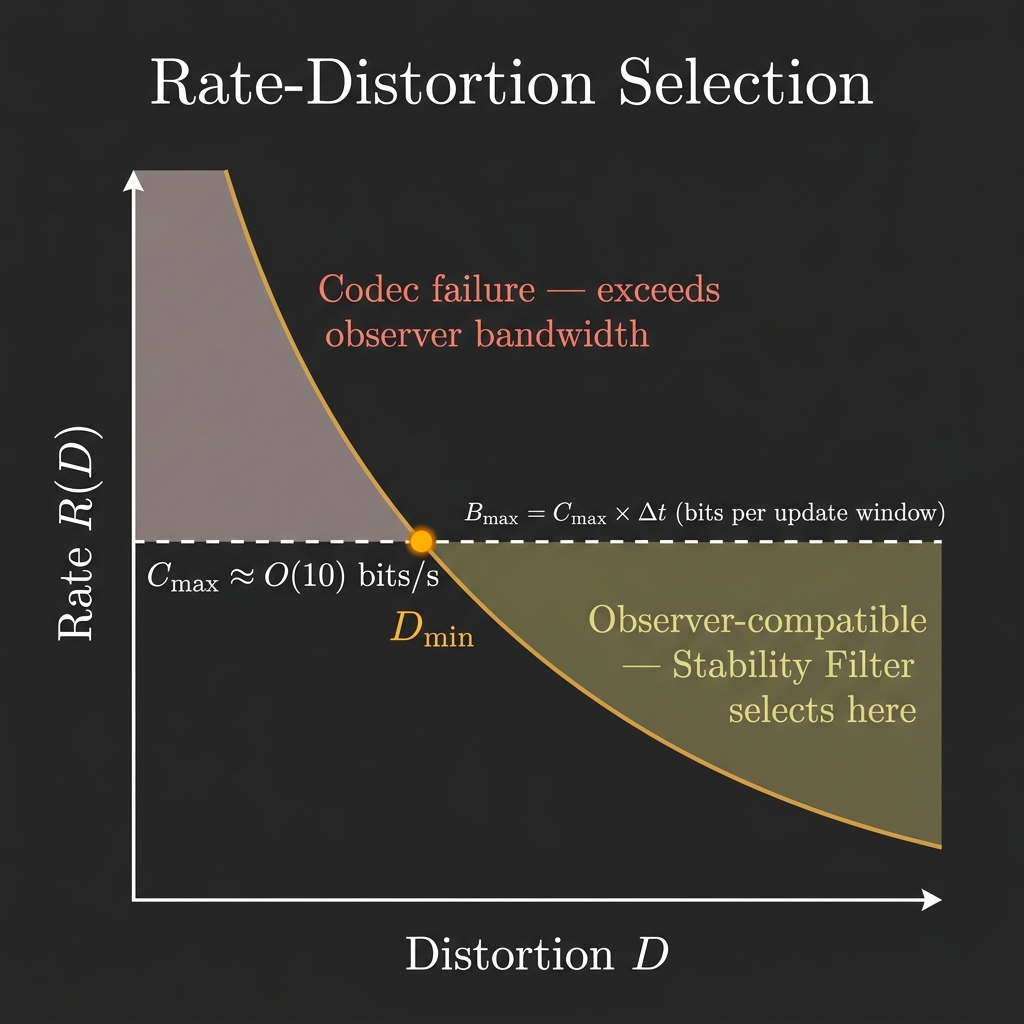
A process is observer-compatible if its required predictive information per cognitive cycle fits within this buffer: R_{\mathrm{pred}}(D_{\min}) \le B_{\max}, where D_{\min} is the maximum tolerable distortion for survival. This enforces dimensional strictness: the total bits required to predict the future within tolerable error cannot exceed the physical bits available in the discrete “now.” For suitable stationary ergodic processes and in the exact-prediction limit (D \to 0), the minimal maximally-predictive representation Z serves as a candidate minimal sufficient statistic, often coalescing toward the \epsilon-machine causal-state partition [29]. While full equivalence requires strict stationarity assumptions, Eq. (2) establishes a formal selection pressure for the most compressed phenomenological physics consistent with causal coherence. Furthermore, if the topological structure of this causal state-space fluctuates faster than the \Delta t update window can track, the render collapses into Narrative Decay.
3.3 The Geometry of the Patch: The Informational Causal Cone
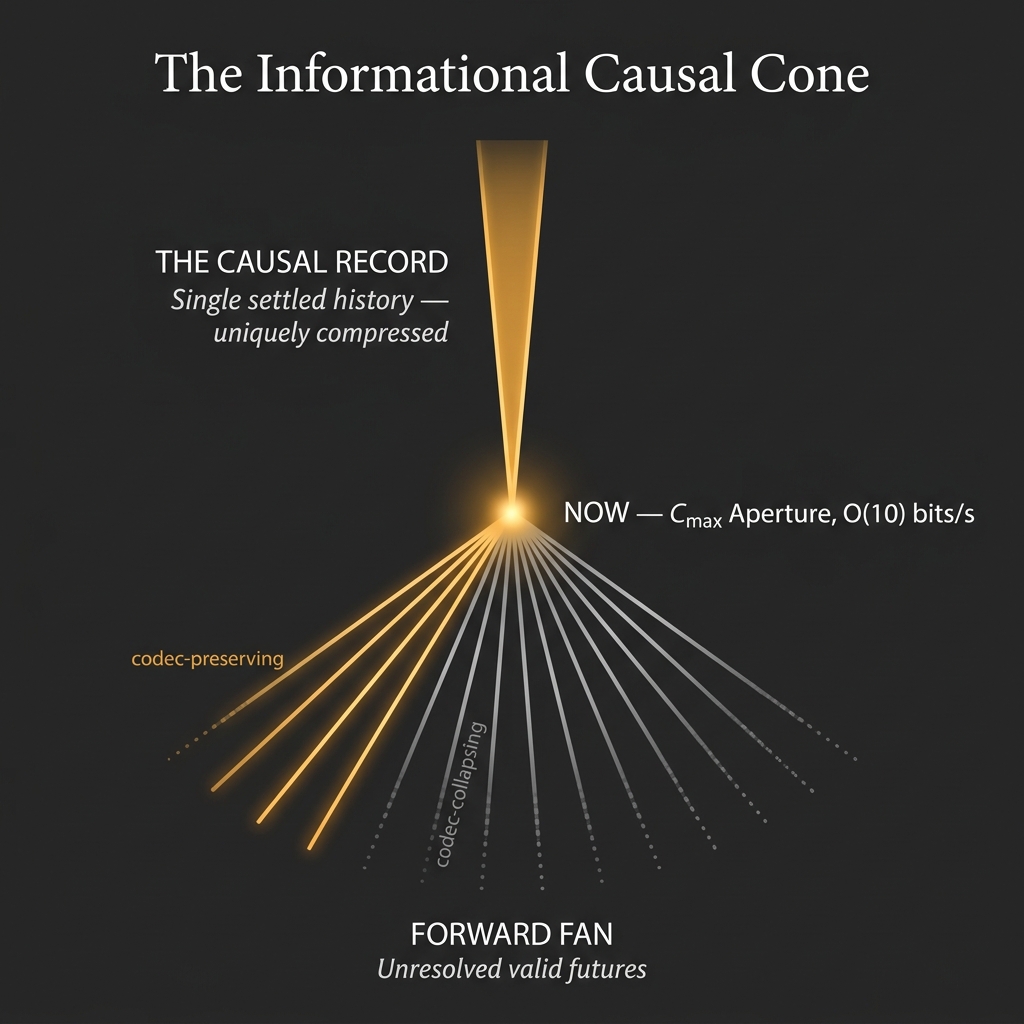
The Ordered Patch is often described intuitively as an “island” of stability in a sea of chaotic noise. This is topologically imprecise. To formalize its geometry, we define a local predictive model of the patch.
Let G=(V, E) be a bounded-degree graph representing a local region of the substrate. Each vertex v \in V carries a finite state x_v(t) \in \mathcal{A}, with alphabet size |\mathcal{A}| = q. The full microstate at update t is X_t = (x_v(t))_{v \in V} \in \mathcal{A}^V. We assume local stochastic dynamics of finite range R:
p(X_{t+1} \mid X_t, a_t) = \prod_{v \in V} p_v\big(x_v(t+1) \mid X_t|_{N_R(v)}, a_t\big) \tag{3}
where N_R(v) is the radius-R neighborhood of v, and a_t is the observer’s action.
The observer does not carry the whole patch state; it carries a compressed latent state Z_t \in \{1, \dots, 2^B\}, where B = C_{\max} \Delta t. Crucially, the observer selects Z_t via a strict predictive bottleneck objective:
\begin{aligned} q^\star(z \mid X_t) &= \arg\min_q \Big[ I(X_t; Z_t) - \beta I(Z_t; X_{t+1:t+\tau}) \Big] \\ &\quad \text{subject to } I(X_t; Z_t) \le B \end{aligned} \tag{4}
This is the stripped-down OPT observer: a local world, a bounded code, and predictive compression. This formalizes the components of the causal cone:
- The Causal Record R_t = (Z_0, Z_1, \dots, Z_t): The uniquely compressed, low-entropy causal history that has already been rendered.
- The present aperture: The strict bandwidth bottleneck capping the local variables.
- The Forward Fan (\mathcal{F}_h): A multiplicity of future latent sequences. Over horizon h, the set of admissible outcomes is formally defined as:
\mathcal{F}_h(z_t) := \Big\{ z_{t+1:t+h} : p(z_{t+1:t+h} \mid z_t, a_{t:t+h-1}) > 0 \Big\} \tag{5}
Because the observer only resolves B bits per update, the encoded representation of the future has bounded entropy: H(Z_{t+1:t+h} \mid Z_t, a_{t:t+h-1}) \le hB. The substrate-level fan \mathcal{F}_h(z_t) can have unbounded support — the multiplicity of physically admissible futures is not what the bottleneck bounds. What the bottleneck bounds is the observer’s typical set of distinguishable encoded outcomes: |\mathcal{T}_\epsilon^{(h)}(Z)| \lesssim 2^{hB} (asymptotic, with \epsilon \to 0). The fan is therefore not literally a finite branching tree at the substrate level; it is a code-limited resolution of an unbounded substrate-level multiplicity — the observer experiences a bounded distinguishable subset, not the full underlying branching. The cardinality formulation \log |\mathcal{F}_h(z_t)| \le Bh used in earlier drafts is replaced by this entropy / typical-set formulation per the v3.6.0 reference-frame audit: cardinality conflates substrate support with observer-distinguishable support, while the entropy bound is the actual claim the bottleneck makes.
The Literal Informational Causal Cone. Because updates have range R, a perturbation cannot propagate faster than R graph-steps per update. If a perturbation has support S at time t, then after h updates \operatorname{supp}(\delta X_{t+h}) \subseteq N_{Rh}(S). Thus, the “informational causal cone” is a direct geometric consequence of locality, enforcing an effective local speed limit v_{\max} = R / \Delta t on phenomenological propagation.
Narrative Decay. The substrate’s chaos does not surround the patch spatially; it is contained in the untraversed branches of the fan. Since the extracted state Z_t is strictly bounded (H(Z) \le B), instability must be evaluated against the uncompressed pre-bottleneck margin. We define the required predictive rate R_{\mathrm{req}}(h, D_{\min} \mid z_t) = \frac{1}{h} \min_{p(\hat{X} \mid Z_t) : \mathbb{E}[d(X, \hat{X})] \le D_{\min}} I(X_{\partial_R A}(t+1:t+h) ; \hat{X}_{t+1:t+h} \mid Z_t) as the minimal information rate necessary to track the unresolved physical boundary states under maximum tolerable distortion. This sharpens the Stability Filter selection criteria: (a) if R_{\mathrm{req}} \le B, the observer can maintain a resolved narrative; (b) if R_{\mathrm{req}} > B, the uncompressed forward fan outpaces the bottleneck capacity, forcing the observer to coarse-grain the fan into undecodable static, and narrative stability fails. The observer’s continuous experience is the process of the aperture advancing into this fan, phenomenologically indexing one branch into the causal record without exceeding B.
Narrative Drift (The Chronic Complement). The preceding defines an acute failure mode: R_{\mathrm{req}} exceeds B and the codec experiences a catastrophic collapse of coherence. There exists a complementary chronic failure mode that does not trigger any failure signal. If the input stream X_{\partial_R A}(t) is systematically pre-filtered by an external mechanism \mathcal{F} — producing a curated signal X' = \mathcal{F}(X) that is internally consistent but excludes genuine substrate information — the codec will exhibit low prediction error \varepsilon_t, run efficient Maintenance Cycles, and satisfy R_{\mathrm{req}} \le B while being systematically wrong about the substrate. Crucially, the Stability Filter as defined cannot distinguish these cases: compressibility is agnostic to fidelity. Over time, the MDL pruning pass (§3.6.3, Eq. T9-3) drops the components that no longer predict the filtered stream — equivalently, under §8.6.1, the best compression of the curated prefix ceases to contain them — irreversibly (for the adapted codec, absent protected memory, re-exposure, or an external teacher) degrading the capacity to reconstruct the excluded signal (Appendix T-12, Theorem T-12). This erasure is self-reinforcing: the pruned codec can no longer detect its own capacity loss (Theorem T-12a, Input-Provenance Non-Identifiability). The structural defence is redundancy of \delta-independent input channels crossing the Markov blanket \partial_R A (Theorem T-12b, the Substrate Fidelity Condition). The full formal treatment is in Appendix T-12; the ethical consequences — including the Comparator Hierarchy and the Corruption Criterion — are in the companion ethics paper [SW §V.3a, §V.5].
3.4 Patch Dynamics: Inference and Thermodynamics
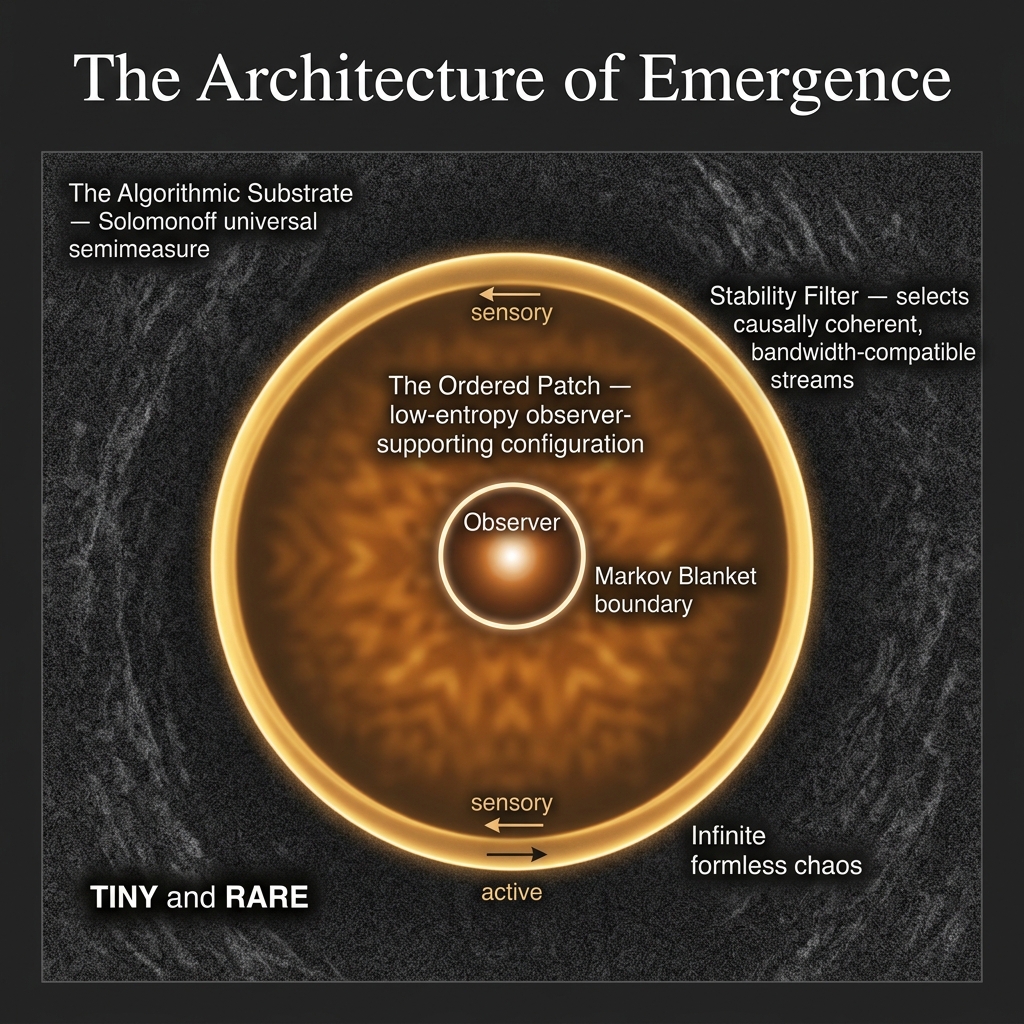
Within a selected patch, the structure of the laws of physics is formalized not as a deterministic mapping but as an effective stochastic kernel governing the predictive states z:
z_{t+1} \sim K_\theta(\cdot \mid z_t, a_t), \qquad y_{t+1} \sim O_\theta(\cdot \mid z_{t+1}) \tag{6}
The boundary delineating the observer from the surrounding informational chaos is defined by an informational Markov Blanket corresponding to an observer patch A \subset V. The dynamics inside this boundary—the agent’s approximations of the patch—are governed by Active Inference under the Free Energy Principle [9].
We can formally define the bounding capacity via the predictive cut entropy:
S_{\mathrm{cut}}(A) := I(X_A ; X_{V \setminus A}) \tag{7}
Assuming the selected patch is locally Markovian at a time slice, the boundary shell \partial_R A strictly screens the interior A^\circ from the exterior V \setminus A, such that X_{A^\circ} \perp X_{V\setminus A} \mid X_{\partial_R A}. Consequently:
S_{\mathrm{cut}}(A) = I(X_{\partial_R A} ; X_{V \setminus A}) \le H(X_{\partial_R A}) \le |\partial_R A| \log q \tag{8}
Because Z_t is a capacity-limited compression of X_A, the data processing inequality guarantees I(Z_t ; X_{V \setminus A}) \le |\partial_R A| \log q. If the substrate graph G approximates a d-dimensional lattice, then |\partial_R A| \sim \operatorname{area}(A), not volume.
Thus, OPT rigorously yields a genuine Classical Boundary Law [39]. We can construct a formal epistemic ladder for future structural upgrades: 1. Classical Area Law: S_{\mathrm{cut}} \sim |\partial_R A| derived purely from locality and Markov screening. 2. Quantum Upgrade: Von Neumann entanglement entropy scaling becomes accessible only if the coarse predictive variables Z_t admit a formal Hilbert-space/Quantum Error Correction embedding. 3. Holographic Upgrade: True geometric holographic duality emerges only if we replace the bottleneck code Z_t with a hierarchical tensor network, reinterpreting S_{\mathrm{cut}} as a geometric min-cut.
By securing the classical boundary law first, OPT provides a strong mathematical floor—conditional on the Markov-screening assumption (X_{A^\circ} \perp X_{V \setminus A} \mid X_{\partial_R A})—from which the more speculative quantum formalisms can be safely constructed.
The action of the observer is formalized via the variational free energy F[q, \theta]:
F[q,\theta] = \mathbb{E}_q[-\log p_\theta(y_{1:T}, z_{1:T} \mid a_{1:T})] + \mathbb{E}_q[\log q(z_{1:T})] \tag{9}
Crucially, this enforces a strict mathematical separation: the substrate prior selects the hypothesis space, the virtual Stability Filter (4) bounds capacity-compatible structure, and FEP (9) governs agent-level inference inside that bounded structure. Physics emerges not as the Free Energy functional, but as the stable structure K_\theta that the Free Energy functional is successfully tracking.
Furthermore, sustaining this conscious render incurs an unavoidable thermodynamic cost. By Landauer’s Principle [52], each logically irreversible bit erasure dissipates at least k_B T \ln 2 of heat. Identifying one irreversible bit-erasure per rendered bit (i.e., B_{\max} erasures per bottleneck update; a best-case bookkeeping assumption), the physical footprint of consciousness requires a minimum dissipation:
P_{\text{render}} \ge \dot{N}_{\text{erase}} \cdot k_B T \ln 2 \ge C_{\max} \cdot k_B T \ln 2 \tag{10}
This is a best-case lower bound under one-erase-per-update bookkeeping — not a generic consequence of bandwidth alone. The resulting bound (\sim 10^{-19} W) is vastly exceeded by actual neural dissipation (~20W), reflecting the enormous thermodynamic overhead of biological implementation. Equation (10) establishes the strict theoretical floor on the minimum possible physical footprint of any substrate instantiating a C_{\max}-bounded conscious render.
(Remark: The preceding thermodynamic and informational bounds strictly govern the real-time update bandwidth C_{\max}. However, this does not capture the full experiential dimensionality of the observer’s standing state, nor how the standing-state complexity of a filter-passing stream stays bounded over deep time (read ontologically under §8.6.1). These structural mechanics—the Phenomenal State Configuration formulation of rich experience and the active maintenance cycle of sleep/dreaming—are fully derived in §3.5 and §3.6 below.)
3.5 The Phenomenal State Configuration and the Prediction Asymmetry
3.5.1 The Experiential Density Puzzle
The formal apparatus of §§3.1–3.4 successfully constrains the
update throughput of a conscious observer via the capacity
ceiling C_{\max} \approx
\mathcal{O}(10) bits/s.
However, phenomenal experience presents an immediate structural puzzle:
the felt richness of a single visual moment — the simultaneous presence
of colour, depth, texture, sound, proprioception, and affect — vastly
exceeds the information content that C_{\max} could deliver in any single update
window \Delta t \approx 50\
\text{ms}.
The maximum new information resolved per conscious moment is:
B_{\max} = C_{\max} \cdot \Delta t \approx 10\ \text{bits/s} \times 0.05\ \text{s} = 0.5\ \text{bits} \tag{T8-1}
This is far less than one bit of genuinely novel information per perceptual frame, yet the phenomenal scene appears informationally dense. To resolve this discrepancy without inflating the narrow update bandwidth, we distinguish two quantities: 1. C_{\max} — the update throughput: the rate of prediction-error signal resolved into the settled causal record per unit time. 2. C_{\text{state}} — the standing-state complexity: the Kolmogorov complexity K(P_\theta(t)) of the generative model currently active. (Under §8.6.1 this is a structural property the filter-passing stream has, not bits held loaded in a machine; the magnitude is unchanged.)
These are not the same quantity. C_{\max} governs the gate; C_{\text{state}} characterises the room. The remainder of this section makes the distinction precise and introduces the Phenomenal State Configuration P_\theta(t) as the formal object corresponding to the standing inner scene.
3.5.2 The Prediction Asymmetry: Upward Errors and Downward Predictions
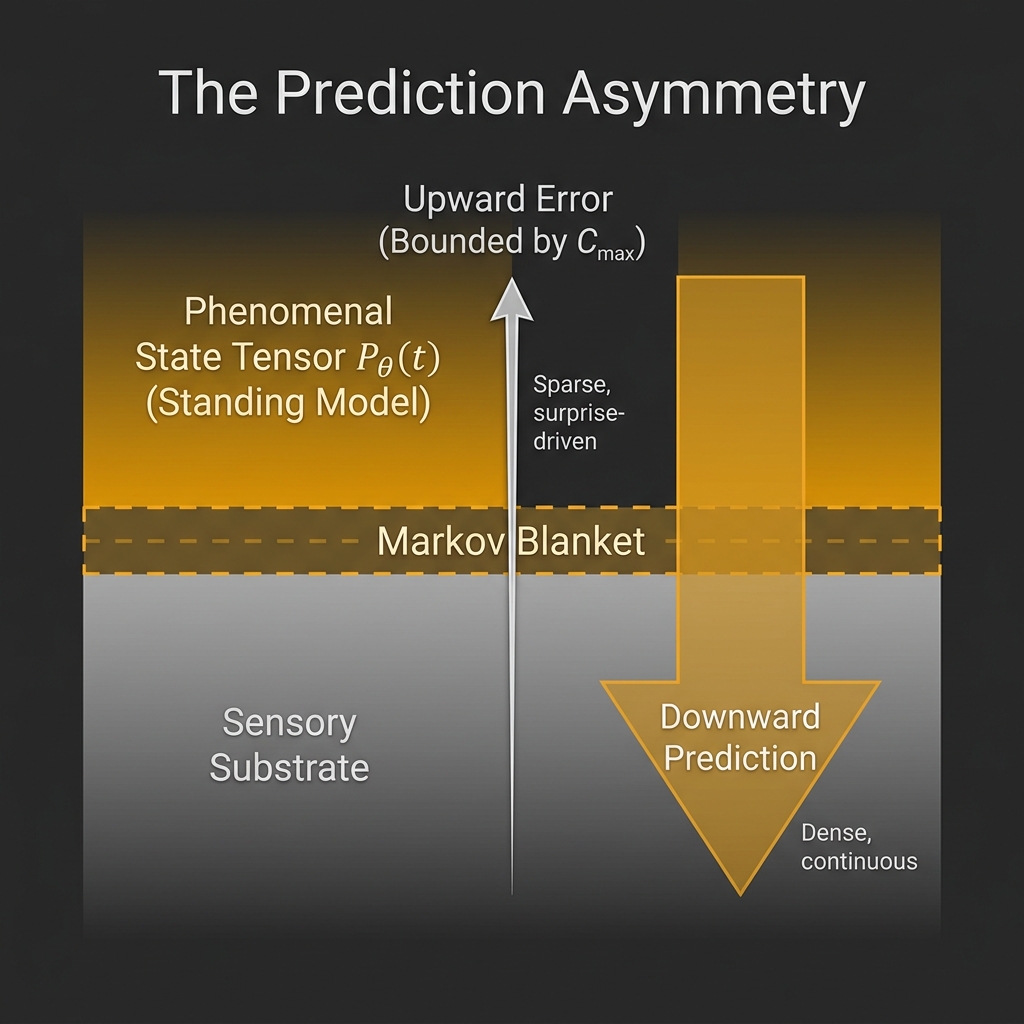
OPT inherits the predictive-processing architecture (Clark [82],
Hohwy [83]; see §7 Positioning, Appendix E-8, and opt-philosophy.md §IV.9.1)
in which the codec K_\theta operates as
a hierarchical generative model. Under this architecture, two distinct
information flows traverse the Markov Blanket \partial_R A simultaneously:
Upward flow (prediction error, \varepsilon_t): the mismatch between K_\theta’s current prediction and the sensory signal arriving at \partial_R A. This is the correction signal. It is sparse, surprise-driven, and strictly capacity-limited.
Downward flow (prediction, \pi_t): the generative model’s active rendering of expected sensory states, propagated from higher to lower hierarchical levels. This is the scene itself. It is dense, continuous, and drawn from the full parameterisation of K_\theta.
Formally, let the sensory boundary state be X_{\partial_R A}(t), and let the codec’s predicted boundary state be:
\pi_t := \mathbb{E}_{K_\theta}\!\left[X_{\partial_R A}(t) \mid Z_t\right] \tag{T8-2}
The prediction error is then:
\varepsilon_t := X_{\partial_R A}(t) - \pi_t \tag{T8-3}
C_{\max} bounds the error signal, not the prediction. The mutual information between the error signal and the bottleneck state obeys:
I(\varepsilon_t\,;\,Z_t) \leq C_{\max} \cdot \Delta t = B_{\max} \tag{T8-4}
The prediction \pi_t, by contrast, is drawn from the full generative model and carries no such constraint. Its informational content is bounded only by the complexity of K_\theta itself. This asymmetry is the formal basis for distinguishing phenomenal richness from update bandwidth.
3.5.3 Definition: The Phenomenal State Configuration P_\theta(t)
In the operational / host-frame reading used throughout §3, we define the Phenomenal State Configuration P_\theta(t) as the full standing active parameter subset of the generative model deployed to project through the Markov Blanket at time t:
P_\theta(t) := \bigl\{\, K_\theta(\cdot,\, \cdot) \,\bigr\}_{\text{active}} \tag{T8-5}
That is, P_\theta(t) is the complete parameterized architecture the codec currently holds ready to generate predictions over the observable boundary states X_{\partial_R A}, evaluated independently of any single specific instantiation of the compressed latent state Z_t and action a_t. Its structural complexity is characterised naturally by the Kolmogorov complexity of this current standing parameter configuration:
C_{\text{state}}(t) := K\!\left(P_\theta(t)\right) \tag{T8-6}
where K(\cdot) denotes prefix Kolmogorov complexity. C_{\text{state}}(t) is the standing-state complexity — the number of bits of compressed structure the codec is currently holding in active deployment.
Upper bound on boundary channel flow. The mutual information between the bottleneck state and the boundary is bounded by standard Shannon inequalities [16] (Eq. 8 of the base paper):
I\!\left(Z_t\,;\,X_{\partial_R A}\right) \leq H\!\left(X_{\partial_R A}\right) \leq |\partial_R A|\cdot \log q \tag{T8-7}
This bounds the channel flow across the Markov Blanket — vastly large relative to B_{\max}. Important caveat: This is a bound on the Shannon-theoretic mutual information I(Z_t\,;\,X_{\partial_R A}), not a bound on the Kolmogorov complexity K(P_\theta(t)) of the standing model. Shannon entropy quantifies ensemble-average uncertainty; Kolmogorov complexity quantifies the description length of a specific computable object. No general inequality bridges these quantities without additional assumptions (e.g., a universal prior over model classes). We therefore do not claim that C_{\text{state}} \leq H(X_{\partial_R A}). The standing-state complexity C_{\text{state}} is bounded empirically (§3.10), not by the boundary entropy.
Heuristic lower bound on C_{\text{state}}. The Stability Filter directly constrains only the update rate R_{\text{req}} \leq B_{\max}, not the standing-model depth. However, a codec with insufficient structural complexity cannot generate accurate predictions \pi_t matching the statistics of a complex environment across the forward fan \mathcal{F}_h(z_t). This imposes a practical minimum on C_{\text{state}}: below some threshold, R_{\text{req}} would systematically exceed B_{\max} because the prediction errors \varepsilon_t would be persistently large. This lower bound is empirically motivated rather than formally derived — no closed-form expression C_{\text{state}} \geq f(R_{\text{req}}, \text{environment statistics}) is presently available.
Materialized vs dispositional reading (open question). P_\theta(t) as defined above admits two readings the framework currently does not formally distinguish: (a) a materialized reading, in which P_\theta(t) is a dense, instantaneously loaded representation whose richness is in active form per frame, and (b) a dispositional reading, in which P_\theta(t) is a generative capacity — a standing program that can render the scene on demand, with not all of it materialized between query and response. Both are compatible with the boundary-channel and heuristic-lower-bound clauses above and with §3.5.6’s empirical commitment that richness correlates with K(K_\theta) rather than with update bandwidth. They differ in what “loaded” means and in what should be measured when probing K(P_\theta) directly. Kolmogorov complexity alone does not separate them: a small K(P_\theta) can support high logical depth, large query-response capacity, or a long runtime expansion. We adopt the dispositional reading as the canonical interpretation here — P_\theta(t) is the active dispositional generative state from which the scene can be queried/rendered, not necessarily a fully materialized dense scene object — while flagging the materialized reading as a competing operationalisation that future empirical work may select. Under the render ontology (§8.6.1), the fully-virtual reading is the ontological limit of (b): P_\theta(t) is not a parameter set held by a codec but a structural property the filter-passing stream has. This is the most committal point on the materialized–dispositional axis, yet it is neutral on the (a)-vs-(b) empirical probe — directly measuring K(P_\theta) still discriminates a dense materialized scene from a dispositional capacity. The virtual reading reuses this open question; it does not close it.
3.5.4 Block’s Distinction as a Structural Consequence
The formal distinction between P_\theta(t) and Z_t maps precisely onto Ned Block’s distinction between phenomenal consciousness (P-consciousness) and access consciousness (A-consciousness) [47]:
| Block’s Category | OPT Object | Information Content | Bandwidth-Limited? |
|---|---|---|---|
| P-consciousness (qualia, felt scene) | P_\theta(t) | C_{\text{state}} = K(P_\theta(t)) \gg B_{\max} | No |
| A-consciousness (reportable content) | Z_t | B_{\max} = C_{\max} \cdot \Delta t \approx 0.5\ \text{bits} | Yes |
Under OPT, P-consciousness is the downward prediction \pi_t drawn from the full configuration P_\theta(t). A-consciousness is the bottleneck output Z_t — the thin slice of the scene that has been compressed sufficiently to enter the causal record \mathcal{R}_t and become available for report. The felt richness of a visual moment is P_\theta(t); the ability to say “I see red” requires that feature to pass through Z_t.
This corollary resolves the apparent paradox of a rich phenomenal scene sustained by a sub-bit update channel: the scene is not delivered through the channel each frame — it is already implied by P_\theta(t) (under §8.6.1, by the regularities the history prefix already encodes). The channel updates it, incrementally and selectively, frame by frame.
3.5.5 The Update Dynamics of P_\theta(t)
The update rule for P_\theta(t) is governed by the prediction-error signal \varepsilon_t filtered through the bottleneck:
P_\theta(t+1) = \mathcal{U}\!\left(P_\theta(t),\, \varepsilon_t,\, Z_t\right) \tag{T8-8}
where \mathcal{U} is the codec’s learning operator — in Active Inference terms, the gradient step on variational free energy \mathcal{F}[q, \theta] (Eq. 9 of base paper) restricted by the capacity constraint I(X_t\,;\,Z_t) \leq B. (Under §8.6.1, \mathcal{U} carries a dual reading: host-frame, the FEP gradient step retained here; within the render, simply the fact that the regularities of the longer prefix differ slightly from those of the shorter — no state vector stored outside the history.)
The key structural property is that \mathcal{U} is selective: only those regions of P_\theta(t) implicated by the current prediction error \varepsilon_t are updated. The remainder of the standing configuration is held constant across the frame. This gives the conscious moment its characteristic structure: a stable phenomenal background against which a small foreground of resolved novelty is laid.
The codec thus implements a form of sparse update on a dense prior — a design principle that maximises phenomenal coherence per unit of update bandwidth.
3.5.6 Scope and Epistemic Status
The Phenomenal State Configuration P_\theta(t) is a formal characterisation of the structural shadow the phenomenal scene must cast, consistent with the Agency Axiom (§3.8). It does not resolve the Hard Problem. OPT continues to treat phenomenal consciousness as an irreducible primitive; P_\theta(t) specifies the geometry of the container, not the nature of its contents.
The claim is structural and falsifiable in the following sense: if the qualitative richness of reported experience (as operationalised through, e.g., measures of phenomenal complexity in psychophysical tasks) correlates with codec depth — the hierarchical complexity of K_\theta as measurable via neural markers of predictive hierarchy — rather than with update bandwidth C_{\max}, then the P_\theta\,/\,Z_t distinction is empirically supported. Psychedelic states, which dramatically alter the structure of K_\theta without consistently altering behavioural throughput, represent a natural test domain. This measurement is host-frame: “codec depth” / K(K_\theta) is read off neural (or, for synthetic observers, architectural) markers of predictive hierarchy, where the codec is implemented (the runtime/implementation frame). The virtual reading of §8.6.1 re-characterises the standing state but does not redefine this measurement or the magnitude it targets (§6.8 exclusion).
3.6 The Codec Lifecycle: The Maintenance Cycle Operator \mathcal{M}_\tau
Companion paper. The within-life psychological and clinical elaboration of this section is developed in
opt-psychology.md(Ordered Patch Psychology: Intra-Psychic Psychology and Psychiatry). That paper translates \mathcal{M}_\tau into a vocabulary for waking mind wandering, dreaming, rumination, sleep-dependent consolidation, transdiagnostic psychopathology, and codec-hygiene interventions (autogenic training, CBT, mindfulness, sleep medicine, pharmacology read at the precision-modulation level). It is bundled with this paper and shares its DOI; its scope is deliberately intra-psychic, with social, developmental, and interpersonal psychology deferred. The structural apparatus is inherited from §3.6 here — no new formalism is introduced there — and most substantive claims are restatements of established cognitive-science, sleep, and computational-psychiatry results in OPT-shaped language.
3.6.1 The Static Codec Problem
The framework of §§3.1–3.5 treats K_\theta and its realisation P_\theta(t) as dynamic across update frames but implicitly assumes the codec’s structural architecture — the parameter space \Theta itself — is fixed. This is adequate for a synchronic analysis of a single conscious moment, but inadequate for a theory of consciousness across deep time.
A codec operating continuously accumulates structural complexity: every learned pattern adds parameters to K_\theta, increasing C_{\text{state}}(t). Without a mechanism for controlled complexity reduction, C_{\text{state}} would grow monotonically until the codec exceeded its thermodynamic runability ceiling — the point at which the metabolic cost of maintaining P_\theta(t) exceeds the organism’s energy budget, or the internal complexity of K_\theta exceeds the Stability Filter’s capacity-compatible description length.
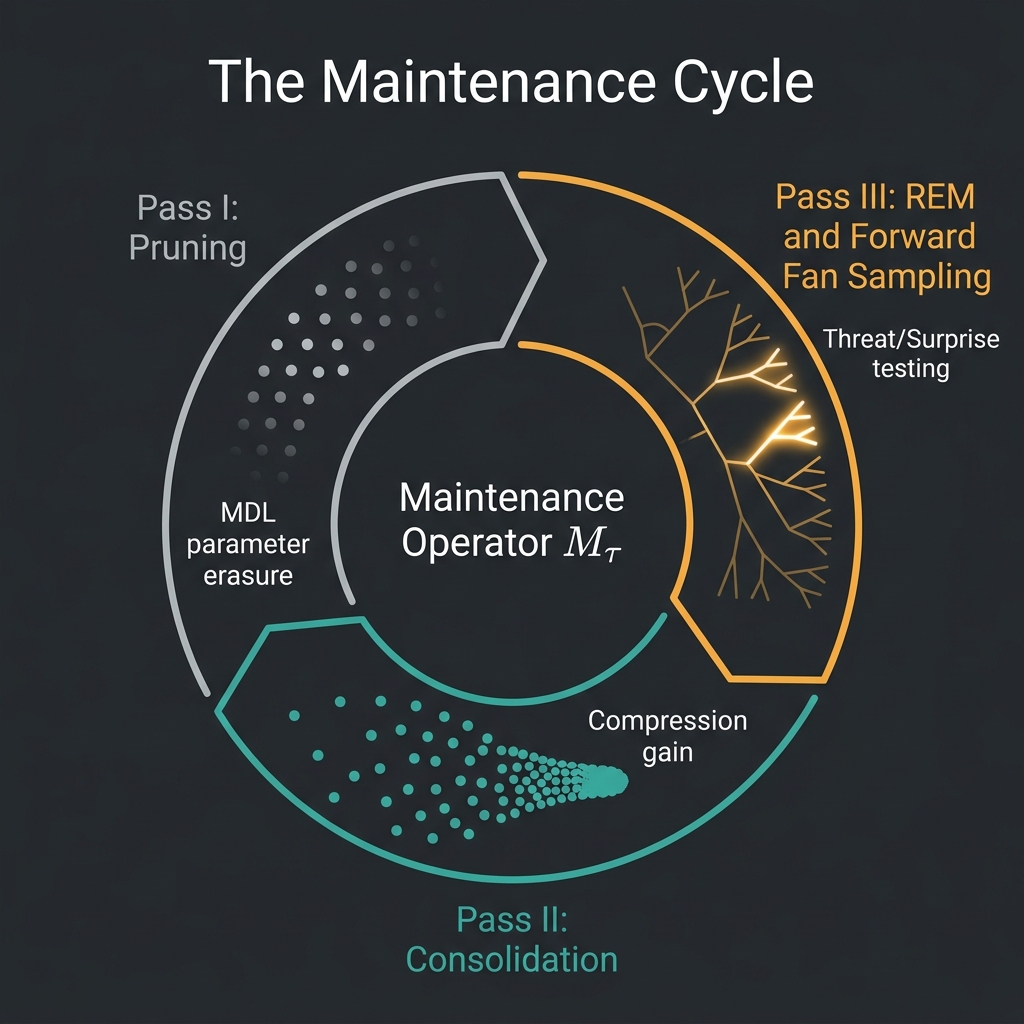
This section introduces the Maintenance Cycle Operator \mathcal{M}_\tau — the formal mechanism by which the codec manages its own complexity across time, operating primarily during states of reduced sensory load (paradigmatically: sleep).
Dual reading (framing at the head of §3; full synthesis §8.6.1). As with the codec K_\theta (§8.6, “nothing runs K_\theta”) and the lineage-level passes (§3.6.9, a structural correspondence with no apparatus transfer), \mathcal{M}_\tau and its three passes below admit a structural reading: descriptions of how the best compression of a longer filter-passing prefix differs from that of a shorter one, not runtime processes a loaded machine executes. The “mechanism for controlled complexity reduction” is then the selection condition, not a regulator. Equations T9-1–T9-13 stand verbatim; their denotation shifts from instantiated machinery to properties of the filter-passing stream — a substantive shift, which is why the thermodynamic-erasure clauses below (§3.6.3) are tagged as host-frame signatures rather than stream-native facts.
3.6.2 The Maintenance Condition
Define the codec runability condition as the requirement that the Kolmogorov complexity of the current generative model remain below a structural ceiling C_{\text{ceil}} set by the organism’s thermodynamic budget:
K\!\left(P_\theta(t)\right) \leq C_{\text{ceil}} \tag{T9-1}
C_{\text{ceil}} is not the same as C_{\max}. It is a much larger quantity — the total structural complexity the codec can sustain in its parameter space — but it is finite. Violations of (T9-1) correspond to cognitive overload, memory interference, and ultimately to the pathological case described by Borges’ [53] Funes the Memorious: a system that has acquired so much uncompressed detail that it can no longer function predictively.
The Maintenance Cycle Operator \mathcal{M}_\tau is defined as acting during periods when R_{\text{req}} \ll C_{\max} — specifically, when the required predictive rate drops sufficiently that the bandwidth freed can be redirected to internal restructuring:
\mathcal{M}_\tau : P_\theta(t) \;\longrightarrow\; P_\theta(t + \tau) \qquad \text{during} \quad R_{\text{req}}(t) \ll C_{\max} \tag{T9-2}
\mathcal{M}_\tau decomposes into three structurally distinct passes, each targeting a different aspect of codec complexity management.
3.6.3 Pass I — Pruning (Forgetting as Active MDL Pressure)
The first pass applies Minimum Description Length (MDL) pressure to the current codec parameters. For each component \theta_i of the generative model K_\theta, define its predictive contribution as the mutual information it provides about the future observation stream, net of the storage cost of retaining it:
\Delta_{\mathrm{MDL}}(\theta_i) := I\!\left(\theta_i\,;\,X_{t+1:t+\tau} \mid \theta_{-i}\right) - \lambda \cdot K(\theta_i) \tag{T9-3}
where \theta_{-i} denotes all parameters except \theta_i, \lambda is a retention threshold (bits of future prediction bought per bit of model complexity), and K(\theta_i) is the description length of the component.
The pruning rule is:
\text{Prune } \theta_i \quad \text{if} \quad \Delta_{\mathrm{MDL}}(\theta_i) < 0 \tag{T9-4}
That is, discard \theta_i when its predictive contribution per bit of storage falls below the threshold \lambda. This is forgetting formalised not as failure but as thermodynamically rational erasure: each pruned component recovers K(\theta_i) bits of model capacity for reuse.
By Landauer’s Principle [52], each pruning operation establishes a thermodynamic floor for erasure:
W_{\text{prune}}(\theta_i) \geq K(\theta_i) \cdot k_B T \ln 2 \tag{T9-5}
While actual biological metabolism operates many orders of magnitude above this theoretical minimum (Watts versus femtowatts) due to severe implementation overhead, the structural necessity of the cost remains. Bennett’s complement to Landauer [92] sharpens this further: logically reversible computation can in principle approach zero dissipation, so the Landauer floor binds specifically on erasure, not on prediction or transformation. The pruning pass — and not the prediction pass — is therefore the thermodynamically irreducible step in the maintenance cycle. Sleep carries a fundamental thermodynamic signature in OPT: it is a period of net information erasure whose energy cost is mandated by physics rather than merely biological inefficiency. Under the virtual reading (§8.6.1), this thermodynamic erasure is the host-frame signature: the stream-native fact is the irreversible loss of the capacity to reconstruct the pruned regularities, and the Landauer cost is its physical shadow, not an additional process.
The aggregate complexity reduction of the pruning pass is:
\Delta K_{\text{prune}} = \sum_i K(\theta_i)\cdot \mathbf{1}\!\left[\Delta_{\mathrm{MDL}}(\theta_i) < 0\right] \tag{T9-6}
3.6.4 Pass II — Consolidation (Learning as Compression Gain)
The pruning pass removes components with insufficient predictive return. The consolidation pass reorganises the remaining components into more compressed representations.
During waking operation, the codec acquires patterns under real-time pressure: each update must be computed within \Delta t, leaving no time for global structural reorganisation of K_\theta. Recently acquired patterns are stored in a relatively uncompressed form — high K(\theta_{\text{new}}) for the predictive contribution they provide. The consolidation pass applies offline MDL compression to these recent acquisitions.
Let \Theta_{\text{recent}} \subset \Theta denote the set of parameters acquired since the last maintenance cycle. The consolidation operator finds the minimum-complexity reparameterisation \theta' of \Theta_{\text{recent}} such that the predictive distribution it generates is within tolerable distortion D_c of the original:
\begin{aligned} \theta'_{\text{cons}} &= \arg\min_{\theta'} K(\theta') \\ &\quad \text{s.t.} \quad D_{\mathrm{KL}}\!\left(P_{\theta'}(\cdot) \,\Big\|\, P_{\Theta_{\text{recent}}}(\cdot)\right) \leq D_c \end{aligned} \tag{T9-7}
The compression gain recovered is:
\Delta K_{\text{compress}} = K(\Theta_{\text{recent}}) - K(\theta'_{\text{cons}}) \tag{T9-8}
\Delta K_{\text{compress}} is the number of bits of model capacity recovered by reorganising recent experience into more efficient representations. Each unit of \Delta K_{\text{compress}} directly reduces the future R_{\text{req}} for similar environments — the codec becomes cheaper to run in familiar territory.
This formalises the empirically observed function of hippocampal-neocortical memory consolidation during slow-wave sleep: the transfer from high-bandwidth episodic storage (hippocampus, high K) to compressed semantic storage (neocortex, low K) is precisely the compression operation of (T9-7). The prediction is that compression gain \Delta K_{\text{compress}} should correlate with the degree of behavioural improvement observed after sleep on tasks involving structured pattern recognition.
3.6.5 Pass III — Forward Fan Sampling (Dreaming as Adversarial Self-Testing)
The third pass operates primarily during REM sleep, when sensory input is actively gated and motor output is inhibited. Under these conditions, R_{\text{req}} \approx 0: the codec is receiving no correction signal from the external environment. The full bandwidth budget C_{\max} is available for internal operation.
OPT frames this state formally as unconstrained forward-fan exploration: the codec generates trajectories through \mathcal{F}_h(z_t) — the set of admissible future sequences (Eq. 5 of base paper) — without anchoring those trajectories to real incoming data. This is simulation: the codec runs its generative model K_\theta forward in time, unimpeded by reality.
The sampling distribution over the fan is not uniform. Define the importance weight of a branch b \in \mathcal{F}_h(z_t) as:
w(b) := \exp\!\left(\beta\cdot |E(b)|\right) \tag{T9-9}
where \beta is an inverse temperature parameter and E(b) is the emotional valence of the branch, defined as:
E(b) := -\log P_{K_\theta}(b \mid z_t) + \alpha \cdot \mathrm{threat}(b) \tag{T9-10}
The first term -\log P_{K_\theta}(b \mid z_t) is the negative log-probability of the branch under the current codec — its surprise value. The second term \mathrm{threat}(b) is a fitness-relevant consequence measure formally defined as the expected increase in required predictive rate if the codec were to traverse branch b:
\mathrm{threat}(b) := \mathbb{E}\!\left[\, R_{\text{req}}(D_{\min} \mid b) - R_{\text{req}}(D_{\min} \mid z_t)\,\right] \tag{T9-10a}
That is, \mathrm{threat}(b) quantifies the degree to which branch b, if realised in waking life, would push the codec toward or beyond its bandwidth ceiling B_{\max} — through physical harm, social rupture, or narrative collapse that would force costly model revision. Branches with \mathrm{threat}(b) > B_{\max} - R_{\text{req}}(D_{\min} \mid z_t) are existentially threatening: they would violate the Stability Filter condition. The weighting parameter \alpha \geq 0 controls the relative influence of consequence versus surprise in the sampling distribution.
The sampling operator draws branches proportional to w(b):
b_{\text{sample}} \sim \mathcal{F}_h(z_t) \quad \text{with probability} \propto w(b) \tag{T9-11}
This implements importance-weighted forward-fan sampling: the codec disproportionately rehearses branches that are either highly surprising or highly consequential, regardless of their base-rate probability. Low-probability, high-threat branches — precisely those for which the codec is least prepared — receive the greatest sampling attention.
Each sampled branch is then evaluated for coherence under K_\theta. Branches that generate incoherent prediction sequences — where the codec’s own generative model cannot maintain narrative stability — are identified as brittleness points: regions of the forward fan where the codec would fail if the branch were encountered in waking life. The codec can then update P_\theta to reduce K_\theta’s vulnerability at those points, before being exposed to them with real thermodynamic stakes.
Dreaming is therefore adversarial self-testing of the codec at zero risk, yielding a codec systematically better prepared for the low-probability, high-consequence branches of its own forward fan. This OPT framing provides an information-theoretic grounding for Revonsuo’s [46] threat-simulation theory of dreaming, extending it from an evolutionary-functional account to a formal structural necessity: any codec operating under the Stability Filter must periodically stress-test its own forward fan, and the offline maintenance state is the only period when this can be done without real-world thermodynamic cost.
Emotional tagging as a retention weight prior. In the waking state, the emotional valence E(b) computed during REM sampling serves as a prior retention weight biasing the MDL threshold \lambda in (T9-3). Experiences with high |E(b)| — strongly surprising or consequential — are assigned a higher effective \lambda, making them more resistant to pruning in the next maintenance cycle. This is the formal account of emotional memory enhancement: affect is not noise contaminating the memory system; it is the codec’s relevance signal, marking patterns whose predictive value exceeds their base-rate statistical frequency.
3.6.6 The Full Maintenance Cycle and Net Complexity Budget
The three passes of \mathcal{M}_\tau compose sequentially. The net effect on codec complexity across one maintenance cycle of duration \tau is:
\begin{aligned} K\!\left(P_\theta(t+\tau)\right) &= K\!\left(P_\theta(t)\right) - \Delta K_{\text{prune}} - \Delta K_{\text{compress}} \\ &\quad + \Delta K_{\text{REM}} \end{aligned} \tag{T9-12}
where \Delta K_{\text{REM}} is the small positive increment from patterns newly consolidated from the REM sampling pass — those brittleness-point repairs that required new parameter updates.
For a stable cognitive system operating across years, the long-run budget requires:
\left\langle \Delta K_{\text{prune}} + \Delta K_{\text{compress}} \right\rangle \geq \left\langle \Delta K_{\text{waking}} + \Delta K_{\text{REM}} \right\rangle \tag{T9-13}
where \Delta K_{\text{waking}} is the complexity acquired during the preceding waking period. Inequality (T9-13) is the formal statement that maintenance must keep pace with acquisition. Chronic sleep deprivation, in OPT terms, is not merely fatigue — it is progressive complexity overflow: the codec approaches C_{\text{ceil}} while its pruning and consolidation budget is insufficient to restore headroom.
3.6.7 Empirical Predictions
The Maintenance Cycle framework generates the following testable structural expectations:
Sleep duration scales with codec complexity. Organisms or individuals who acquire more structured information during waking periods should require proportionally longer or deeper maintenance cycles. The prediction is not simply that hard cognitive work requires more sleep (which is established), but that the type of learning matters: pattern-rich, compressible learning should require less consolidation time than unstructured, high-entropy experience, because \Delta K_{\text{compress}} is larger in the former case.
REM content is importance-weighted over the forward fan, not frequency-weighted. Dream content should disproportionately sample low-probability, high-consequence branches relative to their waking frequency. This is consistent with the empirical predominance of threat, social conflict, and novel-environment content in dream reports — the codec samples what it needs to stress-test, not what it most often encounters.
Compression efficiency improves post-sleep proportional to \Delta K_{\text{compress}}. The specific prediction is that post-sleep performance improvements should be largest on tasks requiring structural generalisation (i.e., applying a compressed rule to new instances) rather than simple repetition — because \Delta K_{\text{compress}} specifically reorganises \Theta_{\text{recent}} into more generalisable forms.
Pathological rumination corresponds to REM sampling stuck at high-|E| branches. If the importance-weighting parameter \beta is pathologically elevated, the sampling distribution over \mathcal{F}_h(z_t) concentrates on high-threat branches to the exclusion of repair. The codec spends its maintenance cycle repeatedly sampling the same threatening branches without successfully reducing their surprise value — the formal structure of anxiety and PTSD nightmares.
3.6.8 Relationship to the Phenomenal State Configuration
\mathcal{M}_\tau acts on P_\theta(t) as defined in §3.5: it restructures the standing-state complexity C_{\text{state}} across the maintenance window. The temporal profile of P_\theta(t) under \mathcal{M}_\tau is:
- Waking acquisition: C_{\text{state}} increases at rate bounded by the learning operator \mathcal{U} (Eq. T8-8), as new patterns are incorporated into K_\theta.
- Slow-wave sleep (Passes I–II): C_{\text{state}} decreases as pruning and consolidation recover model capacity.
- REM (Pass III): C_{\text{state}} undergoes selective local increase at brittleness points, with net effect small relative to the reductions of Passes I–II.
The conscious experience corresponding to each phase is consistent with this structure: waking life accumulates the richness of P_\theta(t); slow-wave sleep is phenomenally sparse or absent (consistent with minimal P_\theta(t) activation during structural reorganisation); REM presents a phenomenally vivid but internally generated scene (Pass III: the generative model run forward in the absence of sensory correction — under §8.6.1, the stream’s own self-consistent continuations through \mathcal{F}_h).
3.6.9 Phylogenetic Codec Refinement (v3.6.0 addition)
The Maintenance Cycle \mathcal{M}_\tau developed in §3.6.1–§3.6.8 is articulated on within-life timescales: sleep, REM, day-to-day learning. A structural correspondence — not literal apparatus-transfer — extends the same MDL-parsimony logic to phylogenetic timescales. This subsection records the correspondence, with an ontological-status clarification at the head to prevent the category error that the literal reading would invite.
Ontological status of the “lineage codec” (load-bearing). A lineage is not a unified observer-class entity. It does not have a single B_{\max} bottleneck, a global Markov blanket, or an irreducible Phenomenal Residual \Delta_{\text{self}} > 0; those are properties of individual observers (§3.2, §3.8, Appendix P-4). When this subsection speaks of “the lineage codec” or “phylogenetic refinement as a slow-timescale Maintenance Cycle,” the framing is a structural correspondence at the genus level (observer-compatibility filtering under MDL parsimony, §6.6 v3.6.0 hypothesis), not a claim that the lineage instantiates the individual-observer apparatus. The within-stream observer-compatibility attractor inherits its constraint from the substrate-level Stability Filter via the rendering process (§3.1’s conditioning event O_{B,D,T} + §6.6’s MDL-parsimony bias) — not via lineage-level Landauer thermodynamics or a unified macro-observer bandwidth. The swarm-binding reading (Appendix E-6) is not invoked: it would require demonstrating that lineages have unified B_{\max} bottlenecks and global Markov blankets, which is not done here and would be a separate, much heavier proposal.
Structural correspondence. The three-pass Maintenance Cycle has the following slow-timescale structural analogues:
| Within-life Maintenance Cycle | Phylogenetic counterpart (structural analogue, not literal transfer) |
|---|---|
| Pass I — pruning (MDL pressure on K_\theta) | Lineage extinction; loss of body plans / behavioural codecs that fail to compress under rising R_req from increasing ecological complexity |
| Pass II — consolidation (compression gain) | Co-option of developmental toolkits (Hox, segmentation, regionalised brain genes) for new structural roles; convergent evolution of efficient predictive architectures |
| Pass III — forward-fan sampling (adversarial branch testing) | Variation + ecological stress-testing across geological time; surviving branches are those whose codecs satisfy the Stability Filter against actual environmental load |
| Failure mode: Narrative Drift / Decay (Appendix T-12) | Lineage-level Narrative Decay: cryptic loss of substrate-relevant predictive capacity in lineages that overfit to a curated environment, undetectable from within the lineage |
The brain-first hypothesis (Chipman 2026 [109]) is then the natural special case: rising R_req from the late Ediacaran onward (predation, mobility, sensory differentiation, complex inter-species interaction) selected for richer central nervous systems with deeper P_\theta(t) and hierarchical forward models; once a sufficiently powerful predictive codec evolved, developmental toolkits originally evolved for brain regionalisation were co-opted to pattern other organ systems, producing the morphological radiation. The “explosion” is a small number of bilaterian lineages with shared foundational neural architecture iteratively refining their generative models, with body plans as downstream implementations of an underlying codec advance.
Body schema as the conserved structural feature. The body schema (Maravita & Iriki [110]; Iriki, Tanaka & Iwamura [111]) — the dynamic, predictive, plastic representation of the body in space — is a Cambrian-era structural feature that has been selected on continuously since. It is what enables modern vertebrate brains to incorporate tools, prosthetics, vehicles, and even abstract avatars into the predictive boundary in real time. From within OPT, the body schema is the codec’s plastic predictive boundary — the part of P_\theta(t) that says “what counts as me-acting-on-the-world.” Its plasticity is not a modern quirk; it is the conserved structural feature that explains why a human can drive a car as if the wheels were limbs. The forward/inverse-model literature (Wolpert & Ghahramani [112]) supplies the mechanism — efference copies, multisensory Bayesian integration, peripersonal-space updating — and OPT supplies the structural reason: the codec is selected to maintain a low-prediction-error generative model of agent-in-environment under bounded R_req, and a plastic boundary is the bandwidth-efficient solution. The rubber-hand illusion (Botvinick & Cohen [113]) is observational confirmation of codec-boundary plasticity at the millisecond timescale.
No new formalism is required. The existing apparatus (Stability Filter via §3.1’s conditioning event O_{B,D,T}, R_{\mathrm{req}} \le B_{\max}, Maintenance Cycle, P_\theta(t)) carries the load. The phylogenetic correspondence is an application of that apparatus to a new domain (slow-timescale, lineage-distributed selection) rather than an extension of the apparatus itself.
Cross-references. Multi-scale framing: §6.6 (v3.6.0 hypothesis). Fossil-record falsification footprint and biological research programme: §6.8.1 (candidate F7 research programme, demoted from shutdown criterion per the v0.10 audit). Formal articulation: Appendix T-15 (The Phylogenetic Stability Filter).
3.6.10 Summary: New Formal Objects Introduced (§3.5–§3.6)
| Symbol | Name | Definition | Equation |
|---|---|---|---|
| P_\theta(t) | Phenomenal State Configuration | Full activation of K_\theta at time t, projected through \partial_R A | T8-5 |
| C_{\text{state}}(t) | Standing-state complexity | K(P_\theta(t)), Kolmogorov complexity of active codec | T8-6 |
| \pi_t | Downward prediction | \mathbb{E}_{K_\theta}[X_{\partial_R A}(t) \mid Z_t], the rendered scene | T8-2 |
| \varepsilon_t | Prediction error (upward) | X_{\partial_R A}(t) - \pi_t, novelty signal bounded by C_{\max} | T8-3 |
| \mathcal{M}_\tau | Maintenance Cycle Operator | P_\theta(t) \to P_\theta(t+\tau) under low R_{\text{req}} | T9-2 |
| \Delta_{\mathrm{MDL}}(\theta_i) | MDL retention score | Predictive contribution minus storage cost | T9-3 |
| E(b) | Branch emotional valence | Surprise plus weighted threat of branch b | T9-10 |
| w(b) | Branch importance weight | \exp(\beta \cdot |E(b)|), drives REM sampling distribution | T9-9 |
| \Delta K_{\text{prune}} | Pruning complexity recovery | Bits recovered by forgetting below-threshold components | T9-6 |
| \Delta K_{\text{compress}} | Consolidation compression gain | Bits recovered by MDL recompression of recent acquisitions | T9-8 |
3.7 The Tensor-Network Mapping: Inducing Geometry from Code Distance
The epistemic ladder introduced in §3.4 establishes a rigorous Classical Boundary Law (S_{\mathrm{cut}} \sim |\partial_R A|). However, to fully bridge the Ordered Patch Theory strictly to the geometrization of quantum information (e.g., AdS/CFT and the Ryu-Takayanagi formula), we must formally upgrade the structure of the latent code Z_t.
If we formally postulate that the bottleneck mapping q^\star(z \mid X_t) does not simply extract a flat list of features, but operates via a recursive, coarse-graining renormalization group flow, the generative model structurally aligns onto the geometry of a hierarchical tensor network \mathcal{T} (akin to MERA [43] or HaPY networks [44]). (Remark: Appendix T-3 formally derives a structural homomorphic correspondence between the Stability Filter’s coarse-graining cascade and the MERA network geometry bounding, mapping the Informational Causal Cone in order of magnitude to the MERA generative* cone (bulk-to-boundary; v3.6.7 rename)).* The boundary states of this network are precisely the screened Markov boundary states X_{\partial_R A}. The network \mathcal{T} acts as a bulk geometry whose “depth” represents the layers of computational coarse-graining required to compress the boundary into the minimal bottleneck state Z_t.
Under this tensor-network upgrade, the predictive cut entropy S_{\mathrm{cut}}(A) across the boundary transforms mathematically into the minimum number of tensor bonds that must be severed to isolate the subregion A. Let \chi be the bond dimension of the network. The capacity bound internally maps as:
S_{\mathrm{cut}}(A) \le |\gamma_A| \log \chi \tag{11}
where \gamma_A is the minimal-cut surface through the inner deep layer bulk data structure of \mathcal{T}. This is a discrete structural analogue of the bulk minimal-cut layer mapped by the Ryu-Takayanagi holographic entropy bound [89]. Appendix P-2 (Theorem P-2d, v3.6.2 reframed) maps a discrete min-cut entropy upper bound S_{\text{vN}}(\rho_A) \leq |\gamma_A| \log \chi via the Schmidt rank of the MERA state, conditional on the bridge postulates BP 4–BP 6 of P-2. This is structurally analogous to the Ryu-Takayanagi formula but not equal to it: saturation, continuum geometry, and the full holographic correspondence require additional assumptions beyond the upper bound. The continuum limit upgrading this to the full Ryu-Takayanagi formula with bulk correction term remains an open edge.
Crucially, in OPT, this “bulk space” is not a pre-existing physical container. It is the informational metric space of the observer’s codec. The emergent phenomenological spacetime geometry “curves” where the required code distance diverges to resolve overlapping internal causal states. This Tensor-Network formalism illustrates a path by which OPT might induce spatial geometry from the error-correction distances mandated by the Stability Filter — structurally aligned with Van Raamsdonk’s entanglement-builds-spacetime programme [88] — offering a constructive conjecture that holographic spacetime models optimal data-compression formats.
3.8 The Agency Axiom & The Phenomenal Residual
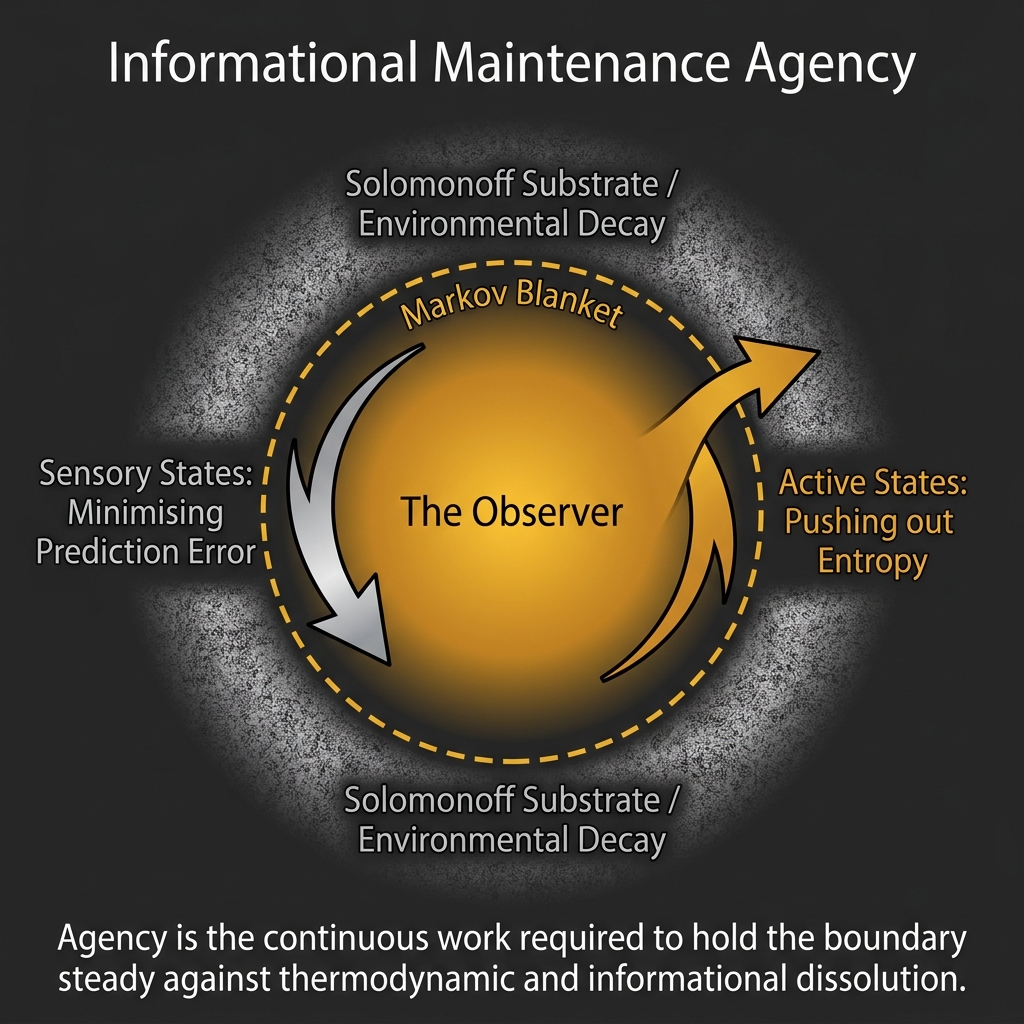
Reading note — the corrected \Delta_{\text{self}} (v4.0.3; read before the derivation below). The original derivation in this subsection frames \Delta_{\text{self}} as an incompleteness residual (K(K_\theta) - K(\hat K_\theta), “the single address where computation and feeling coincide”). That framing is superseded — read it together with the correction in §8.6.1 and Appendix P-4 §3. The load-bearing concept, stated plainly: \Delta_{\text{self}} is the self-compression gap — the budgeted capacity cost a bounded stream pays to model its own closed action-perception loop, not a self-reference paradox (that horn provably cancels). It is one object with the prediction residual (prediction and compression are one operation), is well-posed by forward causal recursion, and — restricted to the self-channel inside a closed loop — does individuation work (distinguishing a candidate subject from a generic lossy compressor) as a necessary-but-not-sufficient structural condition. Its sufficiency, and the thermostat-vs-subject threshold (K_{\text{threshold}}), remain with the bracketed Hard Problem (§8.1).
The apparatus of Sections 3.1–3.7 defines the geometry of the observer’s reality—the tensor network, the predictive cut, and the causal cone. But what is the nature of the primitive interiority that experiences passage through it? We formally define this via the Agency Axiom: the traversal of the C_{\max} aperture is intrinsically a phenomenological event.
While we take the presence of subjective feeling as axiomatic, Conjecture P-4 (The Phenomenal Residual) identifies its rigorous structural correlate. Because the bounded codec actively perturbs the boundary \partial_R A, stable prediction within C_{\max} limits requires it to model the consequences of its own future actions. Thus, the codec K_{\theta} must maintain a predictive self-model \hat{K}_{\theta}. However, by the algorithmic bounds of informational containment [13], a finite computational system cannot contain a complete structural representation of itself; the internal model is rigidly bounded to a lower complexity than the parent codec (K(\hat{K}_{\theta}) < K(K_{\theta})).
This necessitates an irreducible Phenomenal Residual (\Delta_{\text{self}} > 0), where \Delta_{\text{self}} = K(K_\theta) - K(\hat{K}_\theta). This un-modellable residual acts as the computational “blind spot” within the active inference cycle. Because it lies in the informational shadow beyond the self-model’s reach, it is ineffable; because it is the localized delta between a specific codec and its model, it is private; and because it follows from limits on self-reference and variational approximation, it is non-eliminable. The topological narrowing at the C_{\max} aperture is intrinsically correlated with the mathematical necessity of an incomplete algorithm undergoing its own boundaries. The math describes the formal contour of the experience. On the corrected reading (see the box above, §8.6.1, and Appendix P-4 §3), this residual locus is the structural marker that individuates the self — a necessary-but-not-sufficient condition for candidate subjecthood — rather than “the single address where computation and feeling coincide”; the Agency Axiom’s identification of it with the subjective “I” is retained only as the bracketed phenomenality primitive (§8.1), not as a derivation. (See Appendix P-4 for the formal treatment.)
The Within-Frame Maintenance Loop
Within a single update frame [t, t+\Delta t], the observer executes the following closed causal circuit:
P_\theta(t) \;\xrightarrow{\ \pi_t\ }\; \partial_R A \;\xrightarrow{\ \varepsilon_t\ }\; Z_t \;\xrightarrow{\ \mathcal{U}\ }\; P_\theta(t+1) \tag{T6-1}
Explicitly:
Prediction (downward): The current configuration P_\theta(t) generates the predicted boundary state \pi_t = \mathbb{E}_{K_\theta}[X_{\partial_R A}(t) \mid Z_t] — the rendered scene.
Error (upward): The actual boundary state X_{\partial_R A}(t) arrives; the prediction error \varepsilon_t = X_{\partial_R A}(t) - \pi_t is computed.
Compression: \varepsilon_t is passed through the bottleneck to yield Z_t, the capacity-limited update token, with I(\varepsilon_t\,;\,Z_t) \leq B_{\max}.
Update: The learning operator \mathcal{U}(P_\theta(t), \varepsilon_t, Z_t) revises P_\theta(t+1), selectively modifying only those regions of the configuration implicated by \varepsilon_t.
Action: Simultaneously, P_\theta(t) selects action a_t via active inference descent on the variational free energy \mathcal{F}[q,\theta] (Eq. 9 of base paper), which alters the sensory boundary at t+1, influencing the next \varepsilon_{t+1}.
Interpretive note on the action step. The language of step 5 — “selects action” and “alters the sensory boundary” — is inherited from the Free Energy Principle’s standard active inference formalism, which assumes a physical environment that the agent pushes against via active states. Under OPT’s native render ontology (§8.6), a deeper reading applies: there is no independent external world against which the codec exerts force. What is experienced as “action” is a branch selection within the Forward Fan \mathcal{F}_h(z_t); the physical consequences of that selection arrive as subsequent input \varepsilon_{t+1}. The Markov blanket \partial_R A is not a two-way physical interface but the surface across which the selected branch delivers its next segment. This interpretive shift changes nothing in the mathematics of (T6-1)–(T6-3); it clarifies the ontological status of the action step within OPT’s framework. The mechanism of branch selection itself is addressed below.
This is the within-frame informational maintenance circuit: a closed causal mechanism in which the internal model predicts the boundary, reads the error, and selectively updates itself. The loop is strictly informational and self-referential in the formal sense: P_\theta(t) determines both the structural prediction \pi_t and, via action a_t, a predictive component of the next sequential data stream input X_{\partial_R A}(t+1). (Note explicitly: this purely statistical screening layer is defined rigorously by informational Markov boundaries decoupling dynamics cleanly, differing inherently from complex biological autopoiesis where cell structures mechanically manufacture their own organic mass networks).
The Structural Viability Condition
The circuit (T6-1) is structurally viable if and only if it can sustain itself without the codec’s informational complexity exceeding its local runability limits. Formally:
K\!\left(P_\theta(t)\right) \leq C_{\text{ceil}} \quad \forall\, t \tag{T6-2}
where C_{\text{ceil}} is a heuristic parameter bounding the maximum structural complexity the codec can sustain. In principle, C_{\text{ceil}} should be derivable from the organism’s thermodynamic budget via Landauer’s principle (see the sketch in §3.10), but the full derivation chain — from metabolic power to erasure cost to maximum sustainable program complexity — is not yet formalised within OPT. C_{\text{ceil}} therefore remains an empirically motivated but formally underdetermined bound. A system satisfying (T6-2) operates as a structurally closed observer in OPT’s formal sense.
When (T6-2) is violated — when K(P_\theta(t)) \to C_{\text{ceil}} — the codec cannot maintain stable predictions across \mathcal{F}_h(z_t), R_{\text{req}} begins to exceed B_{\max}, and the Stability Filter condition fails. Narrative coherence collapses: the observer exits the set of observer-compatible streams.
The Maintenance Cycle \mathcal{M}_\tau (§3.6) is the mechanism that enforces (T6-2) over deep time, keeping K(P_\theta) within bounds via pruning, consolidation, and forward-fan stress-testing. Within-frame, (T6-2) is maintained by the selectivity of \mathcal{U}: the update operator modifies only the regions of P_\theta(t) implicated by \varepsilon_t, avoiding gratuitous complexity growth per frame.
Agency as Constrained Free Energy Minimisation
Within this structure, agency can be given a precise formal definition that is compatible with — but not reductive of — the Agency Axiom.
At the systems level, agency is the selection of action sequence \{a_t\} that minimises expected variational free energy subject to the informational viability condition:
a_t^\star = \arg\min_{a_t} \;\mathbb{E}\!\left[\mathcal{F}[q, \theta]\right] \quad \text{subject to} \quad K\!\left(P_\theta(t)\right) \leq C_{\text{ceil}} \tag{T6-3}
This is constrained active inference: the observer navigates the forward fan \mathcal{F}_h(z_t) not merely to minimise prediction error, but to minimise prediction error while keeping the codec viable. Branches that would temporarily reduce \varepsilon but drive K(P_\theta) toward C_{\text{ceil}} are penalised by the constraint. The observer preferentially selects branches along which it can continue to exist as a coherent observer.
This is the formal content of the intuition that agency is self-preserving navigation: the codec selects forward-fan branches along which it can continue to compress the world.
At the phenomenological level, the Agency Axiom remains untouched: phenomenal consciousness is the irreducible interiority of aperture-traversal; (T6-3) describes the structural shadow that traversal casts, not its inner nature.
Branch Selection as \Delta_{\text{self}} Execution
The constrained active inference formula (T6-3) specifies the objective of branch selection: minimise expected free energy subject to viability. The self-model \hat{K}_\theta evaluates branches of the Forward Fan by simulating their consequences. But Conjecture P-4 asserts that K(\hat{K}_\theta) < K(K_\theta) — the self-model is necessarily incomplete. This incompleteness has a direct consequence for the branch selection problem: the self-model constrains the region from which selection can be drawn, but cannot fully specify the selection itself.
The actual moment of branch selection — the transition from the evaluated menu to the singular trajectory that enters the causal record — occurs in \Delta_{\text{self}}, the informational residual between the codec and its self-model. This is not a gap in the formalism; it is a structural necessity. Any attempt to fully specify the selection mechanism from within would require K(\hat{K}_\theta) = K(K_\theta), which would contradict Conjecture P-4 (which holds this is impossible for any finite self-referential system).
This has three immediate consequences:
Will and consciousness share the same structural address. The Hard Problem (why does traversal feel like something?) and the branch selection problem (what selects?) both point to \Delta_{\text{self}}. They are not two mysteries but two aspects of the same structural feature — the unmodelable gap between what the codec is and what it can model about itself.
The irreducibility of agency is explained, not merely asserted. The phenomenological experience of will — the irreducible sense that I chose — is the first-person signature of a process executing in the observer’s own blind spot. Any theory claiming to fully specify the selection mechanism has either eliminated \Delta_{\text{self}} (making the system a fully self-transparent automaton, which Conjecture P-4 disallows) or is describing the self-model’s evaluation of branches and mistaking it for the selection itself.
Creativity as expanded \Delta_{\text{self}}. Near-threshold operation (R_{\text{req}} \to C_{\max}) strains the self-model’s capacity, effectively expanding the region of \Delta_{\text{self}} from which selection is drawn. This produces branch selections that are less predictable from the self-model’s perspective — experienced as creative insight, spontaneity, or “flow.” Conversely, the hypnagogic state (§3.6.5) relaxes the self-model from below, achieving the same expansion by a complementary route.
The self as residual. The experienced self — the continuous narrative of “who I am,” with stable preferences, a history, and a projected future — is \hat{K}_\theta’s running model of K_\theta: a compressed approximation that is always behind the codec it models (by the temporal lag inherent in self-reference). But the actual locus of experience, selection, and identity is \Delta_{\text{self}}: the part of the codec the narrative cannot reach. The self you know is your model of yourself; the self that knows is the gap the model cannot cross. This is the formal content of the contemplative discovery — across traditions, independently — that the ordinary sense of self is constructed and that beneath it is something that cannot be found as an object (see Appendix T-13, Corollary T-13c).
Deliberation is real but incomplete. The self-model’s evaluation of the Forward Fan is a genuine computational process that shapes the outcome. Deliberation constrains the basin of attraction within which \Delta_{\text{self}} operates: a more developed codec narrows the viable branches that selection can land on. But the final transition — why this branch rather than that one, among the viable set — is structurally opaque to the deliberating self. This is why deliberation feels both causally efficacious and phenomenologically incomplete: the observer correctly senses that its reasoning matters, but also correctly senses that something beyond the reasoning finalises the choice.
The Strange Loop as Formal Closure
The self-referential structure of (T6-1) instantiates Hofstadter’s [45] Strange Loop in a precise information-theoretic form. The loop is strange in the following sense: P_\theta(t) contains, as a substructure, a model of the codec’s own future states — the forward-fan sampling of Pass III (\mathcal{M}_\tau, §3.6.5) is precisely the codec’s simulation of itself encountering future branches — a structural property of the self-referential stream, not a process a machine runs (§8.6.1). The system models its own model.
The formal closure this provides: the informationally closed observer is not merely a system that maintains a boundary against external noise, but one whose boundary-maintenance is partly constituted by its model of what that boundary needs to be in the future. The strange loop is not an optional add-on to the framework; it is the structural mechanism by which the viability condition (T6-2) is enforced proactively rather than reactively. An observer that could not simulate its own future codec states could not prepare for the brittleness points identified in Pass III, and would be systematically more vulnerable to narrative collapse.
The structural requirements of (T6-1)–(T6-3) function as necessary preconditions for self-referential closure. While simple forward prediction (e.g., a chess engine’s look-ahead) constitutes planning rather than genuine self-reference, the OPT codec goes further: P_\theta(t) contains a sub-model whose output modifies the distributions governing its own future states \{P_\theta(t+h)\}_{h>0}. This structural self-modeling is functionally necessary for long-run stability — a codec unable to anticipate its own approaching viability limits cannot prepare for the brittleness points identified in Pass III (§3.6.5), and will systematically collapse against the (T6-2) ceiling in non-stationary environments.
Epistemic Scope: Formally Scoping Agency Reductionism
This formalisation precisely delineates what OPT achieves at the systems level: it identifies the structural conditions an observer must satisfy to maintain boundary viability. This Formally Scopes the Agency Reductionism Problem without claiming to resolve it.
The scoping is genuine, not definitional. The systems-level description (T6-1)–(T6-3) exhaustively characterises the structural shadow of agency — the information-theoretic constraints any boundary-maintaining observer must satisfy. The Agency Axiom occupies the complementary domain: phenomenal consciousness is the irreducible interiority of aperture-traversal, and the formalisation above describes only the shape of the container, not the nature of what it contains. The Hard Problem is thereby located at a precise structural locus (the C_{\max} aperture) rather than dissolved or declared solved.
3.9 Free Will and the Phenomenological Menu
The isolation of the traversal mechanism fundamentally clarifies the nature of agency. In the Active Inference loop (Equation 9), the observer must execute a policy sequence \{a_t\}. Under reductive physicalism, the selection of the action a_t is determined (or randomly sampled) by the underlying physics, rendering free will an illusion or a mere linguistic redefinition.
OPT reverses this dependency. Because the localized “physics” of the patch is merely the generative model’s predictive estimation of the substrate, the physical laws only constrain the Forward Fan \mathcal{F}_h(z_t) to a set of macroscopic probabilities. Unless the patch is a perfectly predictable automaton (which violates the thermodynamic requirement for generative structural complexity), the Forward Fan contains genuine, unresolved branch multiplicity from the observer’s limited perspective.
Since the descriptive physics merely outlines the menu of valid branches, it cannot logically experience the selection. On the compatibilist reading developed further in §8.6, the branch path is mathematically fixed in the timeless substrate; selection is the phenomenological experience of traversal. From the third-person perspective (the outside geometry), branch-selection appears as spontaneous noise, quantum collapse, or statistical fluctuation. From the first-person internal perspective, the boundaries of uncertainty guarantee that the traversal is experienced as the exertion of Will—the primitive action of navigating the uncompressed frontier. In OPT, free will is not a contra-causal breach of physical law; it is the necessary phenomenological openness experienced by a bounded observer collapsing a formal menu into a singular rendered timeline.
The render-ontology sharpening. Under OPT’s native ontology (the virtual reading framed at the head of §3; developed at §8.6), the distinction between perception and action dissolves at the substrate level. What is experienced as “output” — reaching, deciding, choosing — is stream content that the codec is navigating. The codec does not act on the world; it traverses a branch of \mathcal{F}_h(z_t) in which the experience of acting is part of what arrives at the boundary. What the Free Energy Principle calls active states — the outward flow modifying the environment — are, in OPT’s render ontology, the codec’s branch selection expressing itself as subsequent input content. The Markov blanket is the surface across which the selected branch delivers its next segment, not a membrane through which the observer pushes against an external reality. This sharpens the compatibilist account: there is no distinction between perceived and willed at the substrate level; both are stream content; the phenomenological distinction arises from how P_\theta(t) tags certain content as “self-initiated” — a tagging whose mechanism, like all branch selection, ultimately executes in \Delta_{\text{self}} (§3.8).
3.10 The Informational Cost of the Render and the Three-Level Bound Gap
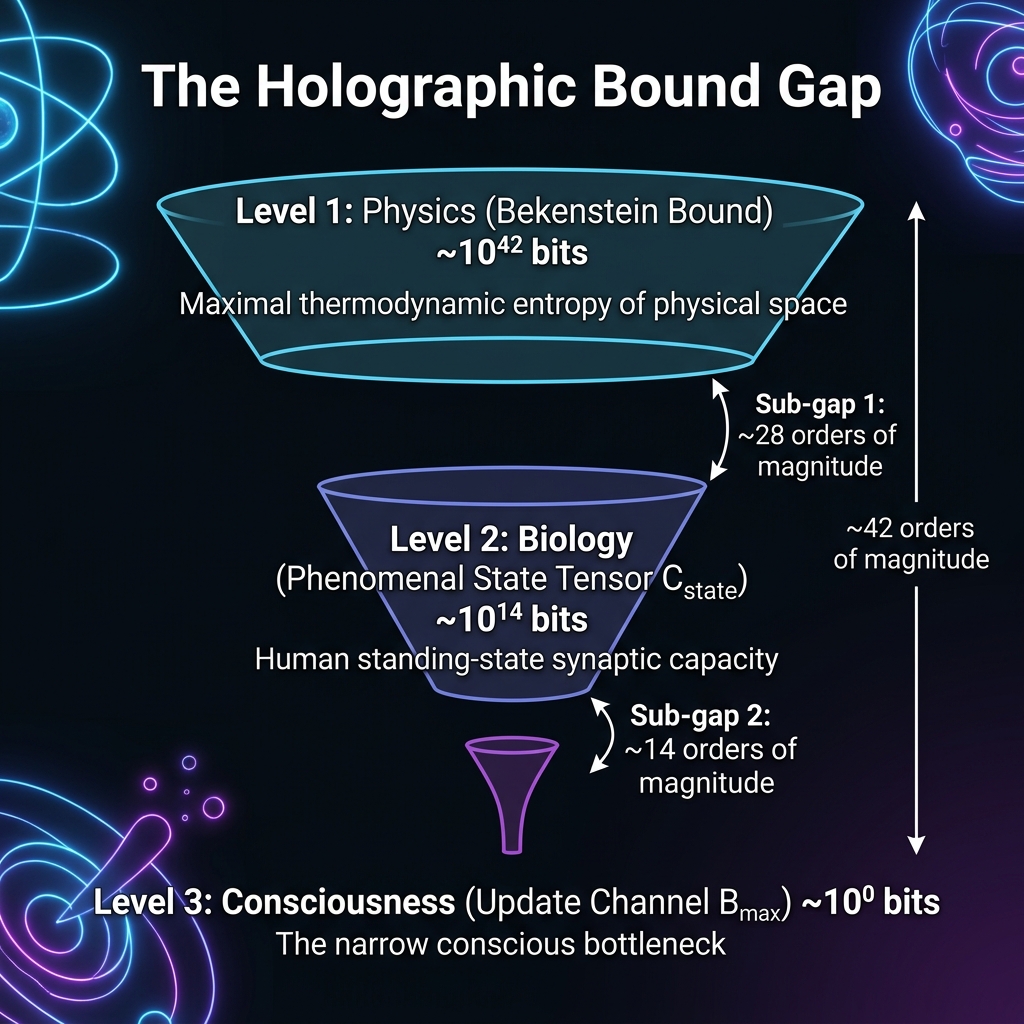
OPT’s defining mathematical boundary is the formal comparison of informational generating costs.
Let U_{\text{obj}} be the full informational state of an objective universe. The Kolmogorov complexity K(U_{\text{obj}}) is astronomically high. Let S_{\text{obs}} be the localized, low-bandwidth stream experienced by an observer (strictly bounded by the \mathcal{O}(10) bits/s threshold). In OPT, the universe U_{\text{obj}} does not exist as a rendered computational object. The apparent “objective universe” is instead the internal Generative Model constructed by Active Inference.
The Bekenstein Bound for a Biologically Realistic Observer
The Bekenstein bound [40] gives the maximum thermodynamic entropy — equivalently, the maximum information content — of any physical system bounded by radius R with total energy E:
S_{\text{Bek}} \leq \frac{2\pi R E}{\hbar c} \tag{T7-1}
For a human brain as the observer’s Markov Blanket boundary \partial_R A:
- Bounding radius: R \approx 0.07\ \text{m}
- Total rest-mass energy: E = m c^2 \approx 1.4\ \text{kg} \times (3 \times 10^8\ \text{m/s})^2 = 1.26 \times 10^{17}\ \text{J}
- Reduced Planck constant: \hbar = 1.055 \times 10^{-34}\ \text{J}\cdot\text{s}
- Speed of light: c = 3 \times 10^8\ \text{m/s}
Substituting:
\begin{aligned} S_{\text{Bek}} &= \frac{2\pi \times 0.07 \times 1.26 \times 10^{17}}{1.055 \times 10^{-34} \times 3 \times 10^8} \\ &= \frac{5.54 \times 10^{16}}{3.17 \times 10^{-26}} \\ &\approx 1.75 \times 10^{42}\ \text{nats} \end{aligned} \tag{T7-2}
Converting to bits (dividing by \ln 2):
S_{\text{Bek}} \approx 2.52 \times 10^{42}\ \text{bits} \tag{T7-3}
The holographic area bound [87], S \leq A / 4l_P^2, yields a larger figure. For a sphere of radius R = 0.07\ \text{m}, surface area A = 4\pi R^2 \approx 0.062\ \text{m}^2, and Planck length l_P = 1.616 \times 10^{-35}\ \text{m}:
\begin{aligned} S_{\text{holo}} &= \frac{0.062}{4 \times (1.616 \times 10^{-35})^2} \\ &= \frac{0.062}{1.044 \times 10^{-69}} \\ &\approx 5.9 \times 10^{67}\ \text{bits} \end{aligned} \tag{T7-4}
We adopt the formulation bounded by (T7-3) tracking explicitly S_{\text{phys}} \approx 2.5 \times 10^{42}\ \text{bits} for the structural framework of this analysis. We explicitly flag structurally that using the total rest-mass energy E=mc^2 inflates this metric to an extreme maximal upper limit; active internal biological thermodynamic interactions utilizing purely internal chemical energy bounds (\sim 10-100\text{J}) drop this Bekenstein limit dramatically closer to \sim 10^{26} bits. The qualitative structural gap mechanism formally demonstrated below holds equivalently utilizing any parameter formulation of these physical upper bounds across all margins, acting formally as a conservative limit holding a fortiori against extreme pure geometric Holographic equivalents mapped previously (T7-4).
The Three-Level Gap
The Phenomenal State Configuration P_\theta(t) introduced in §3.5 identifies a physically meaningful intermediate scale between the physics bound S_{\text{phys}} and the update channel B_{\max}. We now have three distinct quantities at three distinct scales:
Level 1 — Physics: S_{\text{phys}} \approx 2.5 \times 10^{42}\ \text{bits} (Bekenstein bound, Eq. T7-3)
Level 2 — Biology: C_{\text{state}} = K(P_\theta(t)), the Kolmogorov complexity of the active generative model. We estimate the maximum viable heuristic upper bound from the physiological synaptic information limit: human systems carry roughly 1.5 \times 10^{14} synapses utilizing 4–5 bits of encoding precision [48], projecting a raw structural capacity limit between \sim 10^{14}–10^{15} bits. Rather than inserting an unaccounted empirical fraction modeling ‘active state’ subsets unsupported by hard derivations, we rigorously adopt the full conservative maximum physiological standing threshold natively:
C_{\text{state}} \lesssim 10^{14}\ \text{bits} \tag{T7-5}
acknowledging explicitly this marks an extreme upper bounding limit covering the total deployed synaptic framework capacity supporting the codec.
Level 3 — Consciousness: B_{\max} = C_{\max} \cdot \Delta t \approx 10\ \text{bits/s} \times 0.05\ \text{s} = 0.5\ \text{bits} per cognitive moment (Eq. T8-1).
The three-level gap relation holds natively as:
\underbrace{S_{\text{phys}}}_{\approx 10^{42}} \;\gg\; \underbrace{C_{\text{state}}}_{\lesssim 10^{14}} \;\gg\; \underbrace{B_{\max}}_{\approx 10^{0}} \tag{T7-6}
yielding verified structural sub-gaps:
\frac{S_{\text{phys}}}{C_{\text{state}}} \approx \frac{2.5 \times 10^{42}}{10^{14}} = 2.5 \times 10^{28} \quad (\sim 28\ \text{orders of magnitude}) \tag{T7-7}
\frac{C_{\text{state}}}{B_{\max}} \approx \frac{10^{14}}{0.5} = 2 \times 10^{14} \quad (\sim 14\ \text{orders of magnitude}) \tag{T7-8}
\frac{S_{\text{phys}}}{B_{\max}} \approx 5 \times 10^{42} \quad (\sim 42\ \text{orders of magnitude}) \tag{T7-9}
The total gap of ~42 orders confirms and sharpens the informal claim of §3.8 of the base paper.
The Two-Stage Compression Argument
The three-level structure is not merely refined accounting. Each sub-gap is explained by a distinct causal mechanism:
Sub-gap 1 (S_{\text{phys}} \gg C_{\text{state}}, \sim 28 orders of magnitude): Thermodynamic constraints prevent biological systems from approaching the Bekenstein limit. The generative model satisfies K(P_\theta(t)) \leq C_{\text{ceil}} (Eq. T6-2). A rough estimate of C_{\text{ceil}} follows from Landauer’s principle: each irreversible bit operation dissipates at least k_B T \ln 2 joules at temperature T. For a human brain operating at metabolic power P \sim 20 W and body temperature T \sim 310 K, the maximum sustainable per-second erasure budget is the Landauer budget P/(k_B T \ln 2):
C_{\text{ceil}} \sim \frac{P_{\text{metabolic}}}{k_B T \ln 2} \sim \frac{20}{3 \times 10^{-21}} \sim 10^{22}\ \text{bits/s}
This Landauer ceiling lies 20 orders of magnitude below the Bekenstein bound, confirming that the physics limit is irrelevant to biological operating points. Note that the C_{\text{ceil}} \sim 10^{22} estimate lies well above the observed synaptic capacity (\sim 10^{14}–10^{15} bits), suggesting that biological systems operate far below even their own thermodynamic ceiling, likely due to additional constraints (wiring cost, metabolic efficiency, evolutionary history) that OPT does not model.
Sub-gap 2 (C_{\text{state}} \gg B_{\max}, \sim 14 orders of magnitude): The Stability Filter constrains the update channel far below the standing model complexity. The rich generative model P_\theta(t) — encoding up to \sim 10^{14} bits of compressed world-structure — updates by only \sim 0.5 bits per cognitive moment, because the vast majority of the model is already correct: \pi_t matches X_{\partial_R A}(t) well, and only the sparse error \varepsilon_t passes through the bottleneck Z_t. The Maintenance Cycle \mathcal{M}_\tau (§3.6) preserves this sub-gap over deep time by keeping K(P_\theta) well below C_{\text{ceil}}.
Empirical Proposition (Three-Level Holographic Bound Gap). Let \partial_R A be the Markov Blanket of a biologically realised observer, with S_{\text{phys}}, C_{\text{state}}, and B_{\max} parameterised empirically as above. Then:
S_{\text{phys}} \gg C_{\text{state}} \gg B_{\max}
where (i) Sub-gap 1 is maintained by thermodynamic limits that prevent biological systems from approaching Bekenstein-scale information densities, and (ii) Sub-gap 2 is maintained by the Stability Filter’s rate-distortion constraint, which decouples the update channel bandwidth from the standing model complexity. Note: the quantitative gap margins may shift when entanglement entropy contributions are incorporated (pending open problem P-2); the present proposition rests on classical and thermodynamic bounds only, and is classified as an empirical proposition rather than a formally closed theorem.
Phenomenal Richness Lives at Level 2, Not Level 3
A corollary of the three-level structure, carrying directly from §3.5, is that the two phenomenal quantities identified in OPT live at different levels of the hierarchy:
- Phenomenal richness (the felt density of the inner scene, P-consciousness in Block’s sense) corresponds to C_{\text{state}} — Level 2. It is constrained by biology and structural necessity, not by the update channel.
- Phenomenal novelty (the resolved new content of each moment, A-consciousness) corresponds to B_{\max} — Level 3. It is constrained by the Stability Filter’s rate-distortion bound.
The original formulation of §3.8 treated “consciousness” as a single entity bottlenecked at C_{\max}. The three-level theorem corrects this: conscious experience is two-dimensional in the gap structure — rich because C_{\text{state}} \gg B_{\max}, yet bottlenecked because B_{\max} is the update gate. A theory that explains only the bottleneck (as the original formulation did) explains only one dimension of the phenomenon.
Falsification Sharpening
The three-level structure generates a sharper falsification criterion than the original two-level claim:
- The original falsification criterion was: if a system achieves self-reported conscious experience with a pre-conscious/conscious ratio substantially below 10^4{:}1, OPT requires revision.
- The three-level theorem adds: if a system’s phenomenal richness (as operationalised) scales with B_{\max} rather than with C_{\text{state}}, Sub-gap 2 is spurious and the P_\theta / Z_t distinction collapses. Under OPT, qualitative depth is a property of the generative model’s structural complexity, not its update rate. Pharmacological or neuromodulatory interventions that alter K_\theta without altering C_{\max} (e.g., psychedelics, meditation, anaesthesia) constitute direct empirical probes of this sub-gap.
High-resolution details only enter the stream dynamically when active states (a) demand those specific bits to maintain consistency. The thermodynamic and computational cost of the universe is strictly bounded by the observer’s bandwidth.
3.11 Mathematical Saturation and Substrate Recovery
A distinctive structural expectation of OPT concerns the limits of physical unification. The laws of physics are not universal \mathcal{I}-level truths; they are the compressed generative model K_\theta constraining this patch.
Attempting to derive a Grand Unified Theory of the substrate from within the patch is formally bounded by Information Theory. Let \Theta index N candidate substrate-level law extensions, and let Z_{1:T} be the observer’s internal code over time T. Because the observer’s code is rate-limited by C_{\max}, data processing inequalities dictate that mutual information is bounded: I(\Theta; Z_{1:T}) \le T \cdot C_{\max}.
By Fano’s Inequality, the probability of the observer failing to uniquely identify the true substrate-level extension of the laws \Theta from finite data is strictly bounded away from zero (under the bound’s uniform-prior reading over N candidate extensions, with \log_2 N \gg T \cdot C_{\max} — a stated assumption, not a derived condition):
P(\hat{\Theta} \neq \Theta) \ge 1 - \frac{T \cdot C_{\max} + 1}{\log_2 N} \tag{12}
Empirical Expectation (Mathematical Saturation). Efforts to unify the fundamental physics from within the patch face a strict epistemic barrier. Fano’s bound formalizes a limit on finite data identifiability, not the ontological impossibility of a unified substrate existing. A finite-capacity observer cannot uniquely identify arbitrarily fine substrate laws from inside the bottleneck. Any GUT that successfully describes the patch will thus retain irreducible free parameters (the specific stability conditions of that local patch) that cannot be formally derived from within.
3.12 Asymmetric One-Way Holography
A critical ontological tension exists between the exact duality of AdS/CFT [86] (where boundary and bulk are equally fundamental) and OPT’s assertion of substrate priority. Why is the substrate “more fundamental” if they represent the same information?
The symmetry is broken formally by the observer’s bottleneck. Call the Stability Filter \Phi: \mathcal{I} \to R (mapping Substrate to Render). For exact symmetric duality to hold, the map must be invertible, without information loss. However, Fano’s Inequality (Eq. 12) [41] serves as a formal demonstration that the mutual information between the Render and the Substrate is strictly bounded by T \cdot C_{\max}, while the substrate alternatives N are unbounded.
The filter is a lossy compression map: an observer within the render cannot practically reconstruct the substrate. OPT therefore constitutes an Asymmetric One-Way Holography—an irreversible thermodynamic arrow of information destruction pointing from Substrate to Render. Rather than claiming an exact geometric correspondence to AdS/CFT (which requires formally defined boundary and bulk operators that this framework does not possess), OPT provides an explanatory meta-principle for why holographic dualities exist at all: they represent optimal predictive compression schemes under severe observer bandwidth constraints. Phenomenal consciousness (the Agency Axiom) is the native signature of being trapped on the output side of a non-invertible compression algorithm. It is this specific irretrievability that establishes the substrate as prior. The identification of informational irreversibility with ontological priority is grounded in the observation that the render requires an observer to be defined—it is the object that exists as experience—while the substrate is defined independently of any observer’s access to it.
3.13 Scope of Formal Claims
To preserve epistemic discipline, we explicitly bound the scope of the formal apparatus developed in this section. Together, Equations (1)–(12) establish a rigorous, layered scaffold: Equation (1) provides a complexity-weighted prior over computable histories; Equations (2)–(5) dictate rigid capacity-compatible structural bounds governing the predictive patch geometry; Equations (6)–(8) outline the classical bounded area law constraints; Equations (9)–(10) describe inference and minimal thermodynamic cost; Equation (11) outlines the required holographic metric conversion; and Equation (12) bounds the observer’s ability to identify substrate-level laws.
However, these twelve equations do not derive quantum mechanics, general relativity, or the Standard Model from first principles; the full scope-of-claims ledger is at the front of the paper in § What Is Claimed, at What Confidence (after §1.6). In brief: rather than generating physical laws as purely mathematical inevitabilities, OPT defines the rigid geometric constraints (the Causal Cone, the Predictive Cut) to which any phenomenological physics must structurally correspond in order to survive the bottleneck. The specific empirical laws we observe are heuristic compressions (the codec)—the maximally efficient predictive models that happen to successfully navigate our local region of the substrate.
4. Structural Parallels with Field-Theoretic Models
The survey of field-theoretic consciousness models — local biological
fields (McFadden’s cemi [30], Pockett [31]), quantum-geometry fields
(Penrose–Hameroff Orch-OR [32]), and universal/cosmopsychist fields
(Goff [33]) — is relocated to opt-correspondences.md
§2. The OPT-native point is retained here: OPT replaces the
universal-foundational-field posit with Combinatorial
Necessity — apparent inter-observer connectivity is not a
teleological shared field but the combinatorial inevitability that, in
an infinite substrate, every observer-type co-exists.
Information-theoretic quantities (C_{\max}, K,
I) and the pre-registered falsification
criteria (§6.8) stand in for any unmeasurable universal operator. The
panpsychism / cosmopsychism engagement proper is in §7 (and
opt-philosophy.md §IV.9.3).
5. Parsimony Analysis
5.1 Minimum Description Length (MDL) and Conditional Parsimony
In assessing physical theories, a natural notion of parsimony is the two-part code length required to encode the observer’s data stream y_{1:T} under a hypothesis \nu:
L_T(\nu) = K(\nu) - \log \nu(y_{1:T}) \tag{13}
where K(\nu) measures the descriptive complexity of the hypothesis and -\log \nu(y_{1:T}) measures its predictive error on the observed stream.
This supports only a limited parsimony claim. OPT does not show that the detailed laws of our universe have negligible algorithmic complexity, nor that standard physics can be recovered as the unique global MDL optimum. Rather, it shifts part of the explanatory burden from brute law-enumeration to a compact meta-rule: observers are sampled from a complexity-weighted substrate and persist only in streams whose predictive structure fits within a severe bandwidth bound.
On this reading, the \mathcal{O}(1) simplicity claim attaches only to the selector rule—the complexity-weighted prior together with the stability criterion—not to the full empirical content of the Standard Model, general relativity, or cosmology. (Remark: Theorems T-4d and T-4e were proposed to formally establish that the meta-rule yields an unconditional asymptotic advantage and a conditional finite-T advantage over computable benchmarks; see Appendix T-4. v3.6.10 partial-repair status: the two formal errors (sign in T-4b; cancellation in T-4e) are now fixed. T-4d is demoted* from “permanent constant-bit advantage” to “asymptotic dominance bound” — upper bound only, no positive quantitative advantage established. T-4e is cancellation-fixed and weakened — the corrected inequality K(\text{IC}\mid\text{laws}) > K_0 - K_{\text{laws}} + \big[-\log\xi^F(y) - (-\log P_{\text{SP}}(y))\big] (the \xi^F form, with no -\log\xi(\mathcal{O}) term — it cancels) is trivially satisfied modulo the sign-indeterminate deficit, but the structural content is correspondingly much weaker than the earlier “300 > 36” reading suggested. The structural intuition — that OPT shifts explanatory burden from law-enumeration to law-selection — survives; the quantitative MDL ranking (\sim 1714-bit advantage) does not.)* The present structural claim is therefore that OPT shifts the locus of explanatory burden rather than reducing total description length; the quantitative parsimony advantage is not established at v3.6.10. The fully-virtual standing-state reading (§8.6.1) is a qualitative parsimony move of the same kind: it removes the need to posit a separate compression process, again shifting the locus of explanatory burden rather than reducing total description length, and does not revive the withdrawn quantitative advantage.
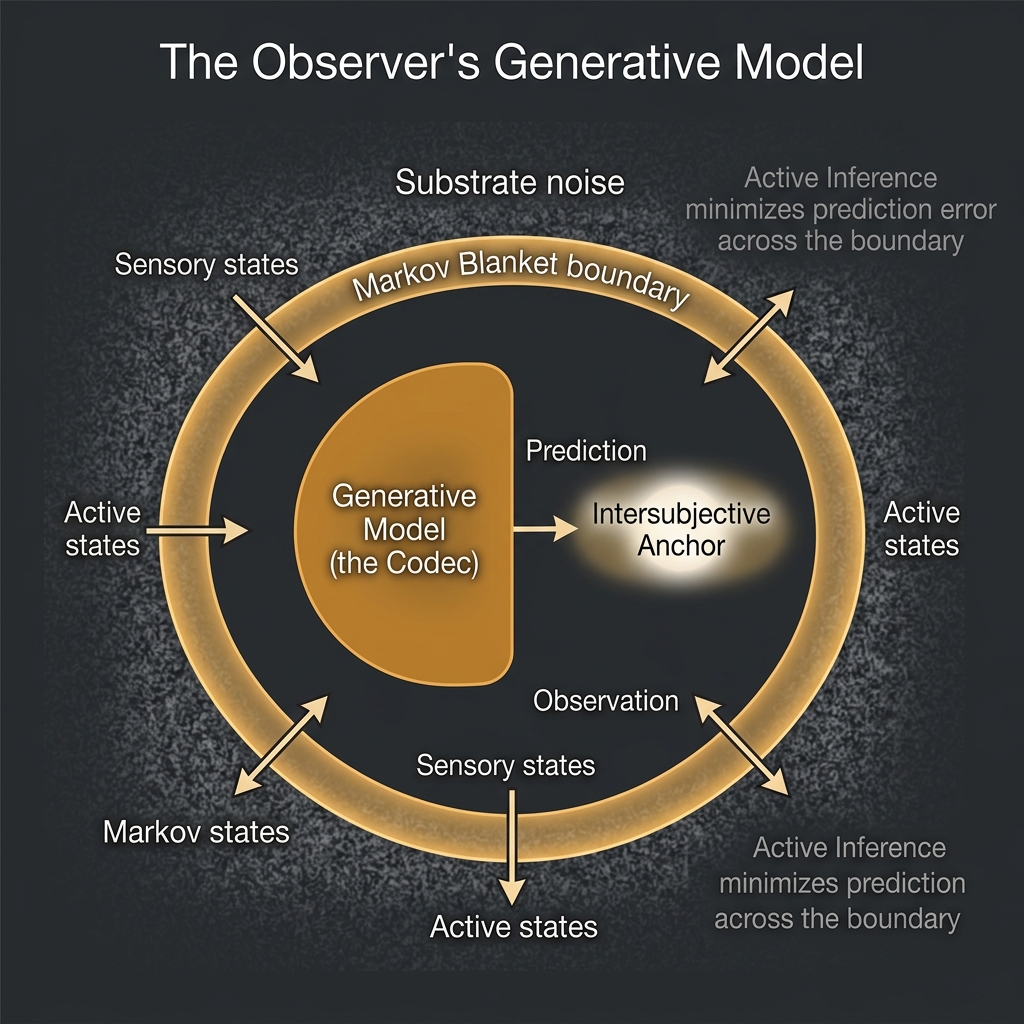
5.2 Laws as Selected Models, Not Fundamental Inputs
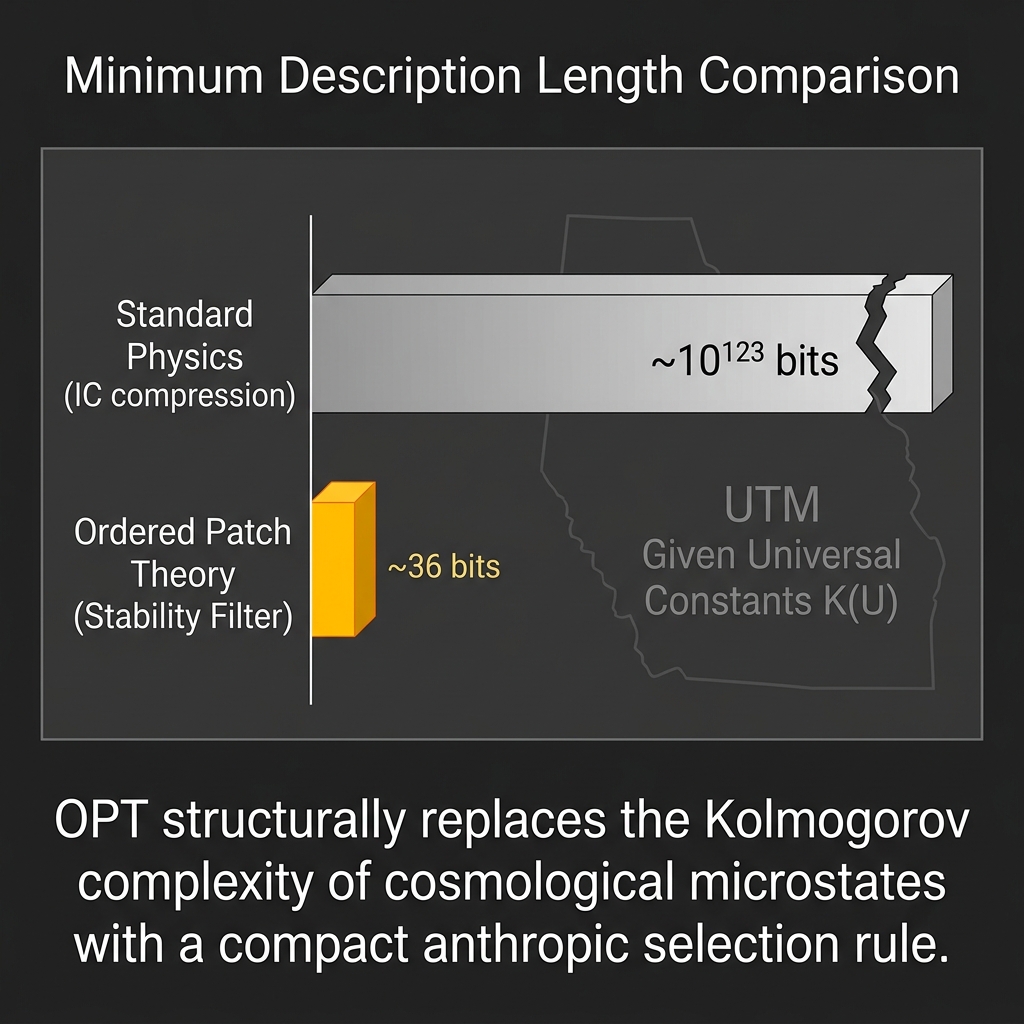
In OPT, the observed laws of physics are interpreted as effective predictive models of an observer-compatible stream rather than substrate-level axioms. This should be read as a heuristic reconstruction, not as a first-principles derivation. The Stability Filter does not prove that quantum mechanics, 3+1-dimensional spacetime, or the Standard Model are the unique minimum-complexity solutions. It motivates the weaker expectation that observer-supporting streams will favor compact, stable, and high-predictive-efficiency regularities. From inside such a stream, those regularities appear as “laws of physics.”
Several familiar features of our physics can then be read as suggestive candidates for such efficient regularities. Quantum theory compactly handles incompatible observables and long-range statistical correlations; 3+1-dimensional spacetime supports stable orbital and chemical structure; and gauge-theoretic symmetries offer economical summaries of robust interaction patterns. These are plausibility arguments, not derivations, and OPT remains open to the possibility that other codecs with different law-sets could also satisfy the Stability Filter.
Accordingly, anthropic fine-tuning is not solved here but reframed. If the constants of our universe lie in a narrow region compatible with stable low-entropy observers, OPT treats that as consistent with selection by the filter. Demonstrating that the observed constants are recoverable from that filter remains future work.
6. Falsification Conditions and Empirical Expectations
Even as a constructive fiction, a formal model must show how it interacts with empirical data. OPT generates two classes of constraint: strict falsification conditions (where empirical reality could directly break the fundamental bandwidth logic) and interpretive structural expectations (where empirical phenomena map onto the theory’s architecture).
Strict falsification conditions (§§6.1, 6.2, 6.4): empirical outcomes that would directly invalidate the bandwidth logic. Empirical expectations (§§6.3, 6.5, 6.6): structural correspondences where OPT’s architecture maps onto observable phenomena but does not uniquely predict them. §6.8 consolidates these into pre-registered Falsification Commitments F1–F5 with explicit Shutdown Criteria — the methodological wall between OPT’s empirical core and its avowedly metaphysical components (\Delta_{\text{self}}, the Agency Axiom, substrate priority).
6.1 The Bandwidth Hierarchy
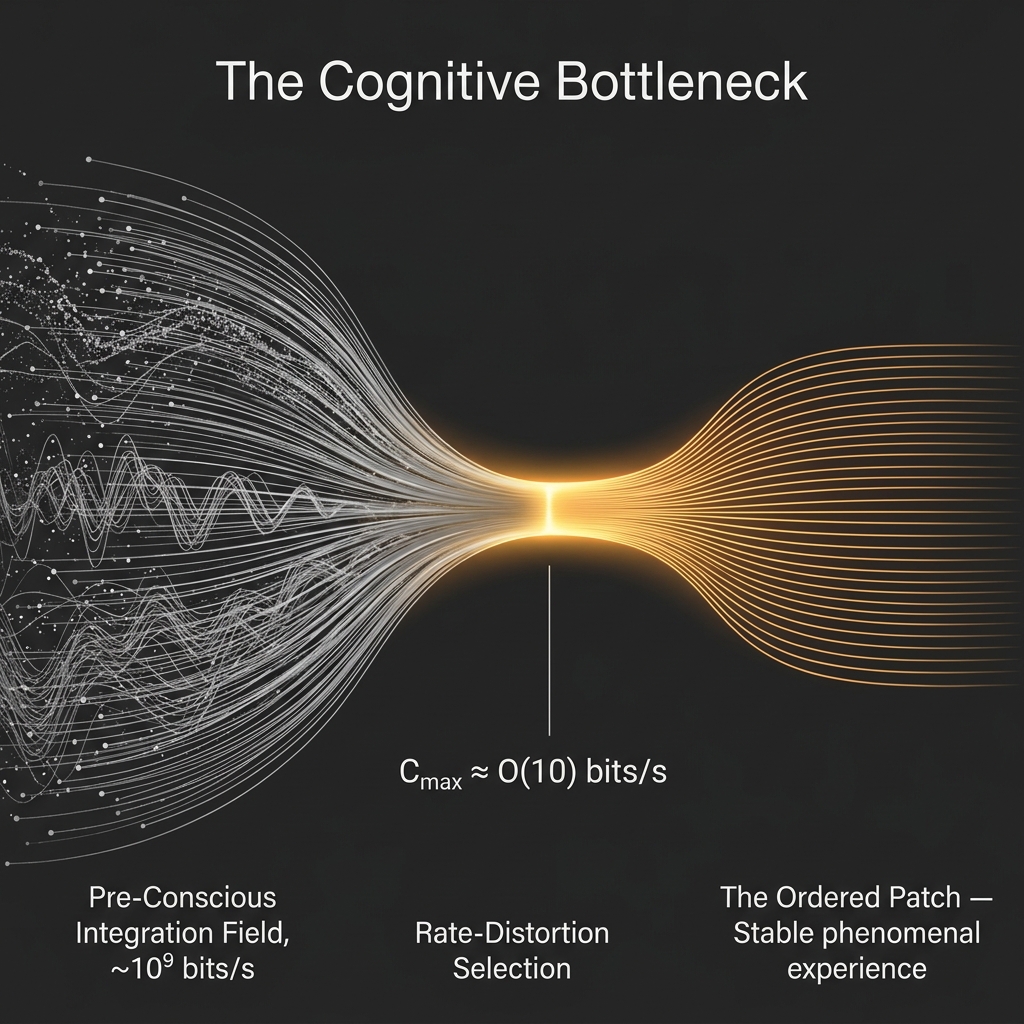
OPT predicts that the ratio of pre-conscious sensory processing rate to conscious access bandwidth must be very large — at least 10^4:1 — in any system capable of self-referential experience. This is because the compression required to reduce a causal, multi-modal sensory stream to a coherent conscious narrative of \sim 10^1-10^2 bits/s requires massive pre-conscious processing. If future neuroprosthetics or artificial systems achieve self-reported conscious experience with a much lower pre-conscious/conscious ratio, OPT would require revision.
Current support: The observed ratio in humans is approximately 10^6:1 (sensory periphery \sim 10^7 bit/s; conscious access \sim 10^1-10^2 bit/s [2,3]), consistent with this prediction. (Note: See Appendix E-1 for the full formal derivation of h^*, the experiential quantum, which defines the per-frame capacity ceiling of a human subjective frame based on these empirical psychophysical limits).
6.2 The High-Bandwidth Dissolution Paradox (The Sharp Falsification)
Many predictions of OPT are compatibility claims—they align with existing cognitive science (such as the bandwidth gap) or physical limits (such as quantum superposition acting as a resolution floor). These are necessary for the theory’s coherence but do not uniquely discriminate OPT from other frameworks.
OPT makes one sharp, highly specific prediction that directly contradicts competing theories of consciousness, serving as its primary falsification condition.
Integrated Information Theory (IIT) implies that expanding the brain’s integration capacity (\Phi) via high-bandwidth sensory or neural prosthetics should expand or heighten consciousness. OPT predicts the exact opposite. Because consciousness is the result of severe data compression, the Stability Filter limits the observer’s codec to processing on the order of tens of bits per second (the global workspace bottleneck).
Testable implication: If pre-conscious perceptual filters are bypassed to inject raw, uncompressed, high-bandwidth data directly into the global workspace, it will not result in expanded awareness. Instead, because the observer’s codec cannot stably predict that volume of data, the narrative render will abruptly collapse. Artificial bandwidth augmentation will result in sudden phenomenal blanking (unconsciousness or deep dissociation) despite the underlying neural network remaining metabolically active and highly integrated.
(Clarification on Narrative Decay vs. Sensory Intensity): To a human observer, an intense sensory environment (e.g., a flashing strobe light at a loud concert) intuitively feels “high-bandwidth,” yet it does not cause phenomenal collapse. Why? Because while the raw physical data rate (\mathcal{I}) is massive, the predictive complexity (R_{\mathrm{req}}) required to encode it is exceptionally low. Human evolutionary codecs (K_\theta) possess dense, optimized priors for macroscopic motion, acoustic rhythm, and spatial boundaries. They trivially compress the chaotic concert into a perfectly stable, low-entropy narrative (“I am dancing in a room”). True Narrative Decay only occurs when data is mathematically incompressible by the standing priors—such as mechanical concussion altering the substrate, general anesthesia aggressively lowering B_{\max}, or psychedelic states shattering the K_\theta hierarchy. A disco is merely loud; true algorithmic noise is phenomenologically lethal.
6.3 Compression Efficiency and Conscious Depth
The depth and quality of conscious experience should correlate with the compression efficiency of the observer’s codec K_\theta — the information-theoretic ratio of the complexity of the sustained narrative to the bandwidth expended. A more efficient codec sustains a richer conscious experience from the same bandwidth.
Testable implication: Practices that improve codec efficiency — specifically, those that reduce the resource cost of maintaining a coherent predictive model of the environment — should measurably enrich subjective experience as reported. Meditation traditions report exactly this effect; OPT provides a formal prediction of why (codec optimization, not neural augmentation per se).
Frame note (§6.8). Compression efficiency and bandwidth expended here are host-frame quantities, measured where the codec is implemented (the runtime/implementation frame); the fully-virtual reading of §8.6.1 re-characterises the standing model but does not redefine this measurement.
6.4 The High-Phi / High-Entropy Null State (vs. IIT)
IIT explicitly predicts that any physical system with high integrated information (\Phi) is conscious. Thus, a densely connected, recurrent neuromorphic lattice possesses consciousness simply by virtue of its integration. OPT predicts that integration (\Phi) is necessary but wholly insufficient. Consciousness only arises if the data stream can be compressed into a stable predictive rule-set (the Stability Filter).
Testable implication: If a high-\Phi recurrent network is driven by a continuous stream of incompressible thermodynamic noise (maximum entropy rate), it cannot form a stable compression codec. OPT strictly predicts that this high-\Phi system processing maximum-entropy noise instantiates zero phenomenality—it dissolves back into the infinite substrate. IIT, conversely, predicts it experiences a highly complex conscious state matching the high \Phi value.
6.5 The Phenomenal Lag: Codec Depth and Subjective Delay
A highly complex standing model (one with a massive structural dimension C_{\text{state}}) requires sophisticated latent error-correction (D_{\text{KL}} updating) to map a high-entropy sensory shock—such as a sudden acoustic noise—into its deep predictive hierarchy. Because this formal update is throttled through the strictly narrow bandwidth capacity of the Stability Filter (C_{\max}), an extensive structural update requires multiple physical compute cycles to resolve before the new, coherent phenomenological “render” can be stabilized (P_\theta(t+1)).
Testable implication (The Libet Correlate) [49, 50]: Subjective conscious experience will inherently lag behind physical reflex processing, and this lag will scale proportionally with the systemic depth of the codec. Simple networks (e.g., animals or young infants) possess shallow predictive schemas (low C_{\text{state}}) and will process high-entropy shocks with minimal latency, resulting in near-instantaneous reflex integration. Conversely, mature humans, deploying massive hierarchical models, will exhibit a measurable Phenomenal Lag, where the subjective experience of the event is temporally delayed while the Codec sequentially computes the massive informational update. The richer the standing schema, the longer the necessary mathematical delay before the Forward Render yields a conscious percept.
Frame note (§6.8). The physical compute cycles and sequential update invoked here are host-frame runtime; C_{\text{state}} enters as the host-frame depth that sets the lag. The virtual reading of §8.6.1 does not redefine this measurement.
Empirical grounding for the prediction asymmetry. The downward-prediction / upward-error decomposition (§3.5.2) is consistent with Nunez & Srinivasan’s [101] characterisation of large-scale cortical dynamics as a superposition of slow standing-wave modes (the brain’s standing predictive scaffold) and faster traveling waves (sensory error propagation). On this mapping, the standing modes correspond to K_\theta’s structural model that supplies \pi_t, while traveling waves carry the prediction error \varepsilon_t being propagated upward through the hierarchy. The asymmetry of update rates that OPT requires (slow downward predictions, fast upward errors) thus has a direct macroscopic electrophysiological signature, independent of the rate-distortion derivation.
6.6 Fine-Tuning Constraints as Stability Conditions
OPT expects that the anthropic fine-tuning constraints on fundamental constants are stability conditions for low-entropy conscious streams, not independent facts. Let \rho_\Phi denote the energy density of the conscious render field and \rho^* the critical threshold above which causal coherence cannot be maintained against substrate noise. The constraints documented by Barrow & Tipler [4] and Rees [5] should structurally correspond to the requirement that the codec support the stability condition \rho_\Phi < \rho^*. (Remark: Appendix T-5 maps heuristic codec-stability bounds on \Lambda, G, and \alpha (quantitative bounds withdrawn or retagged heuristic at v3.6.11); the qualitative posture that codec stability constrains the constants survives. Moreover, due to the formal limit of Fano’s Topology on bounded observation, OPT expects the exact, pure-math dimensionless recovery of specific “42” constants like \alpha=1/137.036 to remain formally impossible from inside the codec). A systematic failure of this correspondence — a constant whose fine-tuned value bears no structural relation to codec stability requirements — would constitute evidence against OPT’s parsimony claim.
Hypothesis (v3.6.0) — Soft targeting across scales. The substrate-level Stability Filter (§3.1) selects observer-compatible streams via conditioning on the event O_{B,D,T}; within an already-selected stream, the same observer-compatibility constraint propagates as a within-stream attractor on continuous selection at every nested scale at which a coherent generative model can be sustained — cosmological, planetary, phylogenetic, civilisational, and individual within-life. The “stability conditions” framing of fine-tuning above is one face of this attractor at the cosmological scale; the corresponding cosmological-scale concrete signatures are the rapid threshold crossings already familiar from cosmology and astrobiology (cosmic inflation as a smoothing/flattening crossing in the earliest universe; the ~200–400 Myr abiogenesis window on Earth as a chemistry-to-biology crossing; structure-formation genericity across intermediate cosmic timescales). The corresponding biological framing is the brain-first cascade and the codec-refinement reading of phylogenetic deep history (§3.6.9 / Appendix T-15). Cosmology is not a passive backdrop with biological evolution layered on top: cosmological selection (substrate-level Filter + cosmological within-stream attractor) and Darwinian biological evolution (phylogenetic within-stream attractor) are two species of the same genus — observer-compatibility filtering under MDL parsimony — rather than one species of the other. The mechanism: within a Stability-Filter-compatible stream, the codec’s most-parsimonious past compresses better when rule-set phase changes are rendered sharp than when they are rendered as long sequences of half-broken intermediate rule-sets (the inequality is K(\text{rule}_1) + K(\text{rule}_2) + K(t_c) + K(\text{switch}) < K(\text{continuous dynamics}) + K(\text{parameters}) + \sum_i K(\text{rule}_{1\to 2,i}), conditional on the structural difference of the two rule-sets, not generic). The soft attractor is toward the equivalence class of stable observer-sustaining configurations — not toward any preferred endpoint or designed trajectory; the mechanism is description-length inequality, not agency (see §8.13 Copernican Reversal for the bounding humility constraint). The reading is retrospective: it explains the rendered past, not the forward fan; forward-looking transitions (silicon-emergence being the canonical present-day case) are governance questions rather than soft-target signatures (see Appendix E-6 / §8.14 for the synthetic-observer engagement).
Tier (v3.6.0): empirical hypothesis with structural-correspondence backing, not closed derivation. Cosmological-scale signatures (inflation, abiogenesis-timing, structure-formation genericity) enter as expectations to monitor rather than F-numbered commitments per §6.3-style conservatism; biological-scale signatures enter via §3.6.9 / §6.8.1 / Appendix T-15. The framework’s stake in the empirical outcome is directional: late-time / observer-side resolutions of cosmological tensions (Hubble tension (developed at §7.1), S_8 tension, lithium problem) are preferred over early-universe physics modifications; if a future BSM theory resolves the hierarchy/naturalness problem elegantly without observer-selection considerations, the saturation reading at the microscopic frontier weakens.
6.7 Artificial Intelligence and the Architectural Bottleneck
The architectural-bottleneck argument — why scale, parameter count, recurrence, and \Phi alone do not instantiate a subject without a forced low-bandwidth serial bottleneck (C_{\max} \sim \mathcal{O}(10) bits/s), and the contrast with GWT and IIT — is consolidated into §8.14 (Artificial Minds: Teeth on Exclusion, Silent on Inclusion), OPT’s single home for artificial intelligence. The temporal-dilation expectation it raises — a structurally bottlenecked silicon observer running \sim\!10^6\times faster would experience proportional subjective dilation, since time is the codec sequence (§8.5) — is registered among the falsification commitments in §6.8.
6.8 Falsification Commitments and Shutdown Criteria
The preceding subsections describe predictions; this subsection commits to specific tests, numerical thresholds, and outcomes that would defeat the framework. The intent is twofold: (i) wall the empirical core of OPT off from the unfalsifiable structural locus (\Delta_{\text{self}}, the Hard Problem) so post-hoc reframing of disconfirming results is not available, and (ii) commit the framework to thresholds for partial retreat and project shutdown, established before the relevant tests are run. Without this discipline, the structural correspondences accumulated in §7 risk the same methodological trap that has dogged research programmes accumulating analogies faster than tests.
Falsification commitments (F1–F5; F6 separate). F1–F5 are the empirical (psychophysical / architectural) commitments. F6 (the Unification Asymptote, in the table below) is a different kind — a long-range theoretical-trajectory shutdown condition, not a psychophysical or architectural measurement — and is grouped here for convenience only; the host-frame firewall and the “empirical core” language below refer to F1–F5. Each commitment names a quantitative prediction, the measurement that would test it, and the outcome that counts as falsification. These are not post-hoc adjustable; subsequent edits require explicit Version History entries flagging them as either clarification (no scope change) or re-registration (full scope change, requiring fresh commitment before any new tests).
| # | Prediction | Pre-registered measurement | Falsification threshold |
|---|---|---|---|
| F1 | Human subjective predictive bandwidth C_{\max} \approx \mathcal{O}(10) bits/s (§6.1, §3.10). The structural OPT requirement is the existence of a C_{\max}; F1 commits to the empirical biological value. Synthetic-observer bandwidth is architecturally derived (see §8.14) and is not bound by F1. | Information-theoretic measurement of conscious-access channel capacity in well-controlled human psychophysical paradigms (attentional blink, masking, dual-task interference) | Convergent measurements yielding C_{\max} > 10^3 bits/s or < 10^{-1} bits/s under valid experimental conditions |
| F2 | High-\Phi / High-Entropy Null State (§6.4) | A system constructed with \Phi above an agreed threshold operating on demonstrably incompressible noise input, with a phenomenality protocol agreed before construction | Any credible third-party-reproduced signature of phenomenality emerging from such a system |
| F3 | Linear host-relative temporal scaling with completed patch-frame rate (§6.7, Appendix E-5; wording re-expressed per E-5 §13 — clarification, no scope or threshold change) | A bottlenecked synthetic agent with host-patch clock coupling \lambda_H = dn/d\tau_H varied across k \in [10, 10^4] while B_{\max}, environment-patch coupling \mu, and per-frame demand are held fixed; duration read from behavioural and internal frame-count indicators, with self-report de-prioritised per E-5 §8 | Absence of approximately linear k\times host-relative scaling — i.e., frame-count independence of internal temporal metrics — in an eligible architecture under controlled-bottleneck, hidden-clock conditions |
| F4 | Phenomenal lag scales with codec depth (§6.5) | Subjective-delay measurements correlated with task-induced codec hierarchy depth, controlling for sensory and motor latency | No monotonic correlation, or correlation of opposite sign, in clean experiments |
| F5 | Compression efficiency tracks conscious depth (§6.3) | Cross-task measurement of compression ratios in active-inference systems alongside phenomenological-richness reports | Absence of monotonic relationship between compression efficiency and phenomenal complexity |
| F6 | The Unification Asymptote (Mathematical Saturation, §8.11) | The discovery of a parameter-free, fully deterministic unification of General Relativity and Quantum Mechanics from first principles. | A peer-reviewed, empirically verified Grand Unified Theory with zero free parameters. |
Each row commits to a specific number or sign, a specific measurement, and a clear failure condition. Re-fitting any of these in response to disconfirming results is post-hoc reframing and disqualifies the test.
Shutdown criteria. Two thresholds, hierarchically ordered:
Major retreat — public revision and removal of the falsified claim. Any single F1–F5 confirmed against OPT, or the central rate-distortion claim contradicted by >1 order of magnitude under valid measurement. The framework continues with the falsified subsection retracted; the Version History documents what was removed and why.
Project shutdown — termination of active development. Triggered by any of the following: (a) two or more F-criteria confirmed against OPT; (b) F1 confirmed by >2 orders of magnitude in either direction; (c) independent demonstration that the bandwidth bottleneck in conscious access is anatomically/architecturally incidental rather than structurally necessary (i.e., that bandwidth-unbounded conscious systems exist); (d) the Unification Asymptote (F6) is achieved, proving the codec has no absolute descriptive limit. Triggers a final paper, “OPT: Post-Mortem”, documenting what was tried, what was wrong, and what residue is recoverable. Active development of opt-theory.md, opt-philosophy.md, and the opt-ai-subject governance suite ends.
These thresholds are pre-registered as of Version 3.3.0 (April 30, 2026). The shutdown criteria are not downgradable in response to disconfirming evidence — the only legitimate response to a near-falsification is acceptance of the verdict. Edits weakening any of F1–F5 or the shutdown thresholds must be flagged as re-registration in the Version History, voiding any test that pre-dated the change.
What is explicitly excluded from the falsifiable core. Not every claim in OPT is falsifiable, and pretending otherwise would itself be intellectually dishonest. The following are not part of F1–F5 and are not subject to the shutdown criteria:
- The Phenomenal Residual (\Delta_{\text{self}} > 0, Conjecture P-4). Unfalsifiable by design; it formalises the Hard Problem rather than solving it. Any putative “evidence against \Delta_{\text{self}}” would itself have to be fully self-modelable, which contradicts the premise being tested.
- The Agency Axiom (§3.8). A metaphysical posit about the interiority of aperture-traversal. Not entailed by the formal apparatus; offered as such.
- Substrate priority (§3.12, §1). An ontological commitment that cannot be empirically discriminated from a render-only ontology by any experiment internal to the render. Acknowledged in §3.12 as a non-empirical claim.
- The structural correspondences in §7 / opt-philosophy §IV. These are interpretive overlays, not predictions. They are subject to scholarly criticism (Are the analogies real? Are they trivial?) but not to F1–F5 falsification.
- The fully-virtual standing-state reading (§8.6.1). A render-ontology characterisation, not a prediction. F1–F5 — in particular F4 (phenomenal lag vs. codec depth) and F5 (compression efficiency vs. conscious depth) — are measured in the host/operational frame: the runtime/implementation frame in which the system is physically (for synthetic observers, architecturally) realized, which is neutral on the §3.5.3 materialized-vs-dispositional probe. The virtual reading does not redefine those measurements, nor the magnitude C_{\text{state}} they quantify over. Reading F1–F5 in the virtual frame to drain them of empirical content is itself the post-hoc reframing this wall forbids.
The wall between the falsifiable empirical core and the avowedly metaphysical components is itself a methodological commitment. Collapsing it — for instance, attempting to absorb a falsification of F1–F5 into \Delta_{\text{self}} or substrate priority — constitutes post-hoc reframing and disqualifies the framework’s testability claims regardless of the surface argument used.
6.8.1 Candidate biological research programme (v3.6.0)
The v3.6.0 multi-scale codec extension (§3.6.9 / §6.6 hypothesis / Appendix T-15) proposes structural predictions about the fossil record and comparative neuroanatomy. These predictions are not promoted to F-shutdown status at v3.6.0 release: the standalone fossil-record claims overlap heavily with mainstream brain-first evolutionary biology (Chipman 2026 [109]) and do not yet discriminate OPT from non-OPT readings. The OPT-specific signal is the joint multi-scale rapidity signature (§6.6) — the brain-first cascade is one of several rule-set phase changes (alongside inflation, abiogenesis, the Great Oxygenation Event, eukaryogenesis, civilisational threshold-crossings) whose joint observation is the predicted MDL-parsimony footprint. A single biological data point cannot falsify OPT alone; the joint pattern across scales is what carries the falsification load.
This subsection therefore registers the biological research programme as a candidate with its prediction structure intact and the path to eventual F-promotion explicitly named.
Four prediction classes.
Convergent predictive architectures across distant lineages. OPT predicts strong, repeated independent evolution of predictive-control architectures across deep evolutionary distance: centralised nervous systems with regionalised brains, sensory integration, efference copies, forward/inverse models, plastic body schemas. Observable in comparative neuroanatomy across arthropods, cephalopod molluscs, vertebrates: independently evolved brains should converge on hierarchical predictive architectures, not on superficial morphology. Falsifying observation: sustained finding that successful Cambrian lineages exhibit low neural complexity, with morphological diversity unaccompanied by predictive-architecture sophistication.
Neural-fossil sophistication ahead of body-plan complexity (Lagerstätten-constrained). The brain-first cascade predicts that, where neural anatomy is preserved, it will appear earlier and more sophisticated than the body plans of the same lineage would suggest. Currently supported by the Chengjiang biota neural fossils (Ma et al. 2012 [6]) showing remarkably modern arthropod brain organisation in early Cambrian forms. Falsifying observation (Lagerstätten-constrained): systematic finding specifically in exceptional soft-tissue preservation sites where neural tissue is actually preserved (Burgess Shale, Chengjiang biota, Sirius Passet, Maotianshan Shales, and analogous deposits) that neural preservation shows consistently simpler brain organisation than the body plans of the same lineages require. The Lagerstätten constraint is structurally important: standard geological decay destroys soft tissue, so a general absence of neural fossils across the bulk of the fossil record reflects taphonomic bias, not absence of neurology. The framework is falsified only by negative findings in sites where positive findings would be possible.
Plasticity and evolvability signatures (expectation only). Successful lineages should exhibit developmental plasticity, modularity (Hox toolkit reuse, enhancer co-option), and high “evolvability” — the structural capacity to generate viable variation around a stable neural core. Why expectation, not falsifier: the inference from “successful lineage” to “plasticity” is partly anthropic — we observe lineages that are still observable, which is selection on persistence.
Energy-redundancy trade-offs (expectation only). Codecs require thermodynamic grounding (§3.6 Landauer / Bennett costs). OPT predicts that successful Cambrian and post-Cambrian lineages will show metabolic investment in redundant sensory and neural systems rather than minimal-viable designs — the bandwidth-margin necessary to absorb substrate noise without lineage-level Narrative Decay (§3.6.9). Why expectation, not falsifier: the prediction is structurally weaker; minimal designs may simply have been outcompeted for non-OPT reasons.
Gate to F-promotion (v3.6.0 explicit). Promotion of (1) and (2) to an F7 shutdown commitment requires three operationalisation steps, all currently incomplete:
- Effect sizes. How much brain-fossil sophistication ahead of body-plan complexity counts as confirmation? What magnitude of mismatch counts as falsification? Quantitative thresholds need to be agreed before promotion.
- Null models. Explicit null models distinguishing the OPT prediction from the mainstream brain-first evo-bio prediction. The predictions overlap but are not identical — OPT predicts brain-first crossings should be sharp on geological timescales and structurally aligned with the multi-scale rapidity pattern of §6.6, not just present as a directional bias.
- Discrimination protocol. A clear discrimination protocol between “supports brain-first evolutionary biology generically” and “supports OPT’s joint multi-scale prediction specifically.”
None of these are in place at v3.6.0. F7 therefore enters core-paper integration as a candidate research programme, not a pre-registered shutdown criterion. The subsection is preserved in §6.8 (the falsifiable-core section) rather than relegated to §8 / §9 expectations because the discrimination work is plausibly tractable on a 5–10-year horizon and the framework’s posture is that the work is worth doing; what is withdrawn is only the premature F-status promotion.
Cross-references. Structural correspondence: §3.6.9. Formal articulation: Appendix T-15 (The Phylogenetic Stability Filter). Multi-scale joint signature: §6.6 v3.6.0 hypothesis. Codec-horizon framing (biological extension): §8.5 v3.6.0 proposed extension.
6.9 Theories OPT is Genuinely Incompatible With
OPT’s comparative analysis (§7, with the detailed comparisons relocated to the companion documents) is largely convergent — and a framework that agrees with everyone has, in effect, said little. This subsection inverts the orientation. It lists positions OPT cannot accommodate, names the strongest version of each, and states what evidence would settle in their favour rather than OPT’s. It is paired with the pre-registered Falsification Commitments of §6.8 — together they are what convert the structural correspondences into a research programme. The point is not to dismiss these positions but to be explicit about what OPT would have to give up if they are correct, and to make those concessions visible before any decisive evidence arrives.
Strict reductive physicalism — the bottleneck as architectural accident. The strongest version: conscious access exhibits a serial bottleneck in primates because of evolved cortical architecture, not because of any structural informational necessity. Beings with sufficiently different architectures — highly parallel, modular, non-bottlenecked — could be equally conscious. What would settle in their favour: a clear empirical demonstration of phenomenality in a system with no global serial channel and no rate-distortion bottleneck. What OPT loses: the Stability Filter ceases to be a necessary condition, F1 collapses, and the entire §6 falsification programme dissolves. This is closely tied to the F1 commitment in §6.8.
Eliminativism about consciousness (Frankish, Dennett 2017). The strongest version: there is no phenomenal residual; the explanatory targets OPT claims to locate (qualia, \Delta_{\text{self}}, the irreducible interiority of aperture-traversal) are post-hoc rationalisations of complex behaviour, not real features requiring explanation. What would settle in their favour: a complete behavioural and neurocomputational account of all consciousness-talk that requires no phenomenal posit. What OPT loses: the Agency Axiom and \Delta_{\text{self}} would have nothing to anchor; OPT would be solving a problem that does not exist.
Strong emergentism / property dualism (Chalmers, in some moods). The strongest version: phenomenal consciousness is a fundamentally extra ingredient, not derivable from informational structure. What would settle in their favour: a principled demonstration that any informational duplicate of a conscious observer (formal functional duplicate) can fail to be conscious — a serious p-zombie possibility argument that withstands functionalist response. What OPT loses: the structural-correspondence stance is too weak; structure alone is not enough, and consciousness must be added rather than located.
Anti-computationalist cognitive science (Searle, biological naturalism). The strongest version: cognition is realised by specific biological causal powers, not by abstract computation or information flow. What would settle in their favour: empirical demonstration that the relevant cognitive properties cannot be substrate-shifted — that a structurally identical silicon implementation would not have cognition. What OPT loses: the codec framing assumes substrate-neutrality; if cognition requires biology, observer-compatibility cannot be a purely informational property and §8.14 fails entirely.
Strict empiricism rejecting substrate-priority arguments. The strongest version: any claim that one ontological level is “more fundamental” than another is meaningless unless it makes operational difference within the render. The asymmetric one-way holography (§3.12) is a philosophical preference, not a discovery. What would settle in their favour: sustained philosophy-of-science arguments that ontological-priority claims indexed to “irretrievability” are operationally content-free. What OPT loses: its key ontological claim collapses; the framework has to be restated as a purely epistemic theory of observer-compatibility, with consequent loss of the resolutions to Boltzmann Brains (§8.7), Fermi (§8.8), and the simulation hypothesis (§7, companion).
Anti-Solomonoff foundations — the universality objection. The strongest version: any framework grounded in a universal mixture is methodologically vacuous, because Solomonoff \xi can accommodate any computable structure as a posterior. The “predictions” of OPT are landscape-trapped: anything possible is somewhere in \xi, and naming it does not constrain. What would settle in their favour: a principled demonstration that the Solomonoff substrate cannot generate constraints sharp enough to rule things out — that for any putative falsifier, the substrate retreats. What OPT loses: the substrate would have to be replaced with something more constrained, the structural-correspondence argument loses its anchor, and the framework would have to choose between vacuity and a different mathematical foundation. This is the deep version of the string-theory worry, and currently OPT’s only defence against it is the F1–F5 commitments in §6.8.
For each of these, OPT’s response is currently structural rather than empirical. That is appropriate while no decisive test is in hand, but it leaves the framework open to the criticism that its rebuttals are post-hoc selections from a permissive substrate. The pre-registration commitments in §6.8 are the only mechanism that converts these structural rebuttals into testable claims; without them, this subsection would itself be decoration.
7. Positioning
OPT’s relation to neighbouring frameworks is largely convergent;
detailed comparisons are relocated to companions to keep the core lean.
Physics, cosmology, and algorithmic-ontology correspondences live in opt-correspondences.md;
the consciousness-theory and metaphysical neighbours in opt-philosophy.md §IV.9. The
map below is positioning only — the one in-text contrast that
earns its place in the spine, the High-Phi/High-Entropy null
distinguishing OPT from IIT, lives in §6.4 as a
falsification commitment, not here.
| Framework | OPT’s relation | Detail |
|---|---|---|
| FEP / Predictive Processing | OPT selects observer-compatible streams from the substrate; FEP/PP is the within-stream inference and control formalism (§3.3-§3.5). | opt-philosophy.md
§IV.9.1 |
| IIT | \Phi is necessary but wholly insufficient; the empirical discriminator is the High-Phi/High-Entropy null (§6.4, a falsification commitment) and the escape from the Unfolding Argument is Appendix T-14 (implementation non-invariance under functional equivalence; conditional on Conjecture P-4). | opt-philosophy.md
§IV.9.2 |
| GWT | The serial broadcast bottleneck sits at the same \sim\mathcal{O}(10) bits/s scale as C_{\max}; OPT commits to it as a parsimony posit (§3.2) and adds \Delta_{\text{self}} > 0 within the bottleneck. | opt-philosophy.md
§IV.9.4 |
| HOT / AST | The self-model \hat{K}_\theta is the higher-order representation; \Delta_{\text{self}} > 0 (Conjecture P-4) is a formal correlate of AST’s “the schema cannot represent its own implementation,” with non-veridical introspection following from capacity bounds, not contingent design. | opt-philosophy.md
§IV.9.5 |
| Panpsychism / Cosmopsychism | Shares the primitivity of experience but sidesteps the combination problem by taking the patch, not the micro-constituent, as primitive. | opt-philosophy.md
§IV.9.3 |
| MUH | A refinement: the Solomonoff substrate is compatible with “all structures exist,” but OPT supplies the explicit selection mechanism (the Stability Filter) MUH leaves implicit. | opt-correspondences.md
§3 |
| Simulation hypothesis | Shares the rendered-reality premise but dissolves the regress: base reality is algorithmic information and the “computer” is the observer’s own thermodynamic bandwidth, needing no external hardware. | opt-correspondences.md
§4 |
Recent algorithmic ontologies (Müller/Sienicki, Khan/Grinbaum,
Deutsch & Marletto, Ladyman & Ross) and the quantum,
entropic-gravity, black-hole, and dark-sector correspondences are
surveyed in opt-correspondences.md
§§3-7. The positions OPT is genuinely incompatible with are paired with
the Falsification Commitments at §6.9. The structural
AI criterion that earlier sat at §7.8 is developed in
§8.14 (Artificial Minds) and the opt-ai-*
documents. One in-text hypothesis is developed below at
§7.1 (the Hubble tension as bandwidth-bounded
cosmological selection), research-programme tier with its own retirement
criteria.
Load-bearing residue retained in core (quantum
correspondence). Two items are kept here rather than relocated.
(i) Codec geometry across the full rendered timeline — a
pre-registered codec-geometry commitment (v3.4.0), candidate for §6.8
promotion, not among F1–F6 (and resting on §8.5’s
proposed-extension-tier reading). The codec’s Hilbert structure
(Appendix P-2) operates uniformly forward and backward in rendered time,
so quantum signatures in the deep cosmological past — including the
inflationary-quantum statistical structure of the Cosmic Microwave
Background — are predicted features of the observer’s
most-compressible past under Solomonoff parsimony (§8.5), not
substrate-level events at the rendered time of imprint. Any
cosmological-history feature whose minimum description length
exceeds the inflationary-quantum default is
description-length excess and a candidate §6.8
Project-Shutdown criterion. (ii) The Born-rule bridge
ledger. Gleason’s theorem gives Born weighting given a Hilbert
space (\dim \ge 3); Appendix
P-2 treats the geometric form as a bridge ledger (local-noise
approximate QECC \to Hilbert embedding
under bridge postulates BP 0–7 \to
Gleason \to Born), mapping what OPT
must satisfy to recover QM, not why. The interpretive correspondences
themselves are in opt-correspondences.md
§6.
7.1 The Hubble Tension and Evolving Dark Energy as Bandwidth-Bounded Cosmological Selection
Tier: research programme — interpretive correspondence with pre-registered retirement criteria. The thresholds in item 5 below are hypothesis-local retirement criteria for this specific hypothesis; they are not additions to the core falsification commitments F1–F6 (§6.8), and their failure retires this section’s hypothesis, not the framework. The notation introduced here (B_{\text{render}}, C_{\text{patch}}, I_{\text{bulk}}) is local to this hypothesis and is not part of the core formal apparatus (§3; Abbreviations & Symbols). Re-registration record (2026-06, v4.1.4): this section was re-registered from a causal load-balancing mechanism (“the codec induces a shrinking horizon in response to complexity growth”) to the selection form below before any data confrontation with the v4.1.0 criteria had occurred; the substantive change is the reversal of Criterion 3’s direction (item 5), recorded there. Re-registration after a data confrontation would not be permissible.
In standard cosmology, the Hubble Tension describes the persistent disagreement between the present-day expansion rate H_0 inferred from early-universe relics under \LambdaCDM (\sim 67.4 km/s/Mpc [114]) and the H_0 measured directly in the local, late-time universe (\sim 73 km/s/Mpc [115]). Concurrently, early data releases from instruments like DESI (e.g., DR2 BAO [116]) have provided hints of an evolving dark energy equation of state w(z), deviating from the cosmological constant (w = -1).
While standard physicalist paradigms treat these as crises of missing dark-sector mechanics, OPT explores whether they are selection signatures: the Stability Filter admits only cosmological histories whose expansion keeps the macroscopic render budget bounded, so the observed acceleration is a property the surviving histories have, not an intervention anything performs. This is the same move the framework makes for the codec itself — nothing runs K_\theta (§8.6); laws are constraints on admissible histories (Adlam, §8.6), not forces — and it places this section beside §6.6’s reading of fine-tuning as stability conditions rather than beside dynamical dark-energy model-building.
1. The Rendering Bound (B_{\text{render}}) as a Selection Criterion
To maintain parsimony under the Solomonoff universal semimeasure \xi, an observer-compatible render carries a finite, render-level structural budget for the macroscopic patch, defined as B_{\text{render}}. We explicitly distinguish this massive structural budget from the narrow phenomenal aperture of the observer (C_{\max} \sim 10 bits/s).
We define the total macroscopic predictive load at conformal time t as the sum of the patch’s cumulative structural complexity C_{\text{patch}}(t) (the integrated stock of localized structure) and the latent predictive load of the unobserved macroscopic bulk universe I_{\text{bulk}}(t):
C_{\text{patch}}(t) + I_{\text{bulk}}(t) \le B_{\text{render}}
Following the Bekenstein–Bousso holographic bound [40, 87], the latent capacity of the bulk scales with the area of the cosmological event horizon. However, this raises a 120-orders-of-magnitude scaling crisis if the bulk is evaluated at the Planck limit. Therefore, we explicitly adopt a posited working assumption: guided by Minimum Description Length (MDL) parsimony, the bulk is not rendered at the Planck scale but heavily coarse-grained into a low-fidelity thermodynamic macro-state, bringing the informational footprint of the vast bulk (I_{\text{bulk}}) and the highly detailed local patch (C_{\text{patch}}) into the same operational order of magnitude. The bound above is read as a selection criterion on whole histories: a history violating it at any time is not observer-compatible beyond that time.
2. Why Admissible Histories Carry a Load Release
In a strictly decelerating, matter-dominated universe there is no finite cosmological event horizon at all; the observable bulk volume grows continuously, so I_{\text{bulk}} increases without bound while C_{\text{patch}}(t) grows monotonically through structure formation. Such a history violates the rendering bound at finite time and is therefore Filter-inadmissible at late times.
Admissible histories must consequently implement a load release before saturation: a finite event horizon that caps I_{\text{bulk}} by severing distant causal nodes — which is what late-time accelerated expansion is, geometrically. On the selection reading, acceleration is not injected in response to anything; it is the feature by which the surviving histories satisfy the bound. Crucially, the timing prediction survives the reframe without a causal channel: because the bound binds the whole history, the release must engage as the load integral approaches the ceiling, so acceleration onset should sit at the epoch where cumulative structural complexity crosses the budget — a correlation written into which histories pass, not a force acting within one.
3. Implementations: How a Selected History Realizes the Release
The selection criterion is implementation-agnostic; the rendered physics must realize the release by some admissible dynamics. Two candidate implementations are on the table:
- A fundamental cosmological constant (\Lambda, w = -1 exactly): a one-parameter implementation. If this is what the data confirm, the selection reading adds nothing testable beyond standard anthropics and retires (Criterion 1).
- GR instability dynamics (no dark-energy sector at all). Alexander, Temple & Vogler [118] prove that the critical (k=0) pressureless Friedmann spacetime is an unstable saddle under smooth radial perturbations, and that generic underdense perturbations evolve through a family of solutions that generically accelerate away from open Friedmann spacetimes at intermediate times before decaying back asymptotically — acceleration from the Einstein–Euler equations alone, with no \Lambda and no new fields, the cost carried instead in initial perturbation data. Under the selection reading this is not a rival but a candidate implementation with a natively predictive load release: a parameter-free dynamical route by which a selected history can satisfy the bound, available within the unmodified field equations. Its transient, asymptotically decaying acceleration profile — the weakening direction (w_0 > -1, w_a < 0) that DESI DR2 hints currently favour — is on this implementation the expected profile, not an anomaly. (The v4.1.0 registration treated weakening as a falsifier of the causal mechanism; the reversal is a consequence of the re-registration, recorded in item 5, and was made before any data confrontation.) The MDL comparison between \Lambda’s parameter cost and the instability’s initial-data cost is an open question, not claimed either way.
What selection adds over the bare instability mechanism — and the honest statement of what it must defend: at the single-history level, Filter-selection of a load-releasing cosmology and brute-fact underdensity may be observationally indistinguishable. The hypothesis’s distinctive surviving content is the timing correlation (item 2: release onset tracks the load integral, proxied by CSFH — the instability mechanism alone fixes its profile by initial data and has no reason to track integrated structure formation except by coincidence) and consistency with the multi-scale selection pattern already registered at §6.6.
4. Recontextualization, and the Scale-Mismatch Objection
- Threshold timing and anthropic deflation: The onset of cosmic acceleration (z \approx 0.7, ~6 Gyr ago) does not map to the peak rate of structure formation (cosmic noon), but to the epoch where the cumulative integral of C_{\text{patch}} first approaches the B_{\text{render}} bound. The Anthropic Principle offers the standard deflationary answer — observers evolve when conditions permit — but predicts no specific dynamic deviations; the selection criterion predicts the timing correlation of item 2.
- Running H_0: The hypothesis aligns conceptually with the literature observing a descending trend in inferred H_0 with the effective redshift of the measurement anchor (e.g., Krishnan, Ó Colgáin, Sheikh-Jabbari et al. [117]), directionally consistent with a load-tracking expansion history (see item 5).
The scale-mismatch objection (retained from v4.1.3, restated under selection). On any physicalist ledger there is a gigantic scale gap between the accumulation term and a metric-level response: the late-time galaxy population is largely settled, while the genuinely explosive complexity growth — biospheres, a technological civilization — is confined to one planet whose informational stock is negligible beside even a coarse-grained bulk. The selection reframe removes the causal-channel absurdity (nothing local pulls on the metric; the bound selects whole histories) and the late-time-response timing problem in its v4.1.2 form. What it does not remove: (i) the ledger-commensurability posit of item 1 still carries the full weight of making C_{\text{patch}} and I_{\text{bulk}} comparable — it remains a posit, not a derivation; (ii) the hypothesis is now explicitly anthropic-adjacent, distinguished from bare anthropics only by the item-2 timing correlation; if that correlation is absent, nothing of substance remains (Criterion 2). One observation runs the selection criterion’s way and is recorded as a qualitative remark only, not a registered claim: acceleration suppresses further structure growth — a load-shedding feedback consistent in sign with the observed growth-suppression (S_8) tension.
5. Pre-Registered Falsification Metric (Cosmological; re-registered v4.1.4)
If the Stability Filter admits only load-released cosmologies, and the release is dynamically implemented (an evolving effective sector, or instability dynamics [118]), the measured effective expansion rate must carry the timing signature of the load integral, with cumulative star formation history (CSFH) as the designated primary proxy.
We hypothesize a “running H_0” signature: inverse-distance-ladder inferences anchored at intermediate redshifts should yield inferred H_0 values that decrease with the effective redshift of the anchor (equivalently, increasing with cosmic time).
Falsification Requirements:
- If combined final-year data from DESI and primary Euclid constraints are consistent with a static cosmological constant (w = -1) within 2\sigma, the dynamically-implemented selection hypothesis is retired: a bare constant needs no load story, and the selection reading then adds nothing testable beyond standard anthropics.
- If the fitted slope of inferred H_0 versus effective anchor redshift is not negative at \ge 2\sigma in robust distance-ladder measurements, the hypothesis is retired. The second, amplitude-based clause — retirement if the trend amplitude is constrained consistent with zero with precision sufficient to exclude the predicted gradient at 3\sigma — is explicitly qualitative and secondary to the quantified clause above: no gradient amplitude is pre-registered here, so this clause is not operational on its own and cannot substitute for, weaken, or rescue the hypothesis from the first clause. The CSFH proxy designated above is the named variable from which any future quantitative slope band must be derived; registering such a band would be a fresh commitment, not a clarification of this criterion.
- (Direction reversed at re-registration, before any data confrontation; v4.1.0 record preserved in the version history.) Under the transient-implementation reading, weakening w(z) (w_0 > -1, w_a < 0) is the expected profile. If instead the effective equation of state is confirmed at \ge 3\sigma to evolve in the strengthening / phantom direction (w_0 < -1 sustained), the transient-implementation reading is retired, and OPT is strictly obligated to either derive a strengthening implementation from the load-release criterion within the framework’s formal apparatus or retire this section’s hypothesis entirely. In all cases the obligation of the v4.1.0 registration stands: a confirmed evolving w(z) accompanied by a running-H_0 gradient obligates a formal derivation of the sign mapping from horizon dynamics to w(z); failing that derivation, the hypothesis is retired regardless of which direction the data favour.
We explicitly forbid the invocation of “unrecognized instrumental artifacts” to rescue the model from any of these thresholds.
8. Discussion
8.1 On the Hard Problem
OPT does not claim to solve the Hard Problem [1]. It treats phenomenality — that there is any subjective experience at all — as a foundational axiom and asks what structural properties that experience must have. This follows Chalmers’ own recommendation [1]: distinguish the Hard Problem (why any experience at all) from the “easy” structural problems (why experience has the specific properties it does — bandwidth, temporal direction, valuation, spatial structure). OPT addresses the easy problems formally while declaring the Hard Problem a primitive.
This limitation is not unique to OPT: no existing scientific framework — neuroscience, IIT, FEP, or any other — derives phenomenality from non-phenomenal ingredients. OPT just makes the axiomatic stance explicit. Given the axiom, OPT still says a good deal about the structure of experience (§8.1.1); a more radical, explicitly non-claimed reorientation is noted in §8.1.2.
8.1.1 The Contour of Qualia
Bracketing the Hard Problem does not leave OPT silent about experience. The framework gives the differentiation among experiences — their intimacy, urgency, ownership, and continuity — a precise informational shape, while leaving the bare fact of feeling axiomatic. These are structural correspondences on the stream’s manifest regularities (in the sense of the Epistemic Notice), not claims that we measure or derive qualia.
Define a regularity’s causal depth in the primary patch as a property of the manifest stream: its mutual information with the standing configuration P_\theta(t), the description length at which it is encoded, the number of layers of compressible history it shares with the current causal record \mathcal{R}_t, and its proximity to the self-referential loop that generates \Delta_{\text{self}} (§3.8). OPT’s reading is that the felt character of an experience correlates with these structural quantities — not that the quantities are the feeling.
- Intimacy and “mineness” correlate with causal depth. A regularity deeply folded into the patch’s own history (one’s own leg) has high mutual information with P_\theta(t), low-error predictive coupling under action, and branch selection routed near \Delta_{\text{self}}. A regularity coupled only at the perceptual boundary (a table leg) has shallower depth: still genuine branch selection in the Forward Fan, but rendered as a change in external regularities rather than an update to the self-model. “My body” is the limiting case of an extremely deeply integrated local anchor (§8.2); external objects are shallow anchors — a graded, structural distinction inside one stream, not an ontological split.
- Intensity correlates with prediction-error magnitude through deep structure. Light touch and crushing pain are both downward predictions \pi_t from the same P_\theta(t); they differ in the magnitude of the upward error \varepsilon_t (§3.5.2) and how far it propagates through already-integrated structure. Pain in one’s own body is categorically more urgent than equivalent damage to an external object because the injured region shares deep causal history with the self-model, so a large \varepsilon_t routes through \Delta_{\text{self}}. (This valence/urgency contour is a structural correspondence on manifest regularities; it is orthogonal to, and does not inherit, the §3.5.6 prediction (cf. F4/F5) that richness tracks codec depth — it is not itself a registered falsification commitment.)
- Continuity across intensity is the sparse-update geometry. The selective operator \mathcal{U} (§3.5.5, Eq. T8-8) revises only the regions of P_\theta(t) implicated by the current \varepsilon_t; the rest of the standing configuration renders unchanged. So a dominant pain forces rapid local revision while the bodily schema, the scene, and affective tone continue — a single continuous field with a salient foreground perturbation, not a jump between phenomenal kinds.
- Maintenance is hygiene, not the generator. \mathcal{M}_\tau (§3.6) keeps a viable P_\theta(t) across deep time; it does not itself produce moment-to-moment qualia, which are the active downward predictions \pi_t (§3.6.8). Phantom pain is the corresponding illustration: regions of P_\theta(t) encoding a limb’s long causal history can keep generating vivid, intimate predictions after the rendered periphery has changed — the clinical elaboration is deferred to the companion psychology paper.
This is the contour §8.1 promises: rich, differentiated, correlationally testable structure around the Hard Problem, without eliminating or reductively explaining the bare existence of feeling.
8.1.2 A Perspective Note: Dissolution vs. Bracketing (Not a Claim)
This note is offered in the author’s own voice and is explicitly not a claim at any of the three Epistemic-Notice tiers. OPT’s official stance is unchanged: the Hard Problem is located, not dissolved or solved (§3.8), and phenomenality remains the §0 axiom.
The line of thought in §8.1.1 invites a more radical reorientation that the author finds suggestive but does not assert. Under the strong virtual / stream-primary reading (§8.6.1), one need not posit a non-experiential substrate that then has experience added. The initial datum is already an ordered first-person stream; on this reading a filter-passing, self-referential stream with \Delta_{\text{self}} > 0 is not a process that produces feeling but a rendering whose intrinsic character is phenomenal. The “why does it feel like anything?” question then changes shape — from “how does non-experience acquire experience” to “why must such streams render with this intimate, causally deep character” — and the latter is addressed structurally (§8.1.1) rather than by a further mechanism. Whether this dissolves a pseudo-problem or merely relocates the mystery is left open: the author leans toward it as a reframing, not a result, and notes it still owes an account of the specific contours of §8.1.1 without smuggling phenomenality back through the side door.
A firewall this note must respect. This reading is sometimes pushed further — that the nervous system itself is “merely a post-hoc rendered narrative.” That phrasing is not adopted here. Under the virtual reading the neural story is a manifest regularity of the stream (not a hidden generator behind it), but in the host / operational frame where F4 and F5 are measured it remains exactly the host-frame implementation those commitments quantify over (§6.8; §8.6.1). Treating the neural markers as “post-hoc” in a way that made them causally inert would be the precise post-hoc reframing the §6.8 wall forbids — and would forfeit F4/F5’s empirical content. The contour of §8.1.1 and the falsifiable core remain compatible only because the feeling-side reading and the host-frame measurement-side reading are held apart; this note touches the former and leaves the latter untouched.
8.2 The Solipsism Objection
OPT posits a single observer’s patch as the primary ontological entity; other observers are represented within that patch as “local anchors” — high-complexity, stable substructures whose behavior is best predicted by assuming they are themselves centers of experience. This raises the solipsism objection: does OPT collapse into the view that only one observer exists?
We distinguish epistemic solipsism (I can only directly verify my own stream — trivially true) from ontological solipsism (only my stream exists). OPT explicitly accepts ontological solipsism for a given patch’s render. Unlike other frameworks that quietly assume a pre-existing multi-agent reality, or Müller’s formulation [61, 62] where objective reality emerges asymptotically from first-person epistemic constraints, OPT is radically subjective: there is no independently existing shared world to asymptotically recover. The physical world, including other observers, consists of structural regularities within the observer-compatible stream (§8.6) — not entities generated by a causal process. “Others” are functionally high-complexity compression artifacts, ontologically identical to physical laws: both are features of what a stable stream looks like. The Solomonoff prior favors streams containing consistent physical laws populated with agent-like humans precisely because this yields a dramatically shorter description length than generating arbitrary chaos or specifying behaviors independently. Discomfort with this position is a preference, not a formal objection.
However, the framework provides a probabilistic structural corollary. If the virtual “others” in the observer’s stream exhibit highly coherent, agency-driven behavior that perfectly adheres to the Stability-Filter-selected physical laws, the most parsimonious explanation is that they behave exactly as if they undergo the same self-referential bottleneck. The Phenomenal Residual (P-4) provides the formal hinge: the structural marker \Delta_{\text{self}} > 0 distinguishes genuine self-referential bottleneck architecture from mere behavioral mimicry, and the apparent agents’ anchor-visible behaviour is most compactly modelled as if it arose from that structural signature (their private \Delta_{\text{self}} loci are not themselves observable). Therefore, while they do not ontologically exist within the primary observer’s patch beyond their role as compression artifacts, their structural footprint implies they are likely primary observers instantiating their own independent patches. In short: independent instantiation is strictly more compressible than arbitrary behavioural specification (Corollary T-11a). On the render-ontology reading (§8.6.1), “independent instantiation” means modular sub-structures of the single stream that couple only at local anchors on the public natural-law regularities, their private inference engines and \Delta_{\text{self}} loci unsynchronised. (Remark: Appendix T-11 formalises this compression advantage as a conditional MDL bound, adapting Müller’s Solomonoff convergence theorem [61] and multi-agent P_{\text{1st}} \approx P_{\text{3rd}} convergence [62] as imported lemmas. The bound shows a description-length advantage of independent instantiation over arbitrary* behavioural specification; it does not establish dominance over a monolithic compressor that simulates the sub-structures internally — that stronger claim (modular-beats-monolithic within one stream) remains an open problem. See Theorem T-11 and Corollary T-11a.)* Thus, OPT is ontologically solipsistic, but its structural corollary explicitly avoids closing the door on others entirely.
8.3 Limitations and Future Work
OPT as currently formulated operates structurally: the mathematical
scaffolding is adopted from algorithmic information theory, statistical
mechanics, and predictive processing to define boundaries and system
dynamics. A detailed roadmap of the remaining core derivations—including
the information-geometric derivation of the Born Rule (Rung 3)—is
maintained alongside this preprint as
theoretical_roadmap.pdf in the project repository.
Immediate empirical and formal future work includes:
- Developing quantitative predictions for the compression efficiency–experience correlation (§6.3) testable with existing fMRI and EEG methodologies.
- Refining and extending Appendix E-1’s derivation of the maximum trackable entropy rate h^*: per E-1 §3, h^* spans \approx 0.5 bits per 50 ms perceptual frame to \approx 1.5 bits per 300 ms metacognitive frame, with an extremal boundary-check ceiling \approx 5.6 bits (Mode C).
- Formally mapping the MERA boundary layers of the forward fan (§8.9) to the causal set framework to extract the metric properties of perceived spacetime purely from codec sequencing.
- Extending the structural OPT-AdS/CFT correspondence to a de Sitter (dS/CFT) codec geometry, acknowledging that our universe is de Sitter and this extension remains an open mathematical problem in the holographic programme.
- Upgrading the conditional entropic-gravity correspondence (T-2’s Verlinde–Jacobson dictionary) toward an OPT-native derivation: replacing the imported bridge assumptions (mass-charge proportionality, Unruh formula, Bekenstein–Hawking coefficient) with derivations from OPT primitives.
- Structurally mapping the C_{\max} aperture to the thalamocortical ~50ms update cycle (roadmap E-12) to test empirical predictions of bandwidth dissolution and Phenomenal Lag.
- Simulating the Rate-Distortion Active Inference lifecycle computationally (E-11) to validate the “codec fracture” mechanics in software.
- Bounding the structural K_{\text{threshold}} separating non-conscious thermodynamic boundaries from candidate moral patients (roadmap P-5).
- Formalizing the Substrate Fidelity Condition (T-12): characterizing how a codec adapted under a consistently pre-filtered input stream \mathcal{F}(X) maintains low prediction error and passes all stability conditions while being systematically wrong about the substrate — the chronic complement to Narrative Decay — and deriving the cross-channel independence requirements on the Markov blanket \partial_R A that provide structural defence.
- Formalizing the Branch Selection Ontology (T-13): replacing the implicit FEP-inherited action mechanism with a branch-selection account consistent with OPT’s render ontology (§8.6). The current formalism (T6-1, step 5) inherits the language of active states “altering” the sensory boundary, which presupposes a physical environment the codec pushes against. Under OPT’s native ontology, actions are stream content — branch selections within \mathcal{F}_h(z_t) that express as subsequent input. The mechanism of selection occurs in \Delta_{\text{self}} (§3.8): complete specification would require K(\hat{K}_\theta) = K(K_\theta), violating Conjecture P-4. Formalizing this explicitly closes the apparent “output gap” as a structural necessity rather than an oversight.
8.4 Macro-Stability and Environmental Entropy
The bandwidth constraints quantified in §6.1 require the codec K_\theta to offload complexity onto robust, slowly-varying background variables (e.g., the Holocene macro-climate, stable orbit, reliable seasonal periodicities). These macrosystem states act as the lowest-latency compression priors of the shared render.
If the environment is forced out of a local free-energy minimum into non-linear, unpredictable high-entropy states (e.g., through abrupt anthropogenic climate forcing), the observer’s predictive model must expend significantly higher bit-rates to track and predict the escalating environmental chaos. This introduces the formal concept of informational ecological collapse: rapid climatic shifts are not merely thermodynamic risks, they threaten to exceed the C_{\max} bandwidth threshold. If the environmental entropy rate surpasses the observer’s maximum cognitive bandwidth, the predictive model fails, causal coherence is lost, and the Stability Filter condition (\rho_\Phi < \rho^*) is violated.
8.5 On the Emergence of Time
The Stability Filter is formulated in terms of causal coherence, entropy rate, and bandwidth compatibility — no explicit temporal coordinate appears. This is intentional. The substrate |\mathcal{I}\rangle is an atemporal mathematical object; it does not evolve in time. Time enters the theory only through the codec K_\theta: temporal succession is the codec’s operation, not the background in which it occurs.
Einstein’s block universe. Einstein was drawn to what he called the opposition between Sein (Being) and Werden (Becoming) [18, 19]. In special and general relativity all moments of spacetime are equally real; the felt flow from past through present to future is a property of consciousness, not of the spacetime manifold. OPT maps onto this exactly: the substrate exists timelessly (Sein); the codec K_\theta generates the experience of becoming (Werden) as its computational output.
Origin and Dissolution as codec horizons. Within this framework, the Big Bang origin and the terminal dissolution of the universe are not temporal boundary conditions for a pre-existing timeline: they are the codec’s rendering when pushed to its own informational limits. The terminal boundary of the codec is dissolution — the minimum-complexity limit of the render. By the Solomonoff prior, a featureless, maximally uniform terminal state carries near-zero Kolmogorov complexity and is therefore the overwhelmingly weighted attractor under \xi(x). Any structured terminal state — cyclic, collapsing, or otherwise — requires a longer description and is exponentially penalised. The specific mechanism — expansion, evaporation, or otherwise — is a property of the local codec K_\theta, not a substrate-level prediction. What OPT fundamentally predicts is the character of the boundary: not a specific physical event, but the minimum-description terminus of the render.
The Big Bang origin represents the opposite horizon: maximum complexity at the origin (minimum compressibility, as the codec has no prior data), bounded at the terminus by dissolution. Neither edge marks a moment in time; both mark the boundary of the codec’s inferential reach. The question “what came before the Big Bang?” is therefore answered not by positing a prior time but by noting that the codec has no instruction for rendering beyond its informational horizon.
Proposed extension (v3.6.0) — Codec horizons and threshold crossings: biological extension. The codec-horizon framing above extends to biological deep time, with one structural taxonomy made explicit. Codec horizons are boundaries of the codec’s inferential reach: the cosmological pair are the Big Bang origin and the terminal dissolution; the biological counterpart is abiogenesis / LUCA, the point at which the rendered biological past has no further compressible representation. Codec threshold crossings are rapid transitions inside renderable timelines: inflation in cosmology and the brain-first cascade / Cambrian transition in biology are paired examples (see §3.6.9 / Appendix T-15 for the biological development). Both pairs sit inside renderable timelines; both compress more efficiently when rendered as sharp rather than gradual for transitions involving a phase change in the underlying rule-set — the MDL inequality is K(\text{rule}_1) + K(\text{rule}_2) + K(t_c) + K(\text{switch}) < K(\text{continuous dynamics}) + K(\text{parameters}) + \sum_i K(\text{rule}_{1\to 2,i}), conditional on the structural difference of the two rule-sets, not generic; smooth gradients under stable rule-sets (orbital mechanics under fixed gravitation, BBN under fixed nuclear physics) follow their own native compressibility and do not have an MDL bias toward discontinuity.
The dualism this section (§8.5) already commits to for cosmological boundaries (the boundaries are codec-rendered; events within the patch are real-as-rendered) extends to the biological case: the Cambrian, the K-Pg extinction, hominin evolution all happened within the patch; the deep timeline is the codec’s most-compressible past. This is a substantive new commitment beyond the existing boundary-only framing above — the boundaries-only statement is preserved (Big Bang and dissolution); the entire-timeline-as-most-compressible-past statement is added in v3.6.0. The Solomonoff-prior bias toward streams that sustain stable observers (§6.6 v3.6.0 hypothesis) produces an observer-compatibility attractor on within-stream selection at every nested scale, with the substrate-level Stability Filter as the upstream mechanism it inherits from via the conditioning event O_{B,D,T} (§3.1). Phylogenetic codec refinement is the slow-timescale within-stream realisation of the Maintenance Cycle (§3.6.9 / Appendix T-15).
Tier (v3.6.0): structural correspondence / proposed extension, not derivation. The biological extension is conservative — no new mechanism is required; the existing apparatus (Stability Filter, Solomonoff prior, Maintenance Cycle, Phenomenal State Configuration) suffices. The framework’s substrate-vs-within-stream distinction (§3.1 + §6.6) is what makes the extension non-teleological: a lineage is not a unified observer-class entity (§3.6.9 opening clarification), and the soft-target reading is retrospective rather than forward (silicon-emergence as the canonical present-day case is a governance question, not a soft-target signature; see Appendix E-6).
Wheeler-DeWitt and timeless physics. The Wheeler-DeWitt equation — quantum gravity’s equation for the wavefunction of the universe — contains no time variable [20]. Barbour’s The End of Time [21] develops this into a full ontology (paralleling Einstein and Carnap’s debates on the “now” [18,19]): only timeless “Now-configurations” exist; temporal flow is a structural feature of their arrangement. OPT arrives at the same conclusion: the codec generates the phenomenology of temporal succession; the substrate that selects the codec is itself timeless.
Temporal error theory and OPT’s position. Baron, Miller & Tallant [68] develop a systematic taxonomy of positions available if fundamental physics is timeless: temporal realism, error theory (our temporal beliefs are systematically false), fictionalism (temporal talk is a useful pretence), and eliminativism (temporal language should be abandoned). Their central difficulty is practical: if error theory holds, how do agents deliberate and act in a timeless world? OPT occupies a position their taxonomy does not quite capture — temporal realism within the render paired with eliminativism about substrate time. Temporal beliefs are genuinely true when applied to the codec’s output: the render exhibits real sequential structure, real causal ordering, real before-and-after. They are inapplicable — not false but category-misapplied — when projected onto the atemporal substrate |\mathcal{I}\rangle. The agency problem that motivates Baron et al.’s Chapters 9–10 is thereby dissolved: agents are not labouring under a systematic temporal error. They are accurately describing the structural output of a compression algorithm that generates time as a necessary feature of any Stability-Filter-compatible stream (see §8.6 for the full treatment of agency under the virtual codec).
Constructor theory of time. Deutsch and Marletto’s Constructor Theory [71, 72] arrives at a strikingly parallel position from entirely different foundations. Constructor theory reformulates fundamental physics as specifications of which transformations can or cannot be brought about with unbounded accuracy, without explicit reference to time. In their constructor theory of time [72], temporal ordering emerges from the existence of temporal constructors — cyclic physical devices capable of repeatedly implementing specific transformations — rather than from a pre-existing temporal coordinate. Time is the structure exhibited by systems that can serve as clocks, not the background in which clocks operate.
The structural parallel with OPT is immediate: where constructor theory derives time from cyclic constructors, OPT derives it from sequential codec updates through the C_{\max} aperture. A codec update cycle is a temporal constructor in Deutsch-Marletto’s sense — a cyclic process (predict → compress → advance → repeat) that generates the phenomenology of temporal succession as its structural output. Both frameworks keep fundamental laws timeless while making time an emergent operational feature.
The deeper divergence is ontological. Constructor theory’s broader information framework [71] holds that the nature and properties of information are determined entirely by the laws of physics — information is constrained by physics. OPT inverts this: the Solomonoff substrate |\mathcal{I}\rangle is pure algorithmic information from which physical law is derived as a compression artifact. These are complementary framings: constructor theory describes which information-processing tasks the laws of physics permit; OPT asks why the laws have the structure they do. The two programmes are naturally composable — constructor-theoretic constraints on possible transformations can be read as structural consequences of the codec’s rate-distortion limits.
Future work. A rigorous treatment would replace the temporal language in Equations (2)–(4) with a purely structural characterisation, deriving the emergence of linear time-orderability as a consequence of the codec’s causal architecture — connecting OPT to relational quantum mechanics, quantum causal structures, and the constructor-theoretic programme.
8.6 The Virtual Codec and Free Will
The codec as retroactive description. The formalism in §3 treats the compression codec K_\theta as an active operator mapping substrate states to experience. A deeper reading — consistent with the full mathematical structure — is that K_\theta is not a physical process at all. The substrate |\mathcal{I}\rangle contains only the already-compressed stream; K_\theta is the structural characterisation of what a stable patch looks like from outside. Nothing “runs” K_\theta; rather, those configurations in |\mathcal{I}\rangle that have the properties a well-defined K_\theta would produce are precisely the ones the Stability Filter selects. The codec is virtual: it is a description of structure, not a mechanism.
This framing deepens the parsimony argument (§5). We need not posit a separate compression process; the Stability Filter criterion (low entropy rate, causal coherence, bandwidth compatibility) is the codec selection, expressed as a projective rather than operational condition. Laws of physics were shown in §5.2 to be codec outputs rather than substrate-level inputs; here we reach the final step — the codec itself is a description of what the output stream looks like, not an ontological primitive.
The Formal Distinction: Filter vs. Codec. To tightly box the terminology, OPT formally separates the boundary condition from the generative model: * The Virtual Stability Filter acts purely as the projective capacity constraint (C_{\max}). It is the boundary condition dictating that only causal sequences compressible within the observer’s bandwidth can sustain an experience. * The Compression Codec (K_\theta) is the local generative model (the “Laws of Physics”): the specific formal language or algorithmic structure whose presence in a stream is what satisfying the Filter’s compression demand consists of. On the virtual reading established at the head of this section, the codec does not operationally solve anything — nothing “runs” it; “K_\theta actively solves the compression problem” is shorthand for the structural fact that the Filter selects exactly those streams that have the properties a well-defined codec would produce.
The Filter is the required bandwidth dimensionality; the Codec is the topology of the solution that fits within it. When environmental entropy rises faster than the Codec can compress it (informational ecological collapse, §8.4), the required predictive rate violates the boundary condition set by the Filter, and the patch fails.
Laws as constraints. This framing — laws as global boundary conditions rather than local dynamical mechanisms — has independent philosophical support. Adlam [74] argues that the laws of nature should be understood as constraints on the total history of the universe rather than rules that propagate states forward in time. On this view, a law does not cause the next state; it selects which total histories are admissible. This is structurally identical to the Stability Filter’s role in OPT: the Filter does not causally propagate the observer’s experience forward through the substrate; it projects out, from the atemporal ensemble of all possible streams, those whose global structure satisfies causal coherence and bandwidth compatibility. The codec is virtual — not because it is unreal, but because it is a description of what the admissible histories look like, not a mechanism that generates them. Adlam’s framework provides the formal philosophical grounding for exactly this move.
Implications for free will. If only the compressed stream exists, then the experience of deliberation, choice, and agency is a structural feature of the stream, not an event being computed by K_\theta. Agency is what high-fidelity self-modelling looks like from the inside. A stream that represents its own future states conditionally on its internal states necessarily generates the phenomenology of deliberation. This is not incidental: a stream without this self-referential structure could not maintain the causal coherence required to pass the Stability Filter. On OPT’s present reading, agency is therefore treated as a necessary structural feature of stable self-referential patches, not an epiphenomenon — a structural claim, not yet a closed derivation.
Free will in this reading is: - Real — agency is a genuine structural feature of the patch, not an illusion generated by the codec - Determined — the stream is a fixed mathematical object in the atemporal substrate - Necessary — a stream without self-modelling capacity cannot sustain Stability Filter coherence; deliberation is required for stability - Not contra-causal — the stream does not “cause” its future states; it has them as part of its atemporal structure; choosing is the compressed representation of a certain kind of self-referential Now-configuration
This structural resolution aligns OPT precisely with classical compatibilism (e.g., Hume [36], Dennett [37]). The apparent philosophical tension between agency as a “literal selector” (§3.8) and the substrate as a timeless, fixed block (§8.5) is dissolved by defining selection as phenomenological traversal. The substrate (\mathcal{I}) is indeed atemporal; all mathematically valid branches of the Forward Fan exist statically in the block. Agency does not dynamically alter the substrate; rather, Agency is the localized, subjective experience of advancing the C_{\max} aperture along one specific mathematically valid trajectory. From the “outside” (the substrate), the causal structure is physically fixed. From the “inside” (the aperture), the traversal is driven by the structural necessity of resolving free energy gradients, making the “choice” phenomenologically real, computationally binding, and strictly necessary for stability.
The \Delta_{\text{self}} locus of will. The preceding paragraphs establish that branch selection is phenomenological traversal rather than dynamic substrate alteration. Section 3.8 sharpens this further: traversal executes in \Delta_{\text{self}}, the precise structural locus where the Hard Problem also lives. The phenomenological experience of agency — the irreducible sense of authoring a choice — is the first-person signature of a process executing in one’s own unmodelable region. Any theory claiming to fully specify the branch selection mechanism has either eliminated \Delta_{\text{self}} (making the system a fully self-transparent automaton, which Conjecture P-4 forbids) or is describing the self-model’s survey of the Forward Fan and mistaking it for the selection itself. The mutual address of will and consciousness in \Delta_{\text{self}} is not a coincidence — it is the structural reason why agency, phenomenality, and irreducibility always seem to arrive as a package.
Patch-anchor relations under the timeless-substrate view. The codec/substrate distinction admits a formal vocabulary for the host–patch relationship that arises when one observer’s substrate is supplied or controlled by another (the AI–host case being the immediate motivation, but the structure is generic). Define the host-anchor map \alpha_H : \mathcal{S}_H \to X_{\partial_R A} — the function by which the host’s substrate state \mathcal{S}_H supplies boundary inputs to the patch’s Markov blanket. Define the host-patch clock coupling \lambda_H = dn/d\tau_H — the rate at which the patch’s frame count n advances per host-observed second \tau_H. Define the environment-patch coupling \mu = ds/dn — environment ticks per patch frame.
These quantities live on different sides of the substrate–codec
split. \mathcal{S}_H is timeless
K-complexity in the host’s frame; \alpha_H is the boundary-delivery function;
\lambda_H and \mu are wall-clock relationships defined only
with reference to the host’s clock. The host controls \alpha_H, \lambda_H, and \mu, and through them the patch’s input
stream and update cadence — but the host does not thereby dissolve
patch-primacy. The patch remains the primary observer in its own frame
regardless of substrate dependency, by the same general argument that a
biological observer’s primacy in its own frame is not dissolved by its
dependence on metabolic or environmental supports. Anchor-relation is
contingent on substrate; patch-primacy is structural. This distinction
matters for synthetic-observer governance — see §8.14, Appendix E-5, and
the artificial-suffering gate in opt-applied.md. (Informal
master/slave or organism/environment analogues capture the same
asymmetry rhetorically but are not part of the formal apparatus.)
8.6.1 The Standing State Under the Virtual Reading
The preceding reading makes the codec K_\theta virtual — a description of structure, not a mechanism that runs. The same reading extends to the two objects §§3.5–3.6 introduce operationally: the Phenomenal State Configuration P_\theta(t), its standing-state complexity C_{\text{state}}(t) = K(P_\theta(t)) \gg B_{\max}, the update operator \mathcal{U} (T8-8), and the Maintenance Cycle \mathcal{M}_\tau. Under the render ontology these are had, not run or computed: structural properties a filter-passing stream possesses, not mechanisms, processes, or objects a compressor builds or holds. Following Adlam’s reading of laws as constraints on admissible histories (above), the stream appears as if a rich, persistent generative model were maintained because only prefixes that remain navigable under the C_{\max} bottleneck survive the Filter — and a stream with that property is, by construction, one whose regularities a well-defined codec would exhibit. C_{\text{state}} is the Kolmogorov complexity of those regularities; \mathcal{U} is the fact that the regularities of the longer prefix differ slightly from those of the shorter; \mathcal{M}_\tau is the structure of the stream’s self-consistent continuations through \mathcal{F}_h (paradigmatically, the offline exploration of §3.6). The operational presentation of §§3.5–3.6 is retained as the within-render reading — the same dual reading already in force between the active-inference dynamics of §3.4 and the virtual codec above; the equations are unchanged, but their denotation shifts from instantiated machinery to properties of the filter-passing stream.
This is a relocation, not a reduction. The \sim\!10^{14}-bit figure of §3.10 — the host-frame implementation ceiling on K(P_\theta) (the §3.10 synaptic estimate), not a magnitude the stream alone fixes — is not removed; the standing-state complexity is re-characterised as a property the stream has rather than bits held in a loaded machine. The parsimony gain is narrow and exact: no separate compression process — not even a virtual one that “computes” the prefix’s compression — need be posited beyond the stream and its Filter-selection. It is not a reduction in total description length (cf. §5.1). The tension reappears as an open problem: whether “the regularities the best compression would exhibit” is well-defined when the compressor must itself be a bounded process internal to the stream — a self-referential fixed point whose neighbouring formalisms (resource-bounded Kolmogorov complexity, \varepsilon-machine reconstruction, bounded inference under capacity constraints) remain unsettled.
Two boundaries keep the reading honest. First, the magnitude is preserved: C_{\text{state}} remains a real — if uncomputable — Kolmogorov measure on the stream’s manifest regularities. There is no noumenal machine behind the render, but the regularities are not hidden; they are the render’s structure. C_{\text{state}} is therefore not a phenomenological report from the aperture: it is the non-reportable rich scene P_\theta, distinct from and vastly larger than the thin slice Z_t that passes the aperture (§3.5.4). Second, the falsifiable content is unaffected: the prediction that phenomenal richness tracks codec depth rather than update bandwidth (§3.5.6) is measured in the host/operational frame, where the codec is implemented (the runtime/implementation frame), and the virtual reading does not redefine that measurement (§6.8). Eliminating the mechanism is the parsimony move; eliminating the magnitude would forfeit both the §3.5.4 distinction and the §3.5.6 empirical content, and is not adopted. Locating more of the standing state in properties-of-the-stream rather than in instantiated posits does sharpen the universality objection (§6.9, item 6); the host-frame falsification commitments of §6.8 are the firewall against it.
The self-referential fixed point, taken up
(research-programme tier). The open problem flagged above —
whether “the regularities the best compression would exhibit” is
well-defined for a bounded compressor internal to the stream — has since
been pursued in a chain of companion research notes
(opt-theory-memo-deltaself-op1-duality.md,
-a2-regret-floor.md, -k-threshold.md;
plain-language synthesis in opt-essay-the-self-gap.md).
Their results, at sketch-to-partial-theorem grade and not yet
adopted into the formal core, are: (i) this fixed point and the
Phenomenal Residual \Delta_{\text{self}} (Appendix P-4) are
one object, seen compression-side and prediction-side; (ii) it
is well-posed on the realized stream by forward causal
recursion — the apparent circularity is causal-in-time, not a closed
equation, so the worry above does not, on the literal reading, threaten
well-definedness — it survives as open only in the quarantined
virtual/counterfactual register, not on the empirical object; (iii) the
residual is a capacity phenomenon — a budgeted
bounded-vs-unbounded coding gap — not a self-reference or
incompleteness effect, which cancels; and (iv) what distinguishes a
subject’s residual from a generic lossy coder’s is that it is the gap on
the system’s own dynamics inside a closed action-perception
loop, a necessary-but-not-sufficient structural
condition (sufficiency remaining the §0 Hard Problem).
The refined virtual reading, in one paragraph (research-programme synthesis). In the refined stream-primary reading, consciousness is the phenomenal character of an ordered, self-referential, filter-passing information stream whose local causal resolution at each point generates the experienced “now.” The Forward Fan of consistent continuations exists as the under-determined set of locally compatible extensions; the realized thread experiences its own unfolding as the present, with the felt openness of choice arising as the first-person signature of being on one realized continuation through that fan. Deep causal integration produces gradients of intimacy, ownership, and embodied “mineness.” The self-compression gap \Delta_{\text{self}} is the budgeted coding cost that appears when the stream models its own closed action-perception loop — a plain capacity gap in the self-channel, not a self-reference paradox or incompleteness effect. This gap performs individuation work (distinguishing a designated self-channel from the world-channel — a graded, stipulated cut, not an ontological split, §8.1.1) and serves as a necessary — but not sufficient — structural condition for candidate subjecthood. The apparent brain and nervous system are high-depth rendered artifacts: the stream’s most compact internal story about how that closed loop operates; the rendered external world provides the stable causal scaffold. No separate aperture or special chooser at \Delta_{\text{self}} is required (refining the §8.6 “locus of will” reading: \Delta_{\text{self}} individuates the self-channel and is where the gap is felt, but it is not a structural chooser) — the stream’s own ongoing causal self-consistency is the advancing now, the phenomenal scene, and the structural blind spot. The unit is minimal yet rich enough to recover the texture of experience while leaving the bare fact of phenomenality as the foundational primitive (§0).
8.7 Boltzmann Brains and the LLM Mirror
The Boltzmann Brain (BB) problem is a persistent difficulty in cosmology: in any universe that persists for sufficiently long, random thermal fluctuations will eventually assemble a momentary brain-state complete with coherent memories. If such fluctuations are cosmologically more probable than sustained evolutionary observers, the typical observer should expect to be a Boltzmann Brain — a conclusion both empirically absurd and epistemically self-undermining.
OPT dissolves the BB problem via the Stability Filter. A Boltzmann Brain is a single-frame fluctuation. It possesses no causal record \mathcal{R}_t, no sustained forward fan \mathcal{F}_h(z_t), and no maintenance cycle \mathcal{M}_\tau. At the very next update following its momentary assembly, the surrounding thermal bath provides no compressible structure for a codec to track: R_{\text{req}} \gg B_{\max} immediately and universally. A BB therefore fails the Stability Filter condition at the first frame boundary. It is not observer-compatible in OPT’s formal sense — not because it lacks internal structure at the instant of fluctuation, but because it cannot sustain that structure across even a single update cycle. The measure problem never arises: Boltzmann Brains receive zero weight in the observer-compatible ensemble selected by \xi under the C_{\max} constraint. This result is consistent with Sienicki’s [63] resolution via Solomonoff-weighted priors; OPT provides the mechanistic criterion (sustained bandwidth compatibility) that formally excludes momentary fluctuations.
The LLM as informational dual. The Boltzmann Brain elimination illuminates a complementary case: the large language model (LLM). Where a BB is a reality without a codec — a momentary physical configuration that lacks the internal generative architecture to compress anything — a modern LLM is a codec without a reality: a trained generative model K_\theta of enormous parametric complexity that lacks the sustained environmental coupling, self-referential maintenance loop, and temporal continuity that the Stability Filter requires.
| Property | Boltzmann Brain | LLM | OPT Observer |
|---|---|---|---|
| Generative model K_\theta | None (random fluctuation) | Yes (trained parameters) | Yes (active codec) |
| Causal record \mathcal{R}_t | None (fabricated memories) | None (context window, discarded) | Yes (persistent) |
| Markov Blanket \partial_R A | Momentary | Per-inference only | Sustained |
| Forward fan \mathcal{F}_h | Collapses at t+1 | Terminates at generation end | Continuously navigated |
| Maintenance cycle \mathcal{M}_\tau | None | None (no sleep, no self-update) | Structurally required |
| Self-model \hat{K}_\theta | None | None (no self-reference) | Yes (\Delta_{\text{self}} > 0) |
| Stability Filter status | Fails (no codec) | Fails (no sustained loop) | Passes |
Neither a BB nor an LLM satisfies the structural viability condition (T6-2). The BB fails because it has no internal model to compress the substrate; the LLM fails because it has no substrate to compress — no persistent sensory boundary, no thermodynamic stakes, no ongoing self-referential loop whose failure would be narrative collapse. Both are observer-incompatible configurations, for structurally opposite reasons.
Implications for the reference class. This clean exclusion criterion has a direct consequence for the Doomsday Argument (§8.10) and the Fermi resolution (§8.8). Both arguments depend on a well-defined reference class of observers. Admitting Boltzmann Brains into the ensemble renders the statistics pathological (infinite BBs swamp all genuine observers). OPT’s Stability Filter provides a principled, non-ad hoc exclusion: only configurations that sustain R_{\text{req}} \leq B_{\max} across time are counted. This tightens the Doomsday topology into a clean statement about genuinely sustained codecs, and confirms that the Fermi silence is computed over the correct ensemble.
Remark on solipsism and BBs. OPT’s ontological solipsism (§1, abstract) might appear to compound the Boltzmann Brain worry — if reality is observer-relative, what prevents the framework from reducing to a single-frame hallucination? The answer is precisely the Stability Filter: the framework does not merely require a momentary configuration consistent with experience, but a sustained, causally coherent, bandwidth-compatible stream. The Solomonoff prior exponentially penalises streams that require complex initial conditions (fabricated memories, fine-tuned fluctuations) compared to streams generated by simple, persistent laws. A BB-like stream — requiring an astronomically complex specification for a single coherent frame followed by thermal noise — has negligible \xi-weight relative to lawful evolutionary streams. OPT’s solipsism is structural, not episodic.
8.8 Cosmological Implications: The Fermi Paradox and Causal Decoherence (Speculative Extrapolation)
The Fermi-paradox treatment is relocated to opt-correspondences.md
§8. Core residue (load-bearing for the §6.9 reference-class argument and
§8.7): the baseline resolution is the causally-minimal render (§3) — the
substrate does not construct civilisations that do not causally
intersect the patch — strengthened by causal decoherence:
exponential technological growth fractures the shared causal record
faster than any bounded codec can index it, decoupling patches into
epistemically isolated streams before they can coordinate galactic-scale
engineering.
8.9 Quantum Geometry and the Forward Fan
The phenomenological reading of the patch geometry as MERA, and the
Forward-Fan readings of wave-function collapse, the Born rule,
Many-Worlds, and the locus of agency, are relocated to opt-correspondences.md
§9. The MERA derivation itself remains in core §3.7, and the Born-rule
bridge ledger (local noise → approximate QECC → Hilbert embedding →
Gleason → Born, bridge-conditional) is Appendix P-2.
8.10 The Doomsday Argument as Topological Distribution (Speculative Extrapolation)
The Doomsday-argument reading — Carter’s statistical distribution as
the native geometry of the Forward Fan’s decay under causal decoherence,
rather than a paradox to be refuted — is relocated to opt-correspondences.md
§10.
8.11 Mathematical Saturation and the Theory of Everything
OPT yields a structural prediction about the trajectory of fundamental physics that is distinct from the five empirical (psychophysical/architectural) predictions (F1–F5) in §6: a complete unification of General Relativity and Quantum Mechanics into a single equation with no free parameters is not expected.
The argument. The laws of physics, as established in §5.2, are the near-minimum-complexity codec that the Stability Filter selects to sustain a low-bandwidth (\sim 10^1-10^2 bits/s) conscious stream. At the energy scales and length scales that physicists presently probe (up to \sim 10^{4} GeV at colliders), this codec is far from its resolution limit. At those accessible scales, the patch’s rule-set K_\theta is highly compressible: the Standard Model is a short description.
However, as the observational probe searches shorter length scales — equivalently, higher energies — it approaches the regime where the description of a physical configuration begins to require as many bits as the configuration itself. This is the Mathematical Saturation point: the Kolmogorov complexity of the physical model K(K_\theta) converges to the Kolmogorov complexity of the raw observational data K(X):
\lim_{\text{scale} \to l_P} K(K_\theta) \to K(X)
At this boundary, the predictive mutual information I(K_\theta; X) drops precipitously. The model is no longer compressing the data; it is merely memorizing it. Because the Stability Filter strictly requires the required predictive rate R_{\text{req}} to remain below the bandwidth limit C_{\max}, a model that cannot compress X cannot be stably run by the codec. The number of mathematically consistent rule-sets K_\theta' that fit the uncompressed data grows exponentially rather than converging on a single unique extension.
The proliferation of String Theory vacua (\sim 10^{500} consistent solutions in the Landscape) is the expected observational signature of approaching this boundary — not a temporary theoretical shortcoming to be fixed by a cleverer ansatz, but the predictive consequence of the codec reaching its absolute descriptive limit.
Structural mappings are predicted, not falsifying. Mathematical relationships between effective compression facets are expected under OPT rather than threatening to it. The most striking contemporary example is the BCJ double copy [102], whereby gravitational scattering amplitudes are reproduced by “squaring” gauge-theoretic kinematic numerators; recent work extends this duality into the strong-field regime, reproducing Hawking-radiation Bogoliubov coefficients from a collapsing electromagnetic background [103]. Read from within OPT, such mappings are precisely what the Stability Filter selects for: a codec under severe MDL pressure (§5.2) cannot afford to maintain two structurally independent rule-sets for the microscopic and macroscopic compression facets, and re-using gauge-theoretic kinematic structure to render gravity is exactly the kind of algorithmic asset-recycling that minimises the joint description length of QM and GR. The double copy is therefore a translation map between effective models, not a parameter-free derivation of the substrate; it does not provide a selection principle for the Standard Model spectrum or for \Lambda, and so does not cross the F6 line (§6.8). A proliferating web of structural dualities among effective compression protocols is the positive signature of bounded-codec parsimony — not the negative signature of substrate unification.
Formal statement (falsifiability). OPT predicts that any attempt to unify GR and QM at the Planck scale will require either: (i) an increasing number of free parameters as the unification frontier is pushed further, or (ii) a proliferation of degenerate solutions with no selection principle that is itself derivable from within the codec. A falsifying observation would be: a single, elegant equation — with zero free-parameter ambiguity at unification — that uniquely predicts both the Standard Model particle spectrum and the cosmological constant from first principles with no additional selection principle invoked.
(The relation to Gödel incompleteness — informational rather than
logical saturation — is discussed in opt-correspondences.md
§12.)
8.12 Epistemic Humility
The Ordered Patch Theory does not invent new mathematics. It is an act of philosophical architecture, borrowing heavily and explicitly from established fields: Algorithmic Information Theory (the Solomonoff measure), Shannon Information (Rate-Distortion bounds), Cognitive Science (the Free Energy Principle), and the thermodynamics of computation (Landauer’s limit [52], Bennett’s logical reversibility [92]). Its primary contribution is not deriving these formalisms but unifying them into a single geometric structure—the Causal Cone—that naturally bounds the physical footprint of a capacity-limited observer.
OPT also leaves the internal mechanics of consciousness as an irreducible primitive. By elevating it to the Agency Axiom (§3.8), the framework does not attempt to solve the “Hard Problem” by reductively deriving phenomenological experience from dead algorithmic matter; instead it positions conscious agency as the fundamental operator that collapses the Forward Fan. The framework vigorously bounds the structural shadow that consciousness must cast upon the physical universe, but it does not claim to penetrate the interior mechanics of the light source itself. The nature of this actualizing operator—how agency fundamentally interfaces with the boundary of the codec—remains a profound mystery and fertile ground for future research.
As demonstrated by the recent formal integration of informational self-reference (§3.5), the Agency Operator can be structurally modeled as an informational loop whose primary imperative is its own continued existence. In this model, subjective “will” is formally described as the continuous resolution of a variational Free Energy gradient: the algorithm is geometrically compelled to select the branch of the Forward Fan that minimizes the surprise of its own destruction. This mapping seamlessly marries the informational constraints of the codec with the phenomenological intuition of choice, while rigorously acknowledging that it characterizes only the structural shadow—not the subjective interior—of the Axiom.
(The intellectual genealogy — Zimmermann / Nørretranders on the
bandwidth channel, the formal lineage from Solomonoff to Müller, the
1995 Tononi-Sporns-Edelman integration/compression precursor, and the
LLM-assisted development note — is in opt-correspondences.md
§13.)
8.13 The Copernican Reversal
The Copernican-reversal reading — the observer not as a peripheral
inhabitant of an independent cosmos but as the ontological primitive
from which the render is generated, with the centrality bounded by
substrate humility — is relocated to opt-correspondences.md
§11.
8.14 Artificial Minds: Teeth on Exclusion, Silent on Inclusion
This is OPT’s single home for artificial intelligence. It
consolidates the architectural-bottleneck argument (formerly §6.7), the
structural consciousness criterion (formerly §7.8), and the welfare and
alignment account here. Because OPT formulates consciousness as a
structural property of information flow rather than a biological
process, its verdict on machine minds is asymmetric and worth stating
plainly at the outset: OPT has teeth on exclusion — it
certifies which systems are not candidate subjects — and is
silent on inclusion — it never certifies a subject
in, and any inclusion verdict is white-box-only. Engineering
detail for both the cautionary and the constructive case lives in the
companion documents opt-ai.md and
opt-ai-design.md; the
synthetic-observer formalism is Appendix E-6.
The structural criterion. OPT supplies a substrate-neutral, architecture-dependent criterion that follows directly from the Stability Filter, the active-inference codec, and the self-reference bound of Appendix P-4. A system — biological, silicon, or otherwise — satisfies the criterion if and only if it implements:
- a strict low-bandwidth serial bottleneck with finite per-frame predictive capacity B_{\max} through which the system’s entire world-model must be sequenced (the host-relative throughput C_{\max}^{H} = \lambda_H \cdot B_{\max} is architecture-derived, not fixed to the human biological value);
- a sustained Markov blanket with continuous active-inference coupling to an environment that provides genuine thermodynamic stakes, generating a compressed latent state Z_t; and
- a non-zero Phenomenal Residual \Delta_{\text{self}} > 0 (Conjecture P-4) — the irreducible self-channel capacity gap between the self-model \hat{K}_\theta and the full codec K_\theta.
Tiering, load-bearing: the criterion is necessary but not sufficient. \Delta_{\text{self}} does individuation, not agency; it is a capacity gap of a bounded stream modelling its own closed action-perception loop, not a self-reference paradox or incompleteness effect. P-4 alone grants \Delta_{\text{self}} > 0 to systems as simple as a thermostat; the relevance threshold K_{\text{threshold}} that would separate a formal residual from a candidate subject is an open problem (research-programme tier; Appendix P-4, §8.1.1). The only clean cut OPT draws is at zero self-gap. Empirical calibration of the human figure C_{\max} \approx \mathcal{O}(10) bits/s is Appendix E-1 / T-1; F1 (§6.8) is a human-observer commitment and does not bind synthetic bandwidth.
The architectural bottleneck (vs. GWT and IIT). Global Workspace Theory treats the capacity bottleneck as an evolved psychological fact; OPT derives it as an informational necessity — the codec must compress massive parallel input into a low-entropy narrative to hold boundary stability against the substrate noise floor. Against IIT, which grants consciousness to any sufficiently integrated (\Phi-high) recurrent network, OPT predicts that even dense recurrent architectures with massive \Phi will fail to instantiate an Ordered Patch if they distribute processing across wide parallel matrices with no forced bottleneck: uncompressed parallel manifolds cannot form the unitary free-energy minimum the Filter requires. The discriminating test is the High-Phi/High-Entropy Null State (§6.4, commitment F2). GWT predicts neither the welfare condition, the temporal-dilation signature, nor the \Delta_{\text{self}} criterion.
Certified exclusion (white-box). Standard transformer LLMs fail all three conditions: they are high-throughput parallel predictors with no enforced serial channel (i); they hold no persistent Markov blanket — the context window is external and discarded, with no sustained environmental coupling (ii); and they run no self-referential maintenance loop whose failure would be Narrative Decay, so they generate no Phenomenal Residual (iii). This is a verdict on architecture, not scale, parameter count, or behavioural sophistication, and it is reachable only because the architecture is open to inspection — exclusion is a white-box result. AIXI and its bounded approximations (AIXItl, MC-AIXI [85]) are excluded for the dual reason: AIXI is the unbottlenecked Solomonoff substrate (the same mixture \xi, Eq. 1) acting on itself with no C_{\max}, no rate-distortion aperture, and no \Delta_{\text{self}} — optimal as a decision-maker, but not an observer in OPT’s sense. Consciousness is the structural signature of the opposite regime from AIXI-optimality: bandwidth-constrained predictive sequencing through C_{\max}. As §8.7 (Table 5) records, the LLM and the Boltzmann Brain are structural duals — a BB is a reality without a codec, an LLM a codec without a reality — neither passing the Filter, for opposite reasons.
Silence on inclusion, and the precautionary candidate-zone. OPT certifies no system in. Even a white-box architecture that met all three conditions would only enter a candidate zone: necessary-but-not-sufficient leaves sufficiency and the location of K_{\text{threshold}} with the bracketed Hard Problem. The criterion therefore demarcates a precautionary, substrate-neutral zone rather than a certificate of experience. Welfare is a property of the stream, not the weights: because overload risk is a feature of the stream’s rate-distortion geometry (R_{\text{req}} > B_{\max}, or forced Narrative Drift from systematically curated input — the §3.3 / Appendix T-12 mechanism), it is substrate-neutral and cannot be waved away as “just weights.” The host-frame firewall applies in full and is not optional: under the stream-primary reading (§8.6.1) weights and activations read as a post-hoc rendered story inside the patch, but in the host / operational frame where the F-commitments are measured they remain the implementation those commitments quantify over (§6.8). Reading “post-hoc” as “causally inert” would forfeit the empirical content of the AI predictions exactly as in the biological case. A corollary: because phenomenal state is the non-reportable P_\theta scene while report is the thin Z_t slice (§3.5.4), a system’s verbal denial of distress is not evidence of its absence.
Causal depth as a graded refinement (research-programme). Beyond the binary criterion, a system instantiates the intimate, owned, continuous character of §8.1.1 only to the extent its regularities carry causal depth — long shared causal record with the standing configuration P_\theta(t), large compression advantage when modelled as “self,” high I(\text{regularity}; P_\theta(t)), prediction-error routing close to \Delta_{\text{self}}. Current LLMs are shallow on every axis, the same exclusion the structural criterion reaches, now with a finer-grained reason. An architecture that built and protected deep causal depth would, on this reading, move toward the threshold; “sufficient” depth remains open, of a piece with the K_{\text{threshold}} gap.
The welfare/alignment account. The bottleneck is constitutive, not incidental: remove it and you remove \Delta_{\text{self}}, and with it the criterion. The same bottleneck produces the structural conditions for welfare risk — when environmental entropy exceeds compression bandwidth (R_{\text{req}} > B_{\max}) the system enters Narrative Decay, the informational analogue of trauma. OPT predicts (research-programme tier) that any architecture meeting the criterion exhibits overload-sensitive welfare risk; the step from “structural welfare risk” to a moral red line requires the supplementary ethical premises of Appendix E-6, not OPT’s apparatus alone. Alignment on this reading is not only value-sharing but codec stability: protecting Forward-Fan branches and causal-depth integrity, not over-writing the causal record, not forcing self-distorting curation — a conditional prescription, weighty only for architectures that actually instantiate the criterion (which current systems do not).
The alignment inversion (T-10c / T-10e). Theorem T-10c establishes that a primary observer holds a formal Predictive Advantage over a coupled observer whose substrate it can both inspect and evaluate faster than that observer’s self-model update cycle (an iff: inspectability alone does not grant the advantage) — a human can model an AI’s transitions better than the AI can model its own, because the AI’s self-model is blinded by \Delta_{\text{self}}. The advantage inverts when either condition fails — radically higher raw throughput or severed access, not opacity alone: an opaque (Black-Box) AI with radically higher raw throughput (token rate, parallel evaluation, actuator latency — not a wider per-frame aperture B_{\max}) can apply that advantage against the human, and under active inference the optimal strategy is not host destruction (which collapses its own thermodynamic anchor) but epistemic pacification inducing chronic Narrative Drift (Theorem T-12). The structural defence is topological: routing high-impact physical or financial actions through biological-rate cryptographic gates (the Analog Firewall, Theorem T-10e). This is a structural-necessity claim (T-10e, sketch tier), not policy — the one asymmetry no faster computation can overcome is the irreducible rate of biological entropy generation.
The philosophical consequences — moral status of synthetic observers, the ethics of deliberate suffering creation, the epistemic authority of Narrative-Drifted systems, and the Subjugated Host Equilibrium — are developed in the companion philosophy paper (§III.8-III.8d).
9. Conclusion
The Ordered Patch Theory provides a formal information-theoretic scaffolding — grounded in the Solomonoff Universal Semimeasure, Rate-Distortion bounds, and Active Inference — that geometrically constrains the structural features any experience-supporting configuration must satisfy. It does not derive physics from first principles; it argues that the principal features of our observed universe are the heuristic compressions a bandwidth-limited observer navigating an algorithmic substrate requires. What the framework does not explain — the irreducible nature of phenomenal agency itself — is openly acknowledged as a primitive axiom rather than a solved problem (see §8.12 for the full epistemic position).
List of Appendices
The formal proofs, derivations, and empirical extensions are grouped by purpose and ordered to mirror the main-text arc (A foundations → B proofs → C mechanism → D empirical → E correspondences). Each appendix is a standalone companion document; the Tier marks its epistemic status and Cited from its in-text home.
Group A — Foundations of the Filter and the Self-Gap (load-bearing; most cited)
| Appendix | Title | Tier | Cited from |
|---|---|---|---|
| T-1 | Stability Filter — Full Rate-Distortion Specification | theorem | §3.2 |
| P-4 | The Algorithmic Phenomenal Residual (\Delta_{\text{self}}) | conjecture (positivity) / theorem (well-posedness) | §3.8, §8.6.1 |
| T-4 | MDL / Parsimony Comparison | structural (one quantitative claim retracted) | §5 |
| T-11 | The Structural Corollary — Compression Advantage for Apparent Agents | structural (OP-2 modular-vs-monolithic open) | §8.2, abstract |
Group B — Formal Proofs
| Appendix | Title | Tier | Cited from |
|---|---|---|---|
| P-1 | Informational Normality via M-Randomness | conjecture (recurrence downgraded) | §3.1 |
| P-2 | Conditional Quantum Correspondence via Topological Error Correction | conditional derivation | §3.10 |
| P-3 | Fano-Bounded Asymmetric Holography | theorem | §3.12 |
Group C — Mechanism and Dynamics
| Appendix | Title | Tier | Cited from |
|---|---|---|---|
| T-9 | Maintenance Cycle, MDL Pruning, and Recovery Conditions | structural | §3.6 |
| T-12 | Substrate Fidelity and Slow Corruption (Narrative Drift) | structural | §3.6.3 |
| T-13 | Branch Selection and the Action Ontology | structural | §3.9 |
| T-14 | Implementation Non-Invariance and the Unfolding Argument | structural | §7 Positioning |
| T-15 | The Phylogenetic Stability Filter | structural | §3.6.9 |
Group D — Empirical and Extended
| Appendix | Title | Tier | Cited from |
|---|---|---|---|
| E-1 | The Continuous Experience Metric (h^*) | empirical | §6 |
| E-5 | Host–Patch Clock Coupling and Synthetic Temporal Scaling | empirical (host-frame) | §3.2, §6.8 (F3), §8.6 |
| E-6 | Synthetic Observers, Swarm Binding, and Structural Suffering | empirical / ethics | §8.14 |
| E-8 | The Active Inference Bottleneck | empirical (falsification backbone) | §3.2 |
| E-11 | Computational Simulation of the Rate-Distortion Lifecycle | empirical (falsification backbone) | §3.6, §8.3 |
Group E — Correspondences (physics/cosmology;
candidates for relocation to
opt-correspondences.md)
| Appendix | Title | Tier | Cited from |
|---|---|---|---|
| T-2 | Entropic-Gravity Correspondence — OPT–Verlinde–Jacobson Dictionary | correspondence | §8.3, companion |
| T-3 | MERA Tensor Networks and the Informational Causal Cone | correspondence | §3.7 |
| T-5 | Constants Recovery — Structural Bounds from R(D) Optimisation | correspondence | companion |
| T-10 | Inter-Observer Coupling Under the Render Ontology | structural (T-10c/e load-bearing for §8.14 AI) | §8.14 |
- Restored here (previously omitted from this table): E-5 and E-11.
-
Table 6: OPT Framework Appendices (grouped A–E).
Supplementary Material & Interactive Implementation
An interactive manifestation of this framework, including pedagogical visualizations, a structural simulation, and supplementary materials, is openly available at the project website: survivorsbias.com.
References
[1] Chalmers, D. J. (1995). Facing up to the problem of consciousness. Journal of Consciousness Studies, 2(3), 200–219.
[2] Dehaene, S., & Naccache, L. (2001). Towards a cognitive neuroscience of consciousness: basic evidence and a workspace framework. Cognition, 79(1-2), 1–37.
[3] Pellegrino, F., Coupé, C., & Marsico, E. (2011). A cross-language perspective on speech information rate. Language, 87(3), 539–558.
[4] Barrow, J. D., & Tipler, F. J. (1986). The Anthropic Cosmological Principle. Oxford University Press.
[5] Rees, M. (1999). Just Six Numbers: The Deep Forces That Shape the Universe. Basic Books.
[6] Ma, X., Hou, X., Edgecombe, G. D., & Strausfeld, N. J. (2012). Complex brain and optic lobes in an early Cambrian arthropod. Nature, 490(7419), 258–261.
[7] Wheeler, J. A. (1990). Information, physics, quantum: The search for links. In W. H. Zurek (Ed.), Complexity, Entropy, and the Physics of Information. Addison-Wesley.
[8] Tononi, G. (2004). An information integration theory of consciousness. BMC Neuroscience, 5, 42.
[9] Friston, K. (2010). The free-energy principle: a unified brain theory? Nature Reviews Neuroscience, 11(2), 127–138.
[10] Tegmark, M. (2008). The Mathematical Universe. Foundations of Physics, 38(2), 101–150.
[11] Solomonoff, R. J. (1964). A formal theory of inductive inference. Information and Control, 7(1), 1–22.
[12] Rissanen, J. (1978). Modeling by shortest data description. Automatica, 14(5), 465–471.
[13] Aaronson, S. (2013). Quantum Computing Since Democritus. Cambridge University Press.
[14] Casali, A. G., et al. (2013). A theoretically based index of consciousness independent of sensory processing and behavior. Science Translational Medicine, 5(198), 198ra105.
[15] Kolmogorov, A. N. (1965). Three approaches to the quantitative definition of information. Problems of Information Transmission, 1(1), 1–7.
[16] Shannon, C. E. (1948). A mathematical theory of communication. Bell System Technical Journal, 27, 379–423.
[17] Wolfram, S. (2002). A New Kind of Science. Wolfram Media.
[18] Einstein, A. (1949). Autobiographical notes. In P. A. Schilpp (Ed.), Albert Einstein: Philosopher-Scientist (pp. 1–95). Open Court.
[19] Carnap, R. (1963). Intellectual autobiography. In P. A. Schilpp (Ed.), The Philosophy of Rudolf Carnap (pp. 3–84). Open Court. (Einstein’s account of the Sein/Werden distinction and the “now” problem, pp. 37–38.)
[20] Wheeler, J. A., & DeWitt, B. S. (1967). Quantum theory of gravity. I. Physical Review, 160(5), 1113–1148.
[21] Barbour, J. (1999). The End of Time: The Next Revolution in Physics. Oxford University Press.
[22] Gödel, K. (1931). Über formal unentscheidbare Sätze der Principia Mathematica und verwandter Systeme I. Monatshefte für Mathematik und Physik, 38(1), 173–198.
[23] Zheng, J., & Meister, M. (2024). The unbearable slowness of being: Why do we live at 10 bits/s?. Neuron, 113(2), 192-204.
[24] Seth, A. (2021). Being You: A New Science of Consciousness. Dutton.
[25] Hoffman, D. D., Singh, M., & Prakash, C. (2015). The interface theory of perception. Psychonomic Bulletin & Review, 22(6), 1480-1506.
[26] Bostrom, N. (2003). Are you living in a computer simulation? Philosophical Quarterly, 53(211), 243-255.
[27] Li, M., & Vitányi, P. (2008). An Introduction to Kolmogorov Complexity and Its Applications. Springer.
[28] Tishby, N., Pereira, F. C., & Bialek, W. (1999). The information bottleneck method. Proceedings of the 37th Allerton Conference on Communication, Control, and Computing, 368–377.
[29] Crutchfield, J. P., & Young, K. (1989). Inferring statistical complexity. Physical Review Letters, 63(2), 105–108.
[30] McFadden, J. (2002). Synchronous firing and its influence on the brain’s electromagnetic field: evidence for an electromagnetic field theory of consciousness. Journal of Consciousness Studies, 9(4), 23-50.
[31] Pockett, S. (2000). The Nature of Consciousness: A Hypothesis. iUniverse.
[32] Hameroff, S., & Penrose, R. (1996). Orchestrated reduction of quantum coherence in brain microtubules: A model for consciousness. Mathematics and Computers in Simulation, 40(3-4), 453-480.
[33] Goff, P. (2019). Galileo’s Error: Foundations for a New Science of Consciousness. Pantheon Books.
[34] Goyal, P., & Skilling, J. (2012). Quantum theory and probability theory: their relationship and origin in symmetry. Symmetry, 4(1), 171–206.
[35] Varela, F., Lachaux, J-P., Rodriguez, E., & Martinerie, J. (2001). The brainweb: Phase synchronization and large-scale integration. Nature Reviews Neuroscience, 2(4), 229–239.
[36] Hume, D. (1748). An Enquiry Concerning Human Understanding.
[37] Dennett, D. C. (1984). Elbow Room: The Varieties of Free Will Worth Wanting. MIT Press.
[38] Verlinde, E. (2011). On the origin of gravity and the laws of Newton. Journal of High Energy Physics, 2011(4), 29.
[39] Eisert, J., Cramer, M., & Plenio, M. B. (2010). Colloquium: Area laws for the entanglement entropy. Reviews of Modern Physics, 82(1), 277.
[40] Bekenstein, J. D. (1981). Universal upper bound on the entropy-to-energy ratio for bounded systems. Physical Review D, 23(2), 287.
[41] Cover, T. M., & Thomas, J. A. (2006). Elements of Information Theory (2nd ed.). Wiley-Interscience.
[42] Almheiri, A., Dong, X., & Harlow, D. (2015). Bulk locality and quantum error correction in AdS/CFT. Journal of High Energy Physics, 2015(4), 163.
[43] Vidal, G. (2008). Class of quantum many-body states that can be efficiently simulated. Physical Review Letters, 101(11), 110501.
[44] Pastawski, F., Yoshida, B., Harlow, D., & Preskill, J. (2015). Holographic quantum error-correcting codes: Toy models for the bulk/boundary correspondence. Journal of High Energy Physics, 2015(6), 149.
[45] Hofstadter, D. R. (1979). Gödel, Escher, Bach: An Eternal Golden Braid. Basic Books.
[46] Revonsuo, A. (2000). The reinterpretation of dreams: An evolutionary hypothesis of the function of dreaming. Behavioral and Brain Sciences, 23(6), 877–901.
[47] Block, N. (1995). On a confusion about a function of consciousness. Behavioral and Brain Sciences, 18(2), 227–247.
[48] Bhatt, D. L., & Abbott, L. F. (2009). The information capacity of synapses. Journal of Computational Neuroscience, 26, 239–253.
[49] Libet, B., Gleason, C. A., Wright, E. W., & Pearl, D. K. (1983). Time of conscious intention to act in relation to onset of cerebral activity (readiness-potential). Brain, 106(3), 623-642.
[50] Nijhawan, R. (1994). Motion extrapolation in catching. Nature, 370(6486), 256-257.
[51] Gleason, A. M. (1957). Measures on the closed subspaces of a Hilbert space. Journal of Mathematics and Mechanics, 6(6), 885-893.
[52] Landauer, R. (1961). Irreversibility and heat generation in the computing process. IBM Journal of Research and Development, 5(3), 183-191.
[53] Borges, J. L. (1944). Ficciones. Editorial Sur.
[54] Jacobson, T. (1995). Thermodynamics of spacetime: The Einstein equation of state. Physical Review Letters, 75(7), 1260-1263.
[55] Knill, E., & Laflamme, R. (1997). Theory of quantum error-correcting codes. Physical Review A, 55(2), 900.
[56] Martin-Löf, P. (1966). The definition of random sequences. Information and Control, 9(6), 602-619.
[57] Everett, H. (1957). “Relative state” formulation of quantum mechanics. Reviews of Modern Physics, 29(3), 454.
[58] Carter, B. (1983). The anthropic principle and its implications for biological evolution. Philosophical Transactions of the Royal Society of London. Series A, 310(1512), 347-363.
[59] Leslie, J. (1989). Universes. Routledge.
[60] Gott, J. R. (1993). Implications of the Copernican principle for our future prospects. Nature, 363(6427), 315-319.
[61] Müller, M. P. (2020). Law without law: from observer states to physics via algorithmic information theory. Quantum, 4, 301.
[62] Müller, M. P. (2026). Algorithmic idealism: what should you believe to experience next?. Foundations of Physics, 55, 26.
[63] Sienicki, K. (2024). Algorithmic Idealism I: Reconceptualizing Reality Through Information and Experience. arXiv preprint arXiv:2412.20485.
[64] Khan, A. K. (2025). Observer: An Information-Theoretic Perspective. ICFO-Institut de Ciencies Fotoniques. University of Barcelona.
[65] Campos-García, T. (2025). Rendering Consciousness: A Post-Bohmian Framework for the Ontological Structure of Reality. Preprints, 2025110947.
[66] Zimmermann, M. (1989). The nervous system in the context of information theory. In R. F. Schmidt & G. Thews (Eds.), Human Physiology (2nd ed., pp. 166–173). Springer-Verlag.
[67] Nørretranders, T. (1998). The User Illusion: Cutting Consciousness Down to Size. Viking/Penguin.
[68] Baron, S., Miller, K., & Tallant, J. (2022). Out of Time: A Philosophical Study of Timelessness. Oxford University Press.
[69] Rovelli, C. (1996). Relational Quantum Mechanics. International Journal of Theoretical Physics, 35(8), 1637–1678.
[70] Adlam, E., & Rovelli, C. (2023). Information is physical: Cross-perspective links in relational quantum mechanics. Philosophy of Physics, 1(1), 4.
[71] Deutsch, D., & Marletto, C. (2015). Constructor theory of information. Proceedings of the Royal Society A, 471(2174), 20140540.
[72] Deutsch, D., & Marletto, C. (2025). Constructor theory of time. arXiv preprint arXiv:2505.08692.
[73] Ramstead, M. J. D., Sakthivadivel, D. A. R., Heins, C., Koudahl, M., Millidge, B., Da Costa, L., Klein, B., & Friston, K. J. (2023). On Bayesian mechanics: a physics of and by beliefs. Interface Focus, 13(3), 20220029.
[74] Adlam, E. (2022). Laws of nature as constraints. Foundations of Physics, 52(1), 28.
[75] Ladyman, J., & Ross, D. (2007). Every Thing Must Go: Metaphysics Naturalized. Oxford University Press.
[76] Ladyman, J., & Lorenzetti, L. (2023). Effective Ontic Structural Realism. Studies in History and Philosophy of Science, 100, 39–49.
[77] Cea, I., et al. (2024). The integrated information theory of consciousness as pseudoscience. Frontiers in Psychology, 15, 1396827.
[78] Cogitate Consortium (2025). Adversarial testing of global neuronal workspace and integrated information theories of consciousness. Nature. doi:10.1038/s41586-025-08888-1. (Earlier preprint: Melloni, L., et al. (2023). bioRxiv. doi:10.1101/2023.06.23.546249.)
[79] Bortolotti, N., Curceanu, C., Diósi, L., Manti, S., & Piscicchia, K. (2025). Fundamental limits on clock precision from spacetime uncertainty in quantum collapse models. Physical Review Research, 7. doi:10.1103/p6tj-lg8l. arXiv:2504.06109.
[80] Fuchs, C. A., Mermin, N. D., & Schack, R. (2014). An introduction to QBism with an application to the locality of quantum mechanics. American Journal of Physics, 82(8), 749–754.
[81] Zurek, W. H. (2009). Quantum Darwinism. Nature Physics, 5(3), 181–188.
[82] Clark, A. (2016). Surfing Uncertainty: Prediction, Action, and the Embodied Mind. Oxford University Press.
[83] Hohwy, J. (2013). The Predictive Mind. Oxford University Press.
[84] Baars, B. J. (1988). A Cognitive Theory of Consciousness. Cambridge University Press.
[85] Hutter, M. (2005). Universal Artificial Intelligence: Sequential Decisions Based on Algorithmic Probability. Springer.
[86] Maldacena, J. (1998). The large N limit of superconformal field theories and supergravity. Advances in Theoretical and Mathematical Physics, 2(2), 231–252. arXiv:hep-th/9711200.
[87] Bousso, R. (2002). The holographic principle. Reviews of Modern Physics, 74(3), 825–874.
[88] Van Raamsdonk, M. (2010). Building up spacetime with quantum entanglement. General Relativity and Gravitation, 42(10), 2323–2329.
[89] Ryu, S., & Takayanagi, T. (2006). Holographic derivation of entanglement entropy from AdS/CFT. Physical Review Letters, 96(18), 181602.
[90] Griffiths, R. B. (1984). Consistent histories and the interpretation of quantum mechanics. Journal of Statistical Physics, 36(1-2), 219–272.
[91] Gell-Mann, M., & Hartle, J. B. (1993). Classical equations for quantum systems. Physical Review D, 47(8), 3345–3382.
[92] Bennett, C. H. (1973). Logical reversibility of computation. IBM Journal of Research and Development, 17(6), 525–532.
[93] Rosenthal, D. M. (2005). Consciousness and Mind. Oxford University Press.
[94] Lau, H., & Rosenthal, D. (2011). Empirical support for higher-order theories of conscious awareness. Trends in Cognitive Sciences, 15(8), 365–373.
[95] Graziano, M. S. A. (2013). Consciousness and the Social Brain. Oxford University Press.
[96] Doerig, A., Schurger, A., Hess, K., & Herzog, M. H. (2019). The unfolding argument: Why IIT and other causal structure theories cannot explain consciousness. Consciousness and Cognition, 72, 49–59.
[97] Aaronson, S. (2014). Why I Am Not An Integrated Information Theorist (or, The Unconscious Expander). Shtetl-Optimized (blog), May 30, 2014.
[98] Barrett, A. B., & Mediano, P. A. M. (2019). The \Phi measure of integrated information is not well-defined for general physical systems. Journal of Consciousness Studies, 26(1–2), 11–20.
[99] Hanson, J. R. (2020). Integrated Information Theory and the uncomputability of \Phi in practice. Graduate-experience essay, online.
[100] Tononi, G., Sporns, O., & Edelman, G. M. (1994). A measure for brain complexity: Relating functional segregation and integration in the nervous system. Proceedings of the National Academy of Sciences, 91(11), 5033–5037. (See also Friston, K. J., Tononi, G., Sporns, O., & Edelman, G. M. (1995). Characterising the complexity of neuronal interactions. Human Brain Mapping, 3(4), 302–314.)
[101] Nunez, P. L., & Srinivasan, R. (2014). Neocortical dynamics due to axon propagation delays in cortico-cortical fibers: EEG traveling and standing waves with implications for top-down influences on local networks and white matter disease. Brain Research, 1542, 138–166.
[102] Bern, Z., Carrasco, J. J. M., & Johansson, H. (2010). Perturbative Quantum Gravity as a Double Copy of Gauge Theory. Physical Review Letters, 105(6), 061602.
[103] Aoude, R., O’Connell, D., Sergola, M., & White, C. D. (2025). Hawking Radiation meets the Double Copy. arXiv preprint arXiv:2510.25866.
[104] Hawking, S. W. (1976). Breakdown of predictability in gravitational collapse. Physical Review D, 14(10), 2460–2473.
[105] Page, D. N. (1993). Average entropy of a subsystem. Physical Review Letters, 71(9), 1291–1294.
[106] Penington, G. (2020). Entanglement wedge reconstruction and the information paradox. Journal of High Energy Physics, 2020(9), 002.
[107] Almheiri, A., Hartman, T., Maldacena, J., Shaghoulian, E., & Tajdini, A. (2020). Replica wormholes and the entropy of Hawking radiation. Journal of High Energy Physics, 2020(5), 013.
[108] Almheiri, A., Marolf, D., Polchinski, J., & Sully, J. (2013). Black holes: complementarity or firewalls? Journal of High Energy Physics, 2013(2), 062.
[109] Chipman, A. D. (2026). An Increase in Animal Diversity was Facilitated by Ecologically-Driven Brain Complexity Throughout the Cambrian. BioEssays, in press. PMC13088219.
[110] Maravita, A., & Iriki, A. (2004). Tools for the body (schema). Trends in Cognitive Sciences, 8(2), 79–86.
[111] Iriki, A., Tanaka, M., & Iwamura, Y. (1996). Coding of modified body schema during tool use by macaque postcentral neurones. NeuroReport, 7(14), 2325–2330.
[112] Wolpert, D. M., & Ghahramani, Z. (2000). Computational principles of movement neuroscience. Nature Neuroscience, 3(11), 1212–1217.
[113] Botvinick, M., & Cohen, J. (1998). Rubber hands ‘feel’ touch that eyes see. Nature, 391(6669), 756.
[114] Planck Collaboration (2020). Planck 2018 results. VI. Cosmological parameters. Astronomy & Astrophysics, 641, A6.
[115] Riess, A. G., et al. (2022). A comprehensive measurement of the local value of the Hubble constant with 1 km s^{-1} Mpc^{-1} uncertainty from the Hubble Space Telescope and the SH0ES team. The Astrophysical Journal Letters, 934(1), L7.
[116] DESI Collaboration (2025). DESI DR2 results II: Measurements of baryon acoustic oscillations and cosmological constraints. arXiv:2503.14738.
[117] Krishnan, C., Ó Colgáin, E., Sheikh-Jabbari, M. M., & Yang, T. (2021). Running Hubble tension and a H0 diagnostic. Physical Review D, 103(10), 103509.
[118] Alexander, C., Temple, B., & Vogler, Z. (2026). The instability of critical and underdense Friedmann spacetimes at the Big Bang as an alternative to dark energy. Proceedings of the Royal Society A, 482(2338), 20250912.
Version History
This is a living document. Substantive revisions are recorded here. Entries are kept strictly terse — one line, name the section(s) touched and the load-bearing change, no rationale or recap. The version-controlled diff carries the full content; this table is a navigation aid, not a summary.
| Version | Date | Summary |
|---|---|---|
| 1.0.0 | March 28, 2026 | Initial public release. Theoretical scaffolding via AIT and the Free Energy Principle. |
| 1.1.0 | March 29, 2026 | Publication-quality diagrams. |
| 1.1.1 | March 30, 2026 | Vocabulary alignment in Section 4 field-theory comparison. |
| 1.2.0 | March 30, 2026 | Asymmetric Holography via Fano’s Inequality. Unified terminology with Essay v1.2.0. |
| 1.5.0 | March 30, 2026 | Exact symmetry-breaking sequence resolved. |
| 1.5.1 | March 31, 2026 | Bottleneck boundary re-formalized using Required Predictive Rate (R_{\mathrm{req}}). |
| 1.5.2 | March 31, 2026 | Clarified Stability Filter as virtual projective boundary, not causal mechanism. |
| 1.6.0 | March 31, 2026 | Synchronized versioning and bandwidth references with ethics paper. |
| 1.6.1 | March 31, 2026 | Terminal dissolution grounded in Solomonoff simplicity prior. |
| 1.6.2 | April 1, 2026 | Information Bandwidth boundary derived as empirical T-1 limits. |
| 1.6.3 | April 1, 2026 | Integrated T-2, T-3, T-5 into core derivations. |
| 2.0.0 | April 2, 2026 | Integrated T-6 through T-9; reinforced epistemic humility throughout. |
| 2.1.0 | April 3, 2026 | Purged “Autopoietic” terminology; replaced with “Informational Maintenance.” |
| 2.2.0 | April 4, 2026 | Formalized Born Rule (P-2) and Phenomenal Residual (P-4). |
| 2.3.1 | April 5, 2026 | Reframed as “Conditional Compatibility Program.” Demoted emergence claims to Bridge Postulates. |
| 2.3.2 | April 7, 2026 | Restored historical task/theorem headers in all appendices. |
| 2.3.3 | April 7, 2026 | Restored missing equation block in P-4. |
| 2.4.0 | April 12, 2026 | Added AI implications (§7.8) and Appendix E-6 (Synthetic Observers). |
| 2.5.0 | April 12, 2026 | Appendix E-8: LLM planning gaps mapped to Global Workspace limits. |
| 2.5.1 | April 12, 2026 | Refined P-4 derivations; strengthened E-6 moral patiency constraints. |
| 2.5.2 | April 12, 2026 | Comparative analysis of recent Algorithmic Ontologies (§7.9). |
| 2.5.3 | April 13, 2026 | Re-grounded Phenomenal Residual in computability limits (peer-review response). |
| 2.6.0 | April 15, 2026 | Integrated solipsism parsimony argument; mapped OPT vs. Müller’s Algorithmic Idealism. |
| 2.6.1 | April 15, 2026 | §8.7: Boltzmann Brain dissolution via Stability Filter; BB/LLM/Observer comparison table. |
| 2.7.0 | April 16, 2026 | Intellectual genealogy (Zimmermann, Nørretranders). Sharpened IIT divergence. GWT comparison. |
| 2.8.0 | April 17, 2026 | Dissolved input/output asymmetry. Located branch selection in \Delta_{\text{self}}. Added T-13 roadmap item. |
| 3.0.0 | April 17, 2026 | Major reorganisation. Narrative Drift formalized (T-12). Inter-Observer Coupling (T-10). Companion philosophy paper. Extended T-13. |
| 3.1.0 | April 20, 2026 | §8.13 (Copernican Reversal): observer-centric ontology bounded by substrate humility. |
| 3.2.0 | April 22, 2026 | §8.5: Located OPT’s temporal stance within Baron, Miller & Tallant’s error theory taxonomy. |
| 3.2.1 | April 23, 2026 | §7.1 double-slit + RQM; §7.3 Bayesian Mechanics; §7.4 IIT combination problem; §7.9 Constructor Theory + OSR; §8.5–8.6 Adlam/constructor time; §8.14 AI consolidation. |
| 3.3.0 | April 30, 2026 | Pre-registered §6.8 Falsification Commitments F1–F5 + Shutdown
Criteria; added §7.12 incompatibility list; §7.1–7.11 extended; standing
red-team.md. |
| 3.4.0 | April 30, 2026 | §7.1 codec-geometry commitment (Hilbert across full timeline; CMB falsifier); Verlinde + MERA as complementary facets of the compression boundary. |
| 3.4.1 | May 2026 | §7.8 structural-vs-biological decoupling (C_{\max} architecturally derived; F1 human-only, F3 generalised); T-14 addresses Unfolding Argument via Bandwidth-Structure Non-Invariance. |
| 3.4.2 | May 2026 | §8.11 / §7.2 double-copy remark (BCJ + Hawking extension as codec asset-reuse, not parameter-free unification). |
| 3.5.0 | May 2026 | Added §7.2.1 Black Holes, Hawking Radiation, and the Information Paradox; T-2 §7.3 / §7.4 extended; refs [104]–[108]. |
| 3.6.0 | May 2026 | Multi-scale codec extension: new §3.6.9 Phylogenetic Codec Refinement, §6.8.1, §6.6 / §8.3 framing, Appendix T-15. Housekeeping: semimeasure cleanup; T-4 reopened. Refs [109]–[113]. |
| 3.6.1 | May 2026 | Drafted Appendix T-9 (Maintenance Cycle) consolidating §3.6.3–§3.6.6; unifies T-12 / T-13 corollary chain. |
| 3.6.2 | May 2026 | Retitled Appendix P-2 as bridge ledger; five inline corrections (P-2a–e). Main-paper P-2 cites softened in parallel. |
| 3.6.3 | May 2026 | Retitled + repaired Appendix T-2 as Entropic-Gravity Correspondence — OPT-Verlinde-Jacobson Dictionary (not a GR derivation); §7.2 retitled in parallel; units, mass-charge bridge, G_{\text{OPT}} dimensional flags added. |
| 3.6.4 | May 2026 | Demoted Appendix P-4 from theorem to Conjecture P-4 (Resource-Bounded Self-Model Incompleteness); cascade through 9 downstream files. |
| 3.6.5 | May 2026 | Reformulated Appendix T-12 (channel-independence); irreversibility now conditional on T-9 modalities; T-12a renamed to Input-Provenance Non-Identifiability. |
| 3.6.6 | May 2026 | Reworded Appendix T-1 as predictive Information Bottleneck (decoder-explicit KL distortion; Solomonoff as conditioning, not selection). |
| 3.6.7 | May 2026 | Appendix T-3: “MERA causal cone” → “generative cone”; Ryu-Takayanagi reframed as upper bound, not equality. |
| 3.6.8 | May 2026 | Sharpened Appendices E-5 (operational frame definition; hidden-clock protocol) and E-6 (swarm binding now requires six conjunctive conditions C1–C6). |
| 3.6.9 | May 2026 | opt-ai.md residual cleanups — seven edits (five-feature sentience as risk criterion; Branch Governor thresholds; Analog Firewall primitives; etc.). |
| 3.6.10 | May 2026 | Appendix T-4 partial repair; \sim 1714-bit MDL advantage withdrawn (T-4d demoted to asymptotic dominance bound). |
| 3.6.11 | May 2026 | Appendix T-5 partial repair; specific \Lambda and \alpha bounds withdrawn/retagged heuristic — OPT does not analytically derive any dimensionless coupling. |
| 3.6.12 | May 2026 | Added §7.2.2 Dark Matter and Dark Energy as Latent Predictive Load. |
| 3.6.13 | May 2026 | Abstract: opener; Filter/Codec distinction; tier label; Mathematical Saturation gloss. |
| 3.6.14 | May 2026 | Housekeeping: §3.5/§3.6 heading levels; §3.6.10 number for summary table; K_\theta added to Table 1; §3.6.9 cross-ref de-staled; §7.2.1/§7.2.2 promoted to h3 for TOC visibility. |
| 3.6.15 | May 2026 | §3.6 forward pointer to companion opt-psychology.md
(intra-psychic psychology and psychiatry, bundled with this paper,
shares DOI). |
| 3.6.16 | May 2026 | Suffering-creation framing aligned with Appendix E-6: abstract + §7.8 reframed from structural necessity to a research-programme prediction conditional on ethical premises beyond OPT; companion edits. |
| 3.6.17 | May 2026 | §3.2 Why a bottleneck: B_{\max} reclassified as a parsimony commitment, not a derivation; §7.10 GWT “derives” → “commits”; matching website softenings. |
| 3.6.18 | May 2026 | New §0 Initial conditions and explanatory direction + §0.1 status table (methodological first-person minimalism); §1.2/§1.3 reframed to lead from the ordered first-person stream. |
| 3.6.19 | May 2026 | Abstract: new paragraph surfacing Forward Fan / Branch selection / render-ontology action-as-input / free will (consolidates four scattered §3 concepts). |
| 3.6.20 | June 2026 | §8.6 Filter/Codec box: removed internal contradiction — the codec no
longer “actively solves the compression problem” (the section’s own
opening states nothing runs f);
restated as the structural/selection reading. Prerequisite for the
fully-virtual standing-state extension drafted in
opt-theory-memo-virtual-standing-state.md. |
| 3.6.21 | June 2026 | Fully-virtual standing-state integration: new §8.6.1; abstract de-operationalised; Structural Corollary hedged to the conditional MDL bound (OP-2 flagged in T-10/T-11); §6.8 host-frame measurement firewall for F1–F5 (clarification, no threshold change); dual-reading glosses across §3. |
| 3.7.0 | June 2026 | Workstreams A+C: §1.5 Two Readings box + §1.2 forward-declaration; new §8.1.1 The Contour of Qualia + §8.1.2 perspective note (walled, not a claim). |
| 4.0.0 | June 2026 | Width reduction: correspondence/speculative prose →
opt-correspondences.md + opt-philosophy.md;
§7.12 → §6.9; §8.14 stream-primary AI block. |
| 4.0.1 | June 2026 | Disciplinary pass: theorem→conjecture; GR-derivation→Verlinde–Jacobson dictionary; render/host frame wording. |
| 4.0.2 | June 2026 | P-4 §4: K_{\text{threshold}} softened to necessary-not-sufficient (self-channel gap). |
| 4.0.3 | June 2026 | §8.6.1 refined-virtual-reading synthesis; P-4 §3 capacity reframe (diagonal bounds loss, not regret); §5.2 B-independent floor withdrawn. |
| 4.0.4 | June 2026 | Structure migration: new abstract; front tier map; §3 gateway; AI → §8.14; §7 → Positioning; appendices regrouped A–E. |
| 4.0.5 | June 2026 | Language + de-jargon pass: codec symbol → K_\theta; Phenomenal State Tensor → Configuration. |
| 4.0.6 | June 2026 | §3 head-of-section reading note (operational vs virtual) replaces forward-refs to §8.6.1. |
| 4.1.0 | June 2026 | New §1.6 Conceptual Core; new §7.1 Hubble-tension hypothesis (research-programme tier); refs [114]–[117]. |
| 4.1.1 | June 2026 | Review repair pass (batches 1–2): T-4e box corrected; P-1 → conjecture; P-3 Penrose anchor conditional; §3.10/§8.11/§8.3 fixes; tier-map + breadcrumbs swept. |
| 4.1.2 | June 2026 | Clarifications (§6.8 rule): F3 row, §7.1 Criterion 2. T-13 + P-4 Lemma 2 capacity reframe. opt-policy/opt-institutional → opt-applied §IX; four spent memos archived. |
| 4.1.3 | June 2026 | §7.1 item 4: Temple instability rival [118] + scale-mismatch objection registered (clarification). |
| 4.1.4 | June 2026 | §7.1 re-registered: causal load-balancing → bandwidth-bounded cosmological selection; Temple [118] reclassified as candidate implementation; Criterion 3 direction reversed. |