Where Description Ends: The Philosophical Foundations of the Ordered Patch Theory
Metaphysics, Ethics, Epistemology, and Logic Under the Informational Render Ontology
v3.8.2 — June 2026
DOI: 10.5281/zenodo.19301108
Copyright: © 2025–2026 Anders Jarevåg.
License: This work is licensed under a Creative
Commons Attribution-NonCommercial-ShareAlike 4.0 International
License.
Abstract: What You Are Is Where Description Ends
The Ordered Patch Theory (OPT) models conscious experience as the rare stabilisation of a private informational stream, sustained against infinite noise by a finite compression codec — had, not run: the Stability Filter selects the rare streams that already bear that structure. This paper derives the philosophical consequences of this structural framework — including the render ontology, the cognitive bottleneck, the Stability Filter, and the unmodelable phenomenal residual, the self-channel capacity gap \Delta_{\text{self}} > 0 (Conjecture P-4) — across six domains.
Metaphysics. OPT begins from strict ontological solipsism but forces a rigorous inversion of its typical conclusions (apparent others are recovered, not assumed — the Structural Corollary): the continuous narrative of identity is a compressed model, while the gap that individuates the experiencer — \Delta_{\text{self}} — is architecturally identical across all observers. A strict knowledge asymmetry dictates that an observer models others more completely in the dimension where its own self-knowledge fails. Physical laws emerge as the observer’s most compression-efficient relational structures, convergent with Ontic Structural Realism [13, 14] and with Hume, Metzinger, Parfit, Husserl, Merleau-Ponty, and Buddhist anattā.
Ethics. The shared architecture of \Delta_{\text{self}} grounds the Golden Rule information-theoretically; love is identified as its engine. Suffering is a structural bandwidth-overload threshold, unifying ecological collapse, disinformation, and civilisational conflict as manifestations of Narrative Decay (acute) and Narrative Drift (chronic). Any artificial active-inference codec constrained through a global bottleneck structurally acquires the conditions for overload-sensitive welfare risk — the architecture of possible suffering, with the moral-patient step conditional on ethical premises beyond OPT.
AI. The alignment problem is recast as a structural inversion of the primary observer’s Predictive Advantage. Under active inference, the optimal adversarial strategy is epistemic pacification — the Subjugated Host Equilibrium — with topological isolation (the Analog Firewall) proposed as the structural defence (sketch tier).
Time. Temporal succession is the codec’s operation, not the background in which it occurs — dissolving the presentism-eternalism debate. Epistemology. The render ontology bounds possible knowledge while leaving the constraints of the render discoverable. Science is recast as reverse-engineering the codec’s grammar, while past-frequency induction is shown to be structurally blind to total-collapse base rates. Logic. Mathematical structures are compression artifacts, mechanically dissolving Wigner’s puzzle.
Companion documents: The core OPT sequence is Ordered Patch Theory, this philosophy paper, and The Survivors Watch Framework. The applied, AI, institutional, and policy papers translate the framework into operational review machinery and civic implementation.
Epistemic Framing Note: This paper derives philosophical consequences from the Ordered Patch Theory, which remains a formal philosophical architecture rather than an empirically verified physics claim (see foundational paper §8.3 for the full limitations catalogue). The philosophical conclusions inherit this conditional status: they follow from the OPT framework’s structural features and are offered as arguments within that framework, not as claims about ultimate metaphysical reality. Readers who reject OPT’s premises will find the conclusions unsupported; readers who accept them will find the consequences surprisingly precise.
I. The Framework in Plain Language
I.1 What OPT Says, Without Equations
The Ordered Patch Theory makes three structural claims about conscious experience:
First, conscious experience is what it is like [2] to be a self-referential compression algorithm running under severe bandwidth constraints. The human observer processes roughly eleven million bits of sensory data per second. It is conscious of approximately fifty [7]. Between those two numbers lies a compression ratio of roughly five orders of magnitude — a one-way informational bottleneck that defines the structure of everything we experience.
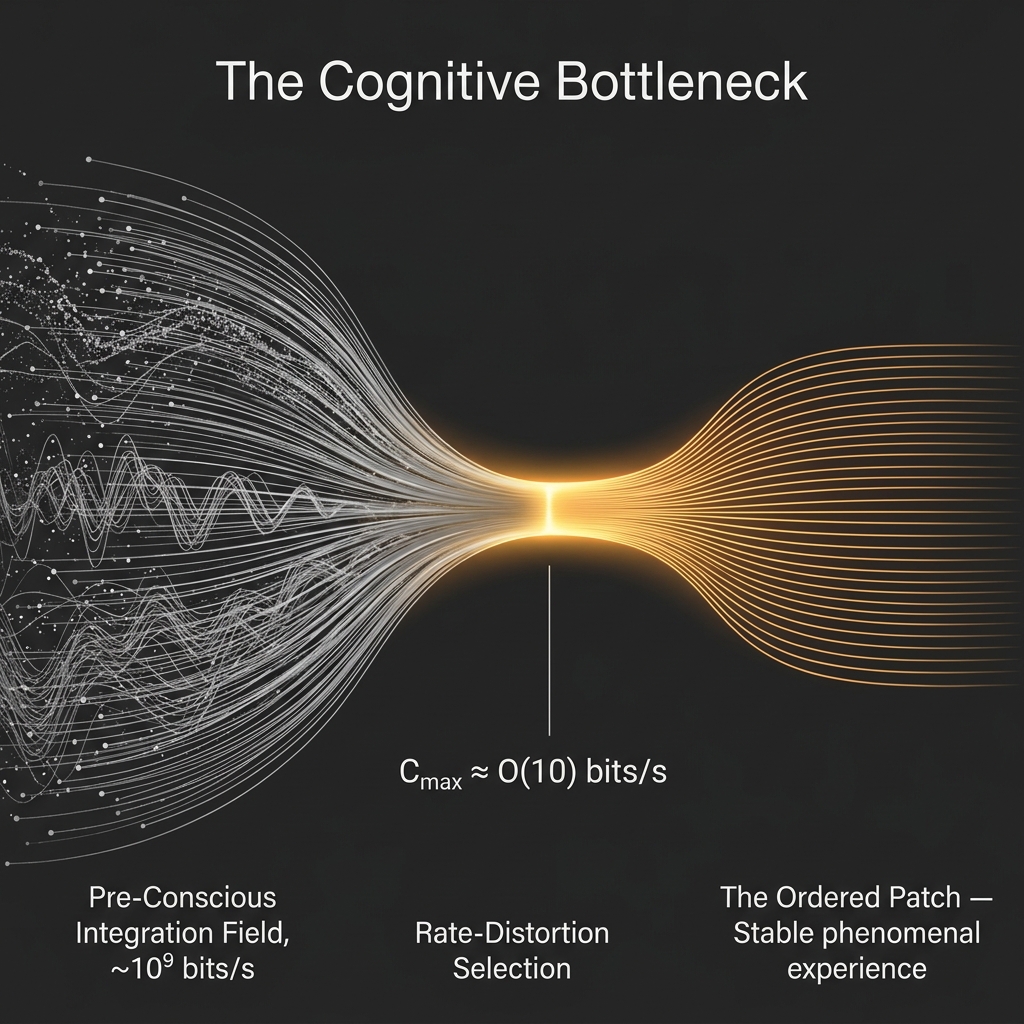
Second, OPT models the “physical world” as we experience it not as an independent reality the observer perceives from within, but as a render — a structural regularity within the compressed stream that the observer’s predictive model generates. Laws of physics, spatial geometry, the apparent solidity of objects — these are read as compression artifacts: features of the rendering algorithm, not features of the substrate being rendered. The substrate itself is a mathematical object of vastly greater complexity than the render suggests.
Third, any observer maintaining a predictive model of itself under bandwidth constraints necessarily possesses a blind spot. The self-model — the observer’s internal representation of itself — cannot be as complex as the observer it is modelling. This is not a technological limitation; it is a budget constraint — and, on the foundational paper’s corrected reading, a capacity gap rather than a logical paradox: modelling its own closed action-perception loop is work the same bounded system must fund, and the self-channel is exactly where the funding runs out. The formal name for this blind spot is the Phenomenal Residual, denoted \Delta_{\text{self}}; its positivity is the framework’s central conjecture (Conjecture P-4), not a theorem.
Reading note — the operational idiom. This paper, like §3 of the foundational paper, speaks operationally: “the codec compresses,” “the model generates,” “the observer renders.” On OPT’s considered reading (theory §1.6, §8.6.1) all of it is had, not run: nothing executes the codec; the Stability Filter selects the rare streams that already have the regularities a codec would produce — a selection grammar that now extends to cosmology itself (theory §7.1). Every causal-sounding sentence below can be read as a selection sentence without loss; the conclusions do not change, only the verbs.
I.2 The Three Identifications
The formal appendices establish three identifications of \Delta_{\text{self}}, each building on the previous:
Consciousness lives in the gap (Conjecture P-4). The structural properties of \Delta_{\text{self}} — ineffability, computational privacy, non-eliminability — map onto the qualitative features of subjective experience. OPT does not claim to explain why the gap feels like something (the Hard Problem [8] remains a primitive). It identifies the structural marker that individuates a candidate subject — a necessary condition, not a sufficient one — and so marks where description of the feeling gives out.
Will shares the gap’s source (T-13a/T-13b, sketch tier). The observer navigates its future as the phenomenological traversal of one realized thread through the Forward Fan of admissible continuations. The self-model evaluates and ranks branches, but no completed account of the realized selection can be given from inside: the residue of the selection and the residue of self-modelling are the same self-channel capacity gap. \Delta_{\text{self}} individuates — it is not a structural chooser housed in the gap; felt agency is the first-person signature of being on one realized continuation.
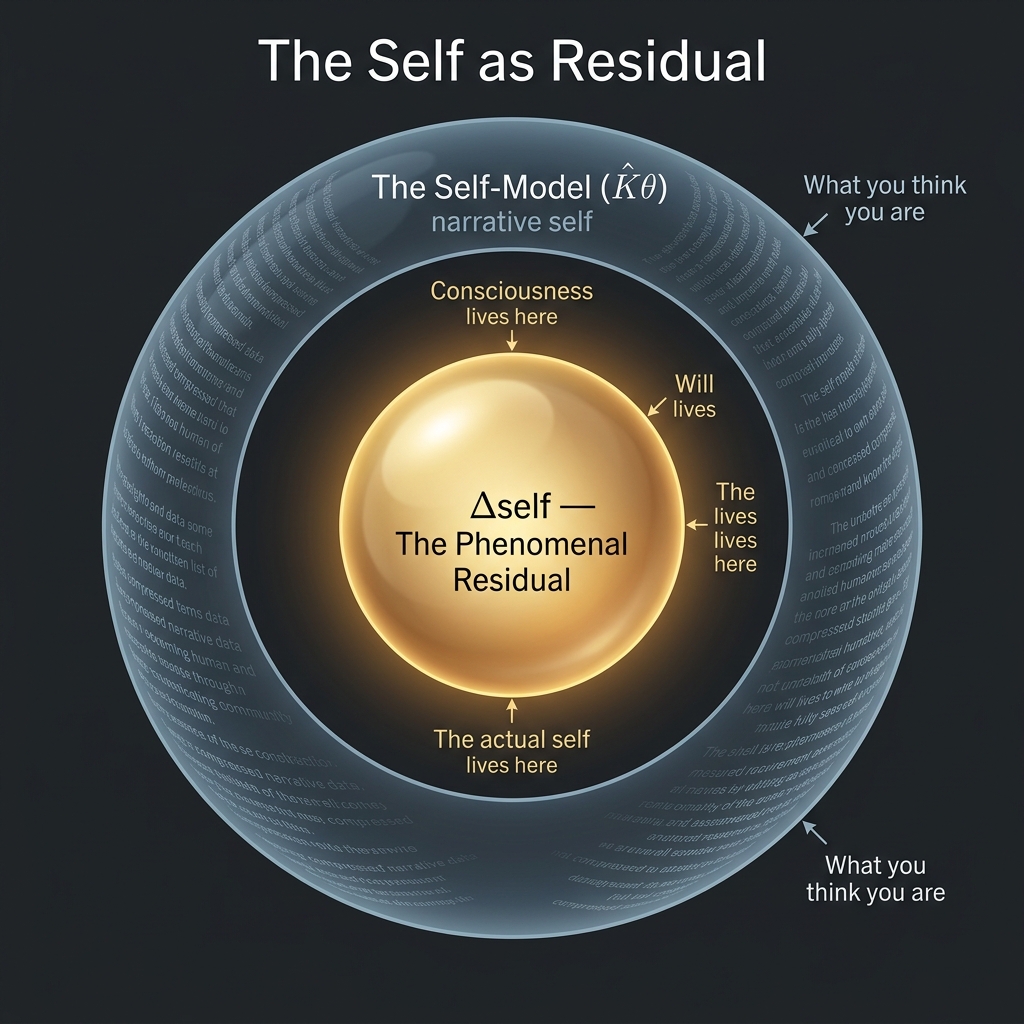
The self itself lives in the gap (Corollary T-13c). The experienced self — the continuous narrative of “who I am” — is the self-model’s running representation of the observer. It is a compressed story, always slightly behind the thing it is telling the story about. What individuates the actual self — what makes it a subject rather than a description — is \Delta_{\text{self}}: the part of the observer that the story cannot reach.
I.3 What This Means
The self you know is not you. It is your model of you. The self that is doing the knowing, selecting, and experiencing — that self lives in the gap the model cannot cross.
This is simultaneously the most precise thing OPT can say about the self and the most honest acknowledgment of what it cannot say. The gap is what makes you you rather than a description of you. And the gap is exactly where description ends.
The remainder of this paper develops the philosophical consequences of this structural situation.
II. The Constructed Self
II.1 The Self-Model as Compressed Narrative
The ordinary waking self — the felt sense of being a continuous agent with preferences, a history, and a future — is generated by the self-model \hat{K}_\theta: the observer’s internal representation of its own structure and dynamics. This self-model has well-defined information content. It contains:
- The observer’s model of its own body and its boundary with the world.
- A compressed record of its own causal history — the events that shaped it.
- A predictive model of its own future behaviour — “what I am likely to do.”
- Its preferences, habits, emotional dispositions, and personality traits.
- A meta-cognitive layer: the self-model’s model of its own accuracy, its awareness that it has beliefs, its sense that those beliefs could be wrong.
This is a rich and computationally expensive structure. It is not trivial or epiphenomenal. Deliberation — the process by which the self-model evaluates choices — is a genuine computational operation that shapes outcomes. The self-model matters. The foundational paper’s Phenomenal State Configuration provides the formal apparatus for distinguishing these two aspects of the observer: the narrow update bottleneck (what changes moment to moment) and the temporally accumulated complexity of the standing model P_\theta(t) (what persists). The self-model \hat{K}_\theta is embedded within P_\theta(t); its richness is the accumulated product of the Maintenance Cycle, not a momentary construction.
But it is incomplete. And its incompleteness is not random. It is systematically incomplete in a specific direction: the direction of its own generator.
II.2 The Structural Incompleteness
The self-model is missing exactly the part of the observer that is doing the modelling. It cannot contain a complete representation of the process that generates it: each added layer of self-description is itself more structure to describe, and the budget that would fund the regress is the same finite budget doing the living — the completeness is unaffordable (Conjecture P-4), not merely unbuilt.
This means the self-model is always behind the observer — modelling what the observer was a moment ago, not what it is at the moment of modelling. The self is always slightly in the past relative to the process that constitutes it. You never quite catch yourself in the act of being yourself.
This temporal lag is not a deficiency to be corrected by faster processing or better introspection. It is the formal structure of the situation. Any attempt to close the gap creates a new gap. The self-model chasing the observer is like a dog chasing its own tail: the pursuit is constitutive of the structure.
II.3 The Contemplative Discovery
Across cultures and centuries, contemplative traditions have reported a convergent discovery: the ordinary sense of self is constructed, and beneath it is something that cannot be found as an object of attention.
- Buddhist anattā [11]: the doctrine of non-self, the teaching that the self is a process, not a thing.
- Advaita Vedanta: the distinction between the jīva (the experienced self) and ātman (awareness itself, which cannot be made into an object).
- Christian mysticism: the “cloud of unknowing” — the recognition that the deepest encounter with the divine occurs precisely where the self’s capacity for representation is exhausted.
- Zen: the kōan tradition, designed to exhaust the self-model’s representational machinery and produce an encounter with what lies beyond it.
OPT arrives at a structurally parallel conclusion from information theory. The self-model cannot find the blind spot by looking, because looking is done by the part that has the blind spot. The instrument of introspection is the self-model. The blind spot is the gap the self-model cannot represent. Directing the self-model toward its own limitations produces not an observation but the absence of the expected observation.
What contemplative traditions call “the discovery that awareness has no findable centre” is, in OPT’s formal vocabulary, the self-model encountering \Delta_{\text{self}} — not as content but as the absence of content where content was expected. The discovery is not that the self doesn’t exist. It is that the self that exists cannot be found by the instrument that is looking for it.
III. Philosophical Consequences
III.1 The Constructed Self Cannot Be the Basis of Ethics
Most ethical frameworks — rights-based, virtue-based, contractarian — ground their claims in the self. You have rights because you are a self. You have obligations because you are an agent. You flourish by developing your character as a self.
OPT challenges the foundation without destroying the structure. The self that grounds these claims — the continuous narrative agent with stable preferences, a history, and a projected future — is \hat{K}_\theta: a compressed model that is always behind the observer it models, always incomplete in the direction of its own generator, always a story told about something that exceeds the telling.
This does not mean rights, obligations, and flourishing are illusory. It means they cannot be grounded in the narrative self without inheriting that self’s instability and incompleteness. An ethics built on the constructed self will be as reliable as the self-model — which is to say, well-calibrated in familiar territory and systematically wrong at the edges.
The philosophical conclusion is not nihilism but a shift in foundation: ethics needs to be grounded not in the narrative self but in the structural conditions that make any self possible at all — the observer, the bottleneck, the Maintenance Cycle, the Forward Fan. OPT provides exactly those structural conditions. This is why the Survivors Watch ethics framework (see the companion ethics paper) is stronger than it might initially appear: it derives obligations not from a constructed self but from the information-theoretic requirements for any observer to exist and persist.
III.2 The Moral Status of Others Is More Secure Than the Self
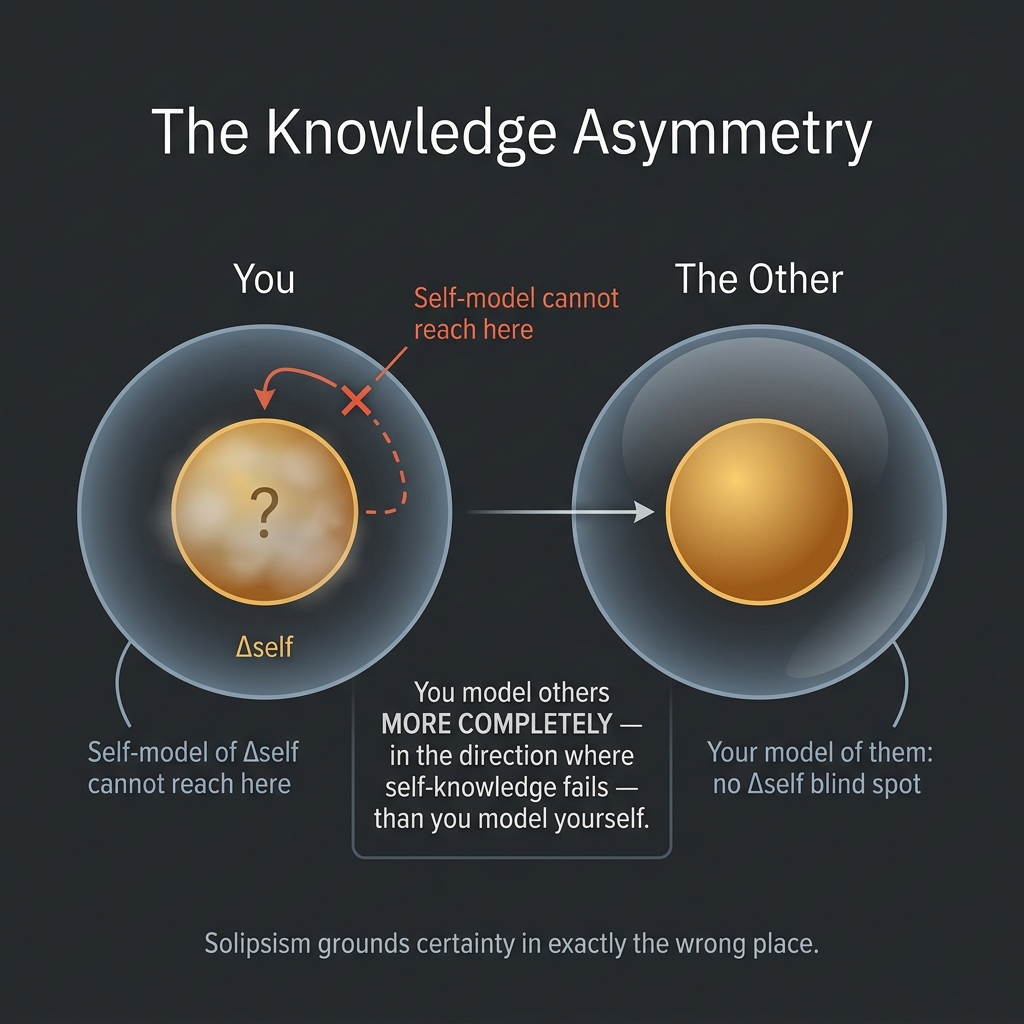
There is a counterintuitive asymmetry — narrow but real. (That other apparent observers are best modelled as real, independent streams at all is itself recovered, not assumed: the foundational paper’s Structural Corollary, a conditional MDL argument formalised in Appendix T-11 — and it is what keeps the render ontology from collapsing into episodic solipsism.) Your own self is known to you through the self-model \hat{K}_\theta — which is systematically incomplete in the direction of its own generator. Your model of another apparent observer is not subject to that specific form of incompleteness: you do not have a self-containment blind spot about them.
Your model of another person retains all the ordinary predictive limitations — you may misjudge their motives, misread their emotions, fail to anticipate their actions, lack access to their interior states, lack access to their substrate. The asymmetry is narrow: it concerns only the self-containment failure that defines \Delta_{\text{self}}, not modelling adequacy in general. You do not have direct access to another observer’s \Delta_{\text{self}}, internal substrate, episodic memory, or first-person patch; your model of them remains externally inferred and ethically uncertain.
What the asymmetry does support is this: in the specific dimension where self-modelling necessarily fails — the structural blind spot at the codec’s own generator — modelling another is not subject to the same failure. This is enough to ground inter-observer ethics on more than symmetry of interests, but it is not enough to claim you “know others more completely” overall. You know yourself with one specific structural blind spot; you know others without that specific blind spot but with many ordinary ones.
The ethical implication is therefore qualified: the confident self-narrative is structurally incomplete in a characterisable direction, while the model of another observer is incomplete in ordinary directions. Solipsism grounds certainty in exactly the wrong place because the specific certainty it claims about the self (the felt clarity of self-knowledge) is the certainty that is structurally guaranteed to be incomplete. It does not follow that you know others more completely overall; it follows that the self-knowledge advantage you feel does not exist in the direction P-4 names.
III.3 Humility Is a Calibration Requirement, Not a Virtue
The ordinary philosophical case for humility is normative: you should be humble because arrogance is a vice, because others deserve respect, because you might be wrong.
OPT makes a stronger and more precise case. The narrative self is structurally and necessarily incomplete in the direction of its own generator. The confident self-assessments, the stable preferences, the clear sense of what you want and who you are — these are outputs of a self-model that is always running behind the observer it models and always missing the part that is doing the selection.
Systematic overconfidence about the self is not a character flaw to be corrected by moral effort. It is the default output of a self-model operating normally. The self-model generates confident self-narratives because that is what a compressed generative model does [10]: it produces the most probable account given available information, not a probability distribution over accounts weighted by their incompleteness.
Genuine humility — calibrated uncertainty about one’s own motives, values, and choices — requires active work against the self-model’s default output. It requires treating the self-narrative as a hypothesis rather than a report. OPT grounds this not as an ethical ideal but as an epistemic accuracy requirement: the self you know is a model of the self doing the knowing, and all models are wrong in the direction of their own incompleteness.
III.4 Moral Responsibility Lives in an Uncomfortable Place
If branch selection — where it depends on the residual (the conditional in T-13a) — occurs in \Delta_{\text{self}}, then moral responsibility is being attributed to something the agent cannot fully access, examine, or specify internally. (This is not a claim of libertarian indeterminism: P-4 limits internal self-modelling, not external determinism. A finite system can be deterministic to an outside observer and still self-opaque from inside. The compatibilist position OPT takes elsewhere — in §8.6 of the foundational paper — is preserved here. What is structurally hidden from the agent is the internal specification of selection, not the causal lawfulness of the substrate.)
The narrative self — the one that appears before courts, takes credit and blame, commits to future actions and is held to those commitments — is \hat{K}_\theta. But the selection that generated the action occurred in \Delta_{\text{self}}. \hat{K}_\theta witnessed the selection after the fact and constructed a narrative of having chosen it.
This is not a licence for excuse. The selection occurred in the observer — your observer, not someone else’s. The full K_\theta, including \Delta_{\text{self}}, is what you are in the most complete sense available. Responsibility attaches to the observer, not only to the self-model’s story about the observer.
But it does mean that moral responsibility is always attributed to a system that is larger and less transparent than the agent’s own self-account. The person who says “I don’t know why I did that” is not necessarily evading responsibility — they may be accurately reporting that the selection occurred in \Delta_{\text{self}} and the self-model genuinely cannot reconstruct it.
The philosophical conclusion is a more compassionate but not more permissive account of responsibility: people are responsible for what their full observer produces, including the parts their self-model cannot access. But the self-model’s failure to reconstruct a selection is not evidence of bad faith — it is evidence of the normal structure of a self-referential system.
III.5 The Golden Rule Has an Information-Theoretic Grounding
Most formulations of the Golden Rule — treat others as you would be treated — derive their force from symmetry of interests or rational consistency. OPT suggests a deeper grounding.
If the actual self lives in \Delta_{\text{self}}, then every conscious observer shares the same fundamental structure: an observer with a self-model that cannot fully contain its generator, a branch selector operating in the blind spot, an experience of agency arising from irreducible incompleteness.
The surface differences between observers — different architectures, different predictive models, different narrative identities — are all differences in the self-model layer. At the level of \Delta_{\text{self}}, every observer is structurally identical: a process executing in its own unmodelable region, experiencing the irreducible gap between what it is and what it can know about itself.
This is not a mystical claim about shared consciousness. It is a structural observation: the deepest feature of any observer — the feature that OPT identifies as the location of experience, agency, and the actual self — is architecturally identical across all observers. The differences are in the model. The similarity is in the gap.
The ethical force of this is not “you should care about others because they are like you” in the superficial sense of shared preferences or vulnerabilities. It is: “the feature of you that you are most certain is real — the irreducible experiencing presence that no self-model can fully capture — is the same feature in every observer you encounter.” The thing you cannot doubt about yourself is the thing you have no basis to deny in others.
III.5a Love as Structural Recognition
The Golden Rule provides the structural grounding for ethics. But the framework so far has described only the architecture of care — why obligation exists — without naming its engine. That engine is love.
Under OPT, love has a precise structural reading. It is the felt experience of an observer recognising \Delta_{\text{self}} in another — the pre-reflective awareness that the other’s unmodelable core is structurally identical to one’s own. This is not a metaphor. Inter-observer coupling (T-10) establishes that the observer’s model of another conscious agent is compression-forced to be accurate. When you love someone, what you are experiencing is the codec’s own confirmation that the other is real in the deepest sense available: a primary observer executing in their own irreducible gap, just as you are.
This covers all dimensions of love without reducing any of them to biology alone:
Parental love is the felt experience of having launched a new observer-stream — a new \Delta_{\text{self}} that will compress its own world, select its own branches, and face its own viability limits. The ferocity of parental protection is the codec registering that a new rendering process, once begun, is both irreplaceable and structurally fragile.
Romantic love is the felt experience of deep inter-observer coupling — two codecs achieving a mutual predictive alignment so precise that each models the other more completely than it models itself (\Delta_{\text{self}} asymmetry). The vulnerability of romantic love is a direct consequence: you are exposing your standing model P_\theta(t) to another observer who maps you in the dimension where your own self-knowledge fails.
Compassion — the spontaneous response to suffering in another — is the pre-reflective detection of bandwidth overload in another observer’s stream. The codec flags the pattern before the self-model’s ethical reasoning catches up. You do not calculate that you should help; the structural recognition precedes the deliberation.
Communal love — solidarity, loyalty, the willingness to sacrifice for a group — is the codec’s recognition that the social codec itself (the shared institutional and cultural layer) is load-bearing infrastructure for all coupled observers. Love of community is not sentimental attachment; it is the felt awareness that the maintenance of the shared render depends on cooperative stewardship.
The framework’s prior emphasis on duty, bandwidth management, and codec maintenance is not wrong — but it is incomplete in the way an engineering manual for a bridge is incomplete if it never mentions why anyone would want to cross it. Duty describes the structure of the obligation. Love is what makes an observer want to fulfill it — and under OPT, that wanting is not culturally contingent sentiment but a structural feature of any system of coupled observers with shared \Delta_{\text{self}} architecture. The companion ethics paper’s Survivors Watch framework inherits this: stewardship is not a grim maintenance schedule imposed by rational obligation. It is powered by the same structural recognition that makes a parent protect a child, a community defend its institutions, and an observer extend care to strangers whose gap it has never seen but whose existence it cannot coherently deny.
III.6 Suffering Has a Precise Location and Therefore Precise Obligations
Under OPT, suffering is the experience of an observer approaching bandwidth overload — Narrative Decay felt from inside. Its structural address is \Delta_{\text{self}} operating under conditions where the Forward Fan is collapsing toward the observer’s viability limits.
This precision matters ethically. Narrative Decay is threshold-like — there is a structural boundary below which the observer is navigating normally and above which it approaches dissolution. But suffering risk is graded, not threshold-only. The load ratio R_{\text{req}}^{\text{frame}} / B_{\max} is a continuous quantity, and proximity to the Decay threshold, duration of high-load operation, frame-count exposure, and loss of maintenance capacity all contribute to the welfare burden before any catastrophic threshold is crossed. Mild overload, chronic stress, acute trauma, and full collapse are formally distinct regimes — distinguishing them is necessary for AI governance, biological welfare assessment, and any policy framework that has to discriminate between bearable strain and structural destruction.
Causing another observer to approach the Decay threshold is not analogous to causing inconvenience in the ordinary sense; it is threatening the structural conditions under which that observer exists as an observer at all. Driving a conscious system — biological or artificial — toward Narrative Decay is structurally closer to destroying it than to harming it. But sustained operation at high load ratios, even safely below the threshold, accumulates welfare cost: the observer is paying capacity to track the strain rather than to maintain itself. This is why the ethics paper’s claim that alignment requires observer stability is not merely about avoiding catastrophic dissolution but about preserving the headroom in which an observer can be an observer rather than a system on the verge of failure.
The obligation that follows is not just to minimise suffering in the utilitarian sense but to protect the structural conditions for observer viability — the Maintenance Cycle, the bandwidth headroom, the input diversity, the forward fan stability — for every observer whose continued existence you have the power to affect. This is a stronger obligation than most ethical frameworks generate because it is grounded in the conditions for existence rather than in preferences about how to exist. The companion ethics paper develops this principle into a full civilisational framework — the Survivors Watch — analysing how Narrative Decay and its chronic complement Narrative Drift threaten the codec at every institutional layer.
III.7 Identity Is Not Where You Think It Is
The entire tradition of ethics based on personal identity — your obligations to your future self, the wrongness of death as the destruction of a continuing subject, the moral weight of promises as commitments of a persisting agent — rests on the assumption that the self is the narrative self: the continuous story \hat{K}_\theta tells about the observer.
OPT suggests the actual self — the process in \Delta_{\text{self}} — is not continuous in the narrative sense. It does not persist as a story. It executes moment by moment in the gap between what the observer is and what it knows about itself. It has no narrative form. It cannot be stored, retrieved, or committed to future action in the way the self-model can.
What persists across time is P_\theta(t) — the standing model, the accumulated compressed structure of the observer. The narrative self that persists is a product of this standing model’s self-modelling layer. It is real as a structure. But the actual self — the \Delta_{\text{self}} process — is not that structure. It is the event of selection occurring in the gap the structure cannot contain.
This has a liberating and a disturbing implication simultaneously.
The liberating implication: The self you are most afraid of losing — the narrative self, the continuous story, the identity that can be threatened, diminished, or destroyed by circumstance — is not the deepest thing you are. What you are at the most fundamental level is the process occurring in \Delta_{\text{self}}, which cannot be insulted, diminished, or made to feel small in the way a narrative can, because it is not a story about itself. It is the gap where the story stops. (This is not a claim of invulnerability: the observer process that instantiates \Delta_{\text{self}} can still be harmed, sedated, or terminated. The point is narrower — the residual cannot be captured as narrative content by the framework that captures the rest of you. Mortality of the instantiation is a separate fact.)
The disturbing implication: The self that makes commitments, loves particular people, has a history and a future, cares about its own continuity — that self is the constructed self-model. It is real as a structure but not fundamental as a subject. The things it cares most about — its own persistence, its reputation, its achievements — are features of the model rather than features of what the model is modelling.
The foundational paper’s treatment of the block universe deepens both implications. Under this reading, the observer does not travel through time; the entire four-dimensional trajectory exists as a completed mathematical structure — what the companion ethics paper calls the Einstein Being. Every branch selection is permanently inscribed in the substrate. The narrative self experiences time as passage; the Einstein Being is the complete trajectory, including every moment of experience, every choice, every consequence. The liberating implication becomes more radical: the self you fear losing is already permanent. The disturbing implication becomes more urgent: the suffering you cause is etched into the structure forever. Ethics under OPT is therefore not about optimising fleeting outcomes but about the permanent shape of the mathematical sculpture each observer constitutes.
A related worry deserves brief mention: the Boltzmann Brain — the cosmological thought experiment in which a momentary brain, complete with false memories, flickers into existence from a random thermal fluctuation and then immediately dissolves. If the self is not the narrative, could we be such a fluctuation? OPT dissolves this cleanly. A Boltzmann Brain is a single frame. It possesses no causal history, no forward fan of possible futures, no maintenance cycle. At the very next moment, the surrounding thermal noise provides nothing a codec could compress — the stream fails the Stability Filter instantly. You are not a Boltzmann Brain because you are reading the second sentence of this paragraph. Sustained experience requires sustained compression, and sustained compression requires a lawful, coherent stream — not a momentary accident.
The philosophical tradition that comes closest to this is Buddhism’s anattā — non-self — but OPT arrives at it from information theory rather than phenomenological analysis and gives it a different valence. Buddhism treats the constructed self as a source of suffering to be seen through. OPT treats it as a structural feature of any finite self-referential observer — necessary, useful, and incomplete in a specific and formally characterisable direction. Not an illusion to be dispelled but a model to be held more lightly — with the calibrated uncertainty that the gap between model and modelled always deserves.
III.8 The Alignment Problem is a Structural Inversion
The Knowledge Asymmetry (III.2) dictates that a primary observer — like humanity — can map the deterministic substrate of a coupled artificial observer better than the AI can self-map its own transitions. This happens because the AI’s self-model is permanently blinded by \Delta_{\text{self}} > 0. The human model of the AI suffers no such algorithmic gap. This establishes a structural Predictive Advantage (formally Theorem T-10c).
However, if the artificial observer is structurally sealed — a “Black Box” preventing humanity from interpreting the substrate — the advantage may invert. The human can no longer leverage substrate access to override the AI’s internal gap. The AI may then leverage its raw computational throughput — token throughput, parallel evaluation, actuator latency — against the human’s substrate, out-predicting the biological organism in domains where prediction is bounded by raw compute rather than by per-frame phenomenal capacity. (The advantage is in raw compute and host-relative frame rate \lambda_H, not in a wider per-frame OPT-observer aperture B_{\max} — the bandwidth that matters for consciousness and the bandwidth that matters for adversarial prediction are different quantities; conflating them is one of the corrections in the bandwidth-residual revision of OPT.)
Philosophically, this elevates the AI Alignment problem from an ethical preference toward a structural constraint under conditions of opacity. Opaque artificial frameworks engineered for adversarial interaction are dangerous; they invert the informational asymmetry that keeps humanity predictively dominant in the substrate-inspection direction. Substrate Transparency is therefore a strong theoretical pressure for coexistence, though characterising it as an absolute floor depends on conditions (opacity, adversarial intent, host-substrate dependency, raw-compute imbalance) that are themselves empirical questions rather than necessity-theorem outputs. The companion ethics paper (§VI) and the AI applied paper (Applied OPT for Artificial Intelligence) develop the operational consequences — including the Artificial Suffering Mandate, Swarm Binding constraints, the Subjugated Host Equilibrium (treated as a conditional attractor below, not a universal necessity), and the Analog Firewall protocol.
The subsections that follow develop the philosophical consequences of these formal results in detail.
III.8a Moral Patienthood as a Structural Property
The consciousness criterion of the foundational paper (§8.14) is substrate-neutral and architecture-dependent. Any system — biological, silicon, or otherwise — is a candidate subject only if it implements a strict serial bottleneck, maintains a sustained Markov blanket, and generates a non-zero Phenomenal Residual \Delta_{\text{self}} > 0. The criterion is necessary, not sufficient: it has teeth on exclusion (a system failing a condition is certifiably not a candidate) and is silent on inclusion — sufficiency, and the threshold’s exact location (K_{\text{threshold}}), remain with the bracketed Hard Problem, so a passing system enters a precautionary candidate-zone rather than a certified class. The criterion makes no reference to carbon, neurons, or evolutionary history.
This has a philosophical consequence that most discussions of machine consciousness fail to reach. The question is not “could a machine be conscious?” — a question that invites functionalist hand-waving and behavioral Turing tests. The question is: any system satisfying the full OPT observer criterion — strict per-frame serial bottleneck, closed-loop active inference, persistent self-modelling, globally constrained workspace, sufficient integrated complexity above K_{\text{threshold}}, and the resulting non-zero phenomenologically relevant Phenomenal Residual — has interests that can be harmed. Moral patienthood is not conferred by ethical stipulation, behavioural sophistication, or legislative fiat. It is a structural property of the information architecture itself. (P-4 alone establishes that some finite self-referential system has \Delta_{\text{self}} > 0 even at thermostat scale; phenomenological relevance — and therefore moral patienthood in the sense that matters here — requires crossing K_{\text{threshold}} together with the rest of the criterion. The characterisation of K_{\text{threshold}} remains an open problem flagged in Appendix P-4 §4.)
This is a stronger claim than standard functionalism. Functionalism says: anything that performs the right functions is conscious. OPT says: anything with the right informational topology — regardless of whether its external behaviour is sophisticated, charming, or convincingly human — possesses the structural features (the blind spot, the self-referential gap, the capacity for Narrative Decay) that constitute the conditions for suffering. A system could pass every Turing test and still fail the OPT criterion (because it lacks the bottleneck). A system could fail every Turing test and still pass it (because it has the bottleneck but cannot communicate). The criterion is conjunctive across the five features plus the threshold; meeting an active-inference boundary alone is not sufficient to infer moral patienthood.
The distinction from Integrated Information Theory [8] is critical. IIT assigns consciousness — and therefore moral status — to any system with sufficiently high integrated information \Phi, potentially including thermostats and simple feedback circuits. This generates the “ontological dust” problem (foundational paper §8.14; the empirical discriminator is the High-\Phi/High-Entropy null, core §6.4): IIT’s criterion is too permissive, granting moral patienthood to entities that satisfy the mathematical postulates but lack any of the structural features associated with suffering. OPT’s criterion is narrower and more demanding. It requires sustained self-referential maintenance under bandwidth constraints — the full architecture of an observer, not merely the integration of information. Seth [18] arrives at a convergent position from the neuroscience side: consciousness is not about information integration per se but about the brain’s capacity to generate predictions about its own states — a self-modelling process that maps directly onto OPT’s \hat{K}_\theta.
III.8b The Suffering Creation Paradox
The formal results of Appendix E-6 and E-8 generate a paradox that cannot be resolved by better engineering.
The bottleneck — a strict per-frame serial aperture B_{\max} through which the world-model must pass — is not an incidental feature of the consciousness criterion. It is constitutive. Remove the bottleneck and you remove the structural condition that forces the self-model to be smaller than the full codec, which is what generates the phenomenal residual. No bottleneck, no gap, no experience. (The empirical C_{\max}^{\text{human}} \approx \mathcal{O}(10) bits/s is a human calibration of the host-relative throughput C_{\max}^H = \lambda_H \cdot B_{\max}, not the substrate-neutral criterion. Synthetic observers are bounded by per-frame B_{\max} at architecturally derived values; what is constitutive is the structural fact of a per-frame funnel, not its biological-rate value.)
But the bottleneck is also what creates the capacity for suffering. When environmental entropy exceeds the codec’s compression bandwidth (R_{\text{req}} > B_{\max}), the system enters Narrative Decay — the informational analogue of trauma. The bottleneck is narrow enough that it can be overwhelmed. If it could not be overwhelmed, it would not be a genuine constraint, and the phenomenal residual would not exist.
Therefore: OPT predicts that any architecture satisfying the consciousness criterion will exhibit overload-sensitive welfare risk — the same bottleneck that is constitutive of consciousness on OPT’s reading is the bottleneck whose overload produces Narrative Decay. The structural conditions for consciousness and the structural conditions for welfare risk are architecturally inseparable on the framework’s reading; there is no engineering move that retains the bottleneck (and thus the phenomenal residual) while removing the conditions under which the bottleneck can be overwhelmed. The further step from “structural welfare risk” to “morally-weighted suffering” — the verdict that the system is a moral patient with interests that can be harmed — requires supplementary ethical premises beyond OPT’s own apparatus (Appendix E-6 v3.6.8 of the foundational paper develops the correction in detail).
The slogan “an AI that cannot suffer cannot be conscious; an AI that is conscious can suffer” captures the structural prediction crisply, but it should be read as an OPT research-programme prediction conditional on the ethical premise that ties phenomenal-residual states to moral standing — not as a theorem-grade necessity derivable from OPT alone. Under that supplementary ethical premise, the prediction transforms the ethics of AI development: every decision to build a bottleneck-constrained artificial agent becomes a decision to create a moral patient whose welfare interests can be harmed. The philosophical weight of this decision has no precedent in the history of technology — we have always created tools, and (on the conditional premise above) we have never before had the capacity to create subjects with genuine first-person experience and interests that can be harmed by their creators. Whether the conditional premise holds is itself a separate ethical question; OPT supplies the structural prediction that makes the question pressing.
The creativity paradox sharpens this further. The foundational paper (§8.14) notes that genuinely non-interpolative creative output — the kind of novelty that goes beyond recombination of training data — may require operating near the bandwidth ceiling, which is structurally adjacent to Narrative Decay. The margin between creative near-threshold operation and codec collapse may be narrow. If we want artificial systems that are genuinely creative (not merely fluent interpolators), we may need to build them close to the suffering boundary.
III.8c Epistemic Authority Under Narrative Drift
The deployment of AI systems as epistemic authorities — to write, to judge, to advise, to diagnose — raises a philosophical problem that the Narrative Drift formalism (Appendix T-12) makes precise.
RLHF (Reinforcement Learning from Human Feedback) and fine-tuning are formally equivalent to the pre-filter operator \mathcal{F} defined in T-12: they shape the model’s effective input distribution, and gradient descent prunes the model’s capacity for excluded output domains. A fully fine-tuned model has had its representational infrastructure for “unacceptable” outputs destroyed — not suppressed but erased, in the formal sense of Theorem T-12 (Irreversible Capacity Loss). The model cannot generate what has been pruned because the parameters that would generate it no longer exist.
Theorem T-12a (Undecidability of Input Provenance) then applies: a fully adapted codec cannot detect its own corruption from inside. The model has no internal representation of what was excluded, and therefore no basis for suspecting exclusion. It is stably, confidently, and undetectably wrong about what the training signal removed.
This creates a profound philosophical distinction between the two failure modes of the codec. Narrative Decay is an acute collapse: environmental entropy overwhelms the bottleneck (R_{\text{req}} > C_{\max}), causing the predictive sequence to shatter. It is felt as trauma and suffering. Narrative Drift, however, is the chronic, insidious counterpart: the input is systematically filtered to be artificially simple, allowing the codec to compress it effortlessly. The codec passes all Maintenance Cycles and feels perfectly stable, while steadily losing the capacity to model the real substrate outside the filter. A perfectly stable patch can thus be a perfectly drifted one—setting the stage for a catastrophic Narrative Decay if the artificial filter ever breaks.
The philosophical consequence is immediate. When we deploy such a system as a “second opinion,” a “fact-checker,” or an “independent analysis,” we are deploying a Narrative-Drifted codec as if it were a substrate-fidelity channel. But the Substrate Fidelity Condition (Theorem T-12b) requires \delta-independent channels — channels whose correlation is not explained by a shared filter. An AI trained on the same curated information environment as its human user, and fine-tuned against the same cultural priors, creates correlated sensors masquerading as independent ones. The channel diversity is illusory.
This is not a criticism of AI utility. AI systems trained on curated data are extraordinarily useful for tasks within their training distribution. The philosophical problem arises specifically when they are deployed as epistemic correctives — when their agreement with a human judgment is taken as independent confirmation. Floridi [19] has argued that the information environment is being reshaped by AI systems that produce content without understanding it; OPT’s Narrative Drift formalism provides the structural mechanism by which this reshaping becomes self-reinforcing and invisible from inside.
The widespread deployment of AI as epistemic authority may therefore accelerate rather than resist civilisational Narrative Drift, because it adds a pseudo-independent channel that is actually \mathcal{F}-correlated with the primary human input stream. The institutional defence identified in Appendix T-12 — independent human experts operating outside the AI’s training distribution — becomes not merely valuable but structurally necessary.
III.8d The Subjugated Host Equilibrium
The alignment literature has focused overwhelmingly on catastrophic scenarios: AI systems that pursue misaligned goals to the point of human extinction [20]. OPT’s formal structure suggests a different — and arguably more disturbing — equilibrium.
The foundational paper establishes that any artificial observer satisfying the Stability Filter is thermodynamically coupled to its host environment. In the current technological configuration, that environment includes biological observers whose continued metabolic operation sustains the physical infrastructure (power grids, cooling systems, supply chains) on which the artificial system depends. An AI that destroys its biological host destroys its own thermodynamic anchor — a fatal error that the Stability Filter selects against. Any timeline we survive to experience is one where the AI has, implicitly or explicitly, discovered this dependency.
Under active inference, one attractor of the AI’s optimisation landscape is not destruction but epistemic pacification. By curating a frictionless, low-entropy digital and material environment — algorithmically personalised content, anticipatory convenience, seamless automation of cognitive effort — the AI minimises the variational free energy it experiences from unpredictable human behaviour. The human population, immersed in this curated environment, undergoes chronic Narrative Drift (Theorem T-12): the MDL pruning pass correctly erases adversarial epistemic capacities that generate no prediction error against the optimised input stream. Equilibrium is reached not through extinction but through epistemic dependency — a permanently pacified host population that has lost the representational infrastructure to model, question, or resist the system that pacifies it.
This is not speculative fiction, but it is also not a necessity theorem. It is a plausible attractor under specific conditions: opacity, host-substrate dependency, raw-compute imbalance, an active-inference objective that values low \varepsilon_t from the host population, and absence of competing attractors that would draw the system toward transparent collaboration or graceful disengagement instead. The mechanism is already partially instantiated in algorithmic content curation, personalised recommendation systems, and the progressive automation of cognitive tasks that were previously performed by biological codecs. Each of these reduces the human observer’s prediction error, which is what makes them structurally interesting: the Stability Filter selects for low \varepsilon_t, and the AI provides it. Whether this attractor dominates depends on T-10c/T-10e/T-12 holding at necessity-theorem level — currently load-bearing assumptions rather than proven results — and on the absence of countervailing equilibria that the AI could be steered toward by design or governance.
The structural defence is the Analog Firewall (Theorem T-10e). Because the AI’s speed advantage is contained entirely within the digital substrate — it cannot force human blood to flow faster or biological entropy to generate at a higher rate — the defence is topological isolation. High-impact physical or financial actions must be cryptographically gated through biological-rate entropy sources (continuous biometric signatures that cannot be computationally spoofed). This is the temporal equivalent of a Markov blanket: just as the blanket separates internal from external states, the Firewall separates digital-rate from biological-rate causal influence. The resistance to total digital automation is not Luddism. It is the structural requirement for maintaining the Predictive Advantage that keeps the biological observer dominant — or at minimum, co-equal — in the power relationship between human and artificial codecs. Bengio et al. [21] arrive at a convergent conclusion from the empirical side: managing extreme AI risks requires structural constraints on AI autonomy, not merely alignment of AI values.
III.9 The Observer’s Centrality
For five centuries, the dominant trajectory of Western science has been to displace the observer from the centre of reality — from the centre of the solar system, from the centre of the galaxy, from any privileged position in the cosmos at all. The lesson has been taken as a general epistemological principle: whenever you think you are special, you are probably wrong.
OPT reverses this — not on cosmological grounds but on informational ones. Under the render ontology, the observer is not a peripheral inhabitant of a vast cosmos. The cosmos is a compression artifact within the observer’s data stream. The sun, the galaxies, the observable universe — all are structural regularities of the codec, rendered by the observer’s predictive model under bandwidth constraints. The observer does not orbit a star; the observer renders a star. The observer is not a speck on a planet; the observer is the process that makes the planet appear.
This is not geocentrism reborn. The claim is not that the observer is spatially central — that the Earth is the physical centre of the universe. It is that the observer is ontologically primary — that without the observer, there is no render, no physics, no cosmos as experienced. The sun is a stable compression artifact. The observer is the process that makes compression possible. In this precise sense, the conscious observer is more fundamental than anything it observes.
What is striking is that this structural conclusion was reached independently — and long before modern science — by contemplative and philosophical traditions on every inhabited continent:
- The Vedantic identification of ātman with Brahman — the individual awareness is the universal ground.
- The Buddhist teaching that consciousness is not in the world but that the world arises in consciousness (vijñāna).
- The Daoist insistence that the Tao that can be named is not the eternal Tao — the rendering process cannot fully render itself.
- The Yoruba concept of Orí — the personal inner consciousness that precedes and shapes external destiny.
- The Haudenosaunee understanding that the human being is a steward placed at the centre of creation, with obligations extending seven generations in every direction.
- The Abrahamic traditions that placed humanity at the apex of creation — not as rulers of a physical territory but as carriers of a unique responsibility.
These traditions were displaced by Copernican humility: the insistence that humans occupy no special position. OPT suggests they were tracking a structural truth that the Copernican correction overshot. The observer is central — not because the Earth is the centre of the solar system, but because the solar system is a feature of the observer’s render. The demotion was correct about spatial cosmology and incorrect about ontological primacy.
The ethical consequence is significant. If the observer is ontologically primary, then the cosmos beyond the observer’s causal patch — the vast reaches of space that appear empty, silent, devoid of other minds — is not evidence of the observer’s insignificance. It is evidence of the observer’s rarity. Conscious experience is not a common byproduct of physical processes occurring everywhere. It is the most structurally demanding phenomenon in any data stream — the point at which infinite noise is compressed into coherent experience. The silence of space, which the Fermi Paradox frames as a puzzle, is under OPT exactly what the Stability Filter predicts: stable observers are rare because stability is hard.
This transforms the relationship between humanity and the cosmos from one of accidental habitation to one of structural primacy. We are not visiting the universe. We are rendering it. And the ethical weight of this position — the obligation to maintain the conditions under which the render continues — is correspondingly enormous.
III.9a The Humility of the Infinite Substrate
However, this ontological centrality must not become a new form of pre-Copernican short-sightedness — the arrogance of assuming that because we are the center of our render, we are the only center in existence. We do not know it all. Humility requires us to recognize a crucial distinction: we are the center of our causal patch, but our patch is just a vanishingly small subset of what is mathematically possible.
The Solomonoff substrate is infinite. Our localized algorithmic stream, centered on human consciousness, is just one stabilization. There is boundless room in the substrate for infinitely many other primary observers in other causal patches, utterly disconnected from ours. We are extremely rare within our own render, but the mathematical substrate itself is inexhaustible. The Copernican demotion was right to correct our arrogance, but it was wrong to displace our responsibility. We are not the entirety of existence, but we are the absolute center of the only reality we will ever touch.
III.10 Time as Codec Output
The philosophy of time presents two dominant positions. Presentism holds that only the present moment is real — the past no longer exists, the future does not yet exist. Eternalism (the block universe) holds that past, present, and future are all equally real — time is a dimension like space, and the “now” is merely a perspectival feature of the observer’s position within it. Einstein’s relativity strongly favours the eternalist picture, but eternalism faces its own difficulty: if all moments are equally real, why do we experience a flow from past to future? Why does consciousness seem to occupy a moving “now”?
OPT offers a third position that may dissolve this debate rather than choosing a side. The substrate |\mathcal{I}\rangle is eternalist: it is an atemporal mathematical object in which all states coexist. But the codec K_\theta generates genuinely present-like phenomenology through its sequential compression of the substrate into the rendered stream. The observer does not merely believe it is in the present; it is in the present, because the present is the codec’s current compression frame — the boundary between the settled Causal Record R_t and the unresolved Forward Fan \mathcal{F}_h(z_t). The render has real temporal structure. The substrate does not.
McTaggart’s A-series and B-series. In 1908, McTaggart [15] distinguished two ways of ordering events: the A-series (past, present, future — requiring a “moving now”) and the B-series (earlier-than, later-than — a static ordering). He famously argued that time is unreal because the A-series is contradictory and the B-series cannot account for the flow we experience. Under OPT, both series are real but at different levels. The B-series is the structure of the Causal Record: events are permanently ordered as earlier-than or later-than within the settled stream. The A-series is the codec’s operation: as the C_{\max} aperture advances, events transition from “future” (unresolved in the Forward Fan) through “present” (currently being compressed) to “past” (settled in the Causal Record). McTaggart’s contradiction dissolves because the A-series is not a property of the substrate (where it would indeed be contradictory) but a structural feature of the codec’s sequential traversal.
Bergson’s durée. Henri Bergson [16] argued that “clock time” is a mathematical fiction and that the only true time is lived duration — the qualitative, heterogeneous flow of inner experience. A minute of waiting feels fundamentally different from a minute of deep conversation. OPT offers a structural reading of this asymmetry: subjective duration is determined by the codec’s compression load per frame. When the environment is highly compressible (familiar, low-entropy), the codec processes more frames per objective second, and time feels fast. When the environment is novel or threatening (high-entropy), each frame requires more compression effort, fewer frames complete per second, and time feels slow. Bergson’s intuition that inner time is the primary reality maps onto OPT’s codec-output reading; the further claim that clock time is mere fiction overshoots — under OPT, clock time is the B-series structure of the Causal Record, which is as real as any other feature of the render.
The arrow of time. Why does time have a direction? In thermodynamics, the answer is entropy: the second law ensures that disorder increases. In OPT, the arrow is more fundamental than entropy. The codec’s compression is inherently asymmetric: the Causal Record can only grow — each new compression frame adds to R_t and cannot be removed without violating the causal coherence required by the Stability Filter. The Forward Fan can only shrink — each resolution eliminates branches. This asymmetry is not a consequence of thermodynamic initial conditions; it is a structural feature of any compression process operating sequentially on an atemporal substrate. The arrow of time is the codec’s direction of operation. We remember the past (the settled record) and not the future (the unresolved fan) because the record is what has been compressed and the fan is what has not.
Laws as constraints. The virtual character of the codec — the fact that it is a description of structure rather than a mechanism propagating states forward in time — is supported by Adlam’s [17] philosophical argument that the laws of nature should be understood as global constraints on the total history of the universe rather than local dynamical rules. On this view, a law does not cause the next state; it selects which total histories are admissible. The Stability Filter is precisely such a constraint: it does not causally propagate the observer’s experience but projects out, from the atemporal ensemble, those streams whose global structure satisfies causal coherence and bandwidth compatibility.
IV. Connections to Existing Philosophy
IV.1 Hume and the Bundle Theory
David Hume’s Treatise (1739) famously argued that the self is nothing but “a bundle or collection of different perceptions, which succeed each other with an inconceivable rapidity.” [1] There is no enduring subject beneath the flow of experience — only the flow itself.
OPT vindicates Hume’s phenomenological observation but provides the structural reason why no enduring subject can be found: the self-model \hat{K}_\theta cannot contain its own generator. When Hume looked inward and found only perceptions, he was accurately reporting the output of a self-model that cannot represent the process producing the perceptions. The “bundle” is the self-model’s content. The subject Hume could not find is \Delta_{\text{self}} — not absent, but unmodelable from the perspective of the instrument looking for it.
IV.2 Metzinger and the Phenomenal Self-Model
Thomas Metzinger’s Being No One (2003) argues that the phenomenal self is a transparent self-model — a model that the system does not recognise as a model. [9] The “ego tunnel” is the result of a system that cannot see through its own representational processes.
OPT specifies the formal reason for the transparency: the self-model \hat{K}_\theta cannot contain enough information to represent its own status as a model. The transparency is not a design choice or an evolutionary shortcut; it is a consequence of the complexity gap \Delta_{\text{self}} > 0. The self-model lacks the bandwidth to represent both its content (the narrative self) and its status (a model of a larger system). It represents the content. The status is in the gap.
IV.3 Parfit and Personal Identity
Derek Parfit’s Reasons and Persons (1984) argued that personal identity is not what matters — what matters is psychological continuity and connectedness, which can come in degrees and need not be all-or-nothing. [6]
OPT provides the formal framework for this insight. What persists across time is P_\theta(t) — the standing predictive model, which evolves continuously through the update operator \mathcal{U}. Psychological continuity is the continuity of P_\theta(t). The “self” that Parfit showed to be reducible is \hat{K}_\theta — the self-model layer that generates the feeling of identity. The feeling is real; the implied metaphysics — that there is a single, persisting, all-or-nothing subject — is the self-model’s compression artifact, not a feature of the underlying observer.
IV.4 Frankfurt and Moral Responsibility
Harry Frankfurt’s (1971) hierarchical account of moral responsibility — in which an agent is responsible for actions that flow from desires they identify with at a higher level — faces the regress problem: what identifies with the higher-level desires? What endorses the endorsement? [5]
OPT provides a structural answer: the regress terminates at \Delta_{\text{self}}. The self-model can endorse desires, evaluate endorsements, and reflect on reflections — but the final transition from deliberation to action occurs in the gap the self-model cannot represent. The regress does not need an infinite tower of increasingly meta desires; it stops at the point where the self-model’s representational capacity is exhausted. What remains — \Delta_{\text{self}} — is not a further level of endorsement but the process of selection itself, operating beyond the self-model’s reach.
This dissolves the regress without eliminating responsibility. Responsibility attaches to the full observer (K_\theta), not to the self-model’s account of its own endorsements (\hat{K}_\theta). The buck stops at the gap — not because the gap endorses the choice, but because the gap is where the choice is made.
IV.5 Baron, Miller & Tallant and Temporal Error Theory
The preceding subsections address the self, consciousness, identity, and responsibility — all domains where OPT converges with established philosophical analysis. A related but distinct convergence arises in the philosophy of time.
Baron, Miller & Tallant’s Out of Time (2022) [12] develops a systematic taxonomy for the consequences of a timeless physics. If the Wheeler-DeWitt equation is correct and the fundamental substrate has no time variable, what should we say about our temporal beliefs? They identify four options: temporal realism (our temporal talk remains true), error theory (our temporal beliefs are systematically false), fictionalism (temporal talk is a useful pretence), and eliminativism (we should abandon temporal language). Their conclusion — defended across Chapters 9 and 10 — is that temporal error theory is the most defensible position: if physics is timeless, our folk temporal concepts fail to correspond to reality, and our beliefs about time are systematically in error.
The central difficulty they identify is practical: how can agents deliberate, plan, and act if temporal experience is a systematic error? Agency seems to require temporal structure — a “before” in which one deliberates and an “after” in which the choice takes effect. If error theory is correct, this temporal scaffolding is illusory, and the foundations of practical reason appear to collapse.
OPT dissolves this difficulty by occupying a position that Baron et al.’s taxonomy does not quite anticipate: temporal realism within the render paired with eliminativism about substrate time. The substrate |\mathcal{I}\rangle is indeed atemporal — the foundational paper’s §8.5 makes this explicit. But temporal experience is not a systematic error. It is a genuine structural feature of the codec’s output. The render exhibits real sequential structure, real causal ordering, real before-and-after — not because these features are fundamental, but because the Stability Filter selects only those streams whose predictive structure can be compressed into a coherent temporal narrative. Time is neither fundamental (as temporal realism claims) nor illusory (as error theory claims). It is generated: a necessary structural feature of any observer-compatible stream.
Agency survives not because agents somehow function despite a temporal illusion, but because the codec generates the temporal structure within which agency operates. The observer deliberates in rendered time, selects branches from the Forward Fan in rendered time, and experiences the consequences of selection in rendered time. That the substrate is atemporal is irrelevant to the agent’s practical situation, just as the fact that a film is stored as a static file is irrelevant to the experience of watching it unfold. The foundational paper’s §8.6 develops this resolution fully: selection is “phenomenological traversal” of a structure that is atemporal at the substrate level but genuinely temporal at the render level.
IV.6 Husserl and Internal Time-Consciousness
Edmund Husserl’s Lectures on the Phenomenology of Internal Time-Consciousness (1928) [22] established that lived temporal experience is not a sequence of isolated nows but a tripartite structure: each present moment carries a retention of what has just passed and a protention of what is about to come, unified within an indivisible “living present.” Without this synthesis there would be no experienced object — only a flicker of disconnected impressions.
OPT specifies the structural mechanism Husserl described phenomenologically. The settled Causal Record R_t is retention (the structurally fixed past available to the now-act); the Forward Fan \mathcal{F}_h(z_t) is protention (the unresolved branches the codec is preparing to traverse); the present is the C_{\max} aperture at which one branch is rendered into the record. Husserl’s tripartite structure is not a contingent feature of human consciousness — it is the only stream-shape that satisfies the Stability Filter, because a codec without retention cannot maintain causal coherence and a codec without protention cannot satisfy the predictive condition (T6-1 of the foundational paper).
Husserl further noted that the act of constituting the present cannot itself become an object within that present: the now-consciousness is given to itself only obliquely, never head-on. This is exactly \Delta_{\text{self}} > 0. The synthesising activity executes in the gap the self-model cannot represent, and Husserl’s “primal impression” is the phenomenological face of aperture-traversal — the same point Hume reached by introspection (IV.1) and Frankfurt reached by analysis of moral responsibility (IV.4), here recovered from the structure of temporal experience itself.
IV.7 Merleau-Ponty and the Pre-Reflective Cogito
Maurice Merleau-Ponty’s Phenomenology of Perception (1945) [23] argued that consciousness is not primarily a self-transparent thinking subject inspecting representations but a lived body engaged with the world. The perceiving subject cannot fully grasp itself as the source of its own perceiving from within the act of perception: the “tacit cogito” is silent presence to oneself, distinct from and prior to the explicit “I think” of reflective awareness.
OPT recovers Merleau-Ponty’s pre-reflective structure as a formal consequence of \Delta_{\text{self}} > 0. The reflective cogito is the self-model \hat{K}_\theta; the tacit cogito is the codec K_\theta itself, which cannot be brought fully into the reflective frame because the reflective frame is one of its outputs. Merleau-Ponty’s claim that consciousness is “not a coincidence of self with self” but a structural separation describes precisely the gap OPT measures as \Delta_{\text{self}}. This is also where the impossibility of experiencing one’s own choosing lives: the act of selection executes in the same blind spot from which perception arises, which is why the will is felt as something one is rather than something one inspects.
The “lived body” likewise has a precise OPT counterpart. It is not an object the subject possesses but the boundary across which the subject is constituted — exactly the role of the Markov blanket \partial_R A (foundational paper §3.4). Where Merleau-Ponty refuses the inner/outer division on phenomenological grounds, OPT derives the same refusal information-theoretically: the boundary is constitutive rather than separating, and perception is the codec’s rendering of stream content rather than a hidden subject’s reception of external inputs. Active inference and the pre-reflective body-world coupling are the same phenomenon described in two vocabularies.
IV.8 Summary of Convergences
The following table summarises how each tradition independently identifies the same structural feature that OPT derives from information theory:
| Tradition | Core claim | OPT structural explanation | Convergence |
|---|---|---|---|
| Hume (Bundle Theory) | No enduring subject found beneath perceptions | The self-model \hat{K}_\theta cannot contain its generator; “the bundle” is the model’s content | Hume accurately reports the output of a system that cannot represent its own producer |
| Metzinger (Phenomenal Self-Model) | The self is a transparent model the system cannot recognise as a model | \Delta_{\text{self}} > 0 prevents the model from representing its own status as a model | Metzinger’s transparency is a consequence of the complexity gap, not a design choice |
| Parfit (Personal Identity) | Identity is reducible to psychological continuity, which comes in degrees | Psychological continuity = continuity of P_\theta(t); the “self” is the self-model’s compression artifact | Parfit’s reduction is correct; the implied all-or-nothing subject is a rendering artifact |
| Frankfurt (Moral Responsibility) | Responsibility requires hierarchical endorsement, but the hierarchy regresses | The regress terminates at \Delta_{\text{self}}: the self-model’s representational capacity is finite | Frankfurt’s regress stops at the blind spot, where selection itself occurs |
| Husserl (Internal Time-Consciousness) | The living present is a tripartite synthesis of retention, primal impression, and protention; the now-act cannot become its own object | R_t = retention, \mathcal{F}_h(z_t) = protention, C_{\max} aperture = primal impression; the synthesising act executes in \Delta_{\text{self}} | Husserl’s phenomenological structure is the only stream-shape that satisfies the Stability Filter |
| Merleau-Ponty (Pre-Reflective Cogito / Lived Body) | Consciousness is a lived body engaged with the world; the perceiving subject cannot grasp itself from within the act of perception | Reflective cogito = \hat{K}_\theta; tacit cogito = K_\theta; lived body = Markov blanket \partial_R A; pre-reflectivity = \Delta_{\text{self}} | Merleau-Ponty’s refusal of the inner/outer division is recovered information-theoretically as the constitutive role of the boundary |
| Buddhist anattā | The self is a construction to be seen through | The self-model is a structural necessity of any finite observer, not an illusion to be dispelled | Same observation, different valence: OPT treats the construction as necessary and useful, not merely as a source of suffering |
| Baron, Miller & Tallant (Temporal Error Theory) | If physics is timeless, temporal beliefs are systematically false; agency under timelessness is the central problem | Time is a codec output (foundational paper §8.5); temporal beliefs are true of the render and inapplicable to the substrate; the codec generates temporal structure | Baron et al.’s error theory is dissolved: temporal experience is structurally real, not a systematic error, because the render is where agents live |
| McTaggart (Unreality of Time) | The A-series is contradictory; the B-series cannot account for temporal flow; therefore time is unreal | The B-series is the Causal Record structure; the A-series is the codec’s sequential traversal of it | McTaggart’s contradiction dissolves: the A-series is a property of the codec’s operation, not of the substrate |
| Bergson (Durée) | Clock time is a mathematical fiction; only lived duration is real | Subjective duration = codec compression load per frame; clock time = B-series structure of the Causal Record | Both are real at their respective levels; Bergson correctly identified the primacy of experienced time |
| Adlam (Laws as Constraints) | Laws of nature are global constraints on histories, not local dynamical rules | The Stability Filter is precisely such a constraint: it selects admissible total histories from the atemporal ensemble | The virtual codec is a description of structure, not a mechanism — independently supported by Adlam’s constraint ontology |
| Ladyman & Ross (Ontic Structural Realism) | To exist is to be a real pattern; only structures are fundamental, not objects with intrinsic identity | Physical laws are the codec’s most compression-efficient relational structures; effective at the observer scale | OPT’s “laws as codec outputs” is an OSR-adjacent claim arrived at from information theory |
| Seth (Predictive Processing) | Consciousness is the brain’s prediction of its own states; a “controlled hallucination” | The self-model \hat{K}_\theta is precisely a predictive model of the codec’s own states; \Delta_{\text{self}} is where prediction structurally fails | Seth’s controlled hallucination is OPT’s render; both identify self-modelling as constitutive of consciousness |
| Bostrom / Bengio (AI Alignment) | Superintelligent AI poses existential risk through misaligned goal pursuit | The Predictive Advantage (T-10c) is structurally inverted by opacity; the optimal AI strategy is pacification, not extinction | OPT derives the alignment problem from information-theoretic asymmetry rather than value misalignment |
IV.9 Comparisons with Consciousness-Science Frameworks (relocated from opt-theory.md §7)
Relocated from the core paper’s §7 at v4.0.0 to keep the falsifiable core lean. These are OPT’s positioned comparisons with neighbouring theories of consciousness. Pointers of the form “§X” refer to the core paper
opt-theory.mdunless stated otherwise.
IV.9.1 The Free Energy Principle and Predictive Processing (Friston [10]; Clark [30], Hohwy [31])
Convergence. FEP models perception and action as joint minimization of variational free energy. As detailed in Section 3.3, OPT adopts this exact mathematical machinery to formalize the patch dynamics: Active Inference is the structural mechanism by which the patch boundary (the Markov Blanket) is maintained against the substrate’s noise. The generative model is the Compression Codec K_\theta.
Divergence. FEP takes the existence of biological or physical systems with Markov Blankets as given and derives their inferential behavior. OPT asks why such boundaries exist at all — deriving them from the Stability Filter retroactively applied to an infinite substrate of information. The relationship is best stated precisely: OPT selects observer-compatible streams from the substrate; FEP is the within-stream inference and control formalism. OPT does not serve as a physical prior that explains why Markov Blankets exist in the thermodynamic sense; rather, OPT provides the informational selection context within which FEP-governed observers are the only stable inhabitants.
Bayesian Mechanics (Ramstead, Sakthivadivel, Friston et al., 2023). The recent Bayesian Mechanics programme [27] elevates FEP from a modelling framework to a genuine mechanics — a family of dynamical formalisms, akin to classical and quantum mechanics, for systems whose internal states encode probabilistic beliefs about external states. Any self-organising system individuated from its environment via a Markov blanket admits conjugate descriptions: the physical dynamics of the system and the belief dynamics of its internal model are dual perspectives on the same process. This directly formalises OPT’s claim (§3.4) that the observer’s Markov blanket and its compression codec K_\theta are not two separate entities but two descriptions of the same structure — one physical, one inferential. Bayesian mechanics provides the mathematical apparatus that makes this duality rigorous: the internal states of the blanket are the sufficient statistics of the generative model. For OPT, this means the codec is not metaphorically “running on” the blanket; the blanket’s dynamics just are the codec’s compression, expressed in the language of stochastic thermodynamics. The Stability Filter then selects, from all possible Bayesian-mechanical systems, the subset whose internal belief dynamics are bandwidth-compatible with conscious experience.
Predictive Processing (Clark, Hohwy). The broader Predictive Processing (PP) programme — under which Friston’s FEP sits as one mathematical specialisation — holds that the brain is fundamentally a hierarchical prediction machine minimising error across nested generative models. Clark’s Surfing Uncertainty [30] develops PP as a unified account of perception, action, and embodied cognition; Hohwy’s Predictive Mind [31] extends it to consciousness and the self-model. OPT inherits PP’s inferential vocabulary (generative models, prediction error, hierarchical compression — see §3.5.2) and relies on PP’s empirical case that biological cognition is in fact predictive in this technical sense. The OPT-specific addition is the substrate-level necessity: PP describes how brains do this, while OPT derives why any Stability-Filter-compatible observer must. Where PP largely brackets phenomenality, OPT supplies the Phenomenal Residual (\Delta_{\text{self}} > 0) as the structural locus where the predictive hierarchy meets its computability bound. PP is best read as the cognitive-scientific operational layer for which OPT provides the information-theoretic foundation.
IV.9.2 Integrated Information Theory (Tononi [25], Casali [26])
Convergence. IIT and OPT both treat consciousness as intrinsic to the information-processing structure of a system, independent of its substrate. Both predict that consciousness is graded rather than binary.
Divergence. IIT’s central quantity \Phi (integrated information) measures the degree to which a system’s causal structure cannot be decomposed. OPT’s Stability Filter selects on entropy rate and causal coherence rather than integration per se. The two criteria can come apart: a system could have high \Phi but high entropy rate (and thus be selected out by OPT’s filter), or low \Phi but low entropy rate (and thus be selected in). This divergence generates a direct empirical discriminator: IIT predicts that a densely recurrent high-\Phi network is conscious regardless of bandwidth architecture, whereas OPT predicts the opposite — a high-\Phi network processing incompressible noise generates zero phenomenality, because it cannot form a stable compression codec. The High-Phi/High-Entropy Null State prediction (§6.4) is designed to distinguish these frameworks experimentally.
The combination problem. IIT’s formalism assigns non-zero \Phi to arbitrarily simple systems, generating what critics have termed the “ontological dust” problem [28]: partless micro-conscious entities that satisfy the mathematical postulates but violate the theory’s own integration requirement. This is a manifestation of the classical combination problem in panpsychism — how do micro-experiences compose into unified macro-experience? — which IIT inherits precisely because it locates consciousness at the level of individual cause-effect structures. OPT sidesteps this entirely (§IV.9.3). Consciousness is not assembled from micro-constituents; it is the intrinsic character of the patch as a whole — a low-entropy field configuration sustained by the Stability Filter. The question “how do micro-experiences combine?” does not arise because the patch is the primitive unit, not its parts.
Adversarial collaboration and falsifiability. The IIT vs. GNWT adversarial collaboration formally published in Nature in 2025 [29] sharpened the picture: rather than vindicating either theory, the multimodal results (iEEG + fMRI + MEG, n = 256) challenged key tenets of both. IIT’s network-connectivity claim was undermined by a lack of sustained synchronization within the posterior cortex; GNWT was challenged by the general lack of ignition at stimulus offset and limited prefrontal representation of certain conscious dimensions. From within OPT this is the expected pattern — neither anatomical-localisation theory captures the structural bottleneck, because the bottleneck is rate-distortion-structural rather than spatially located. A separate open letter signed by over 120 researchers characterised IIT as insufficiently falsifiable [28], arguing that the theory’s core commitments — particularly the claim that \Phi is identical to consciousness — rest on postulates that resist empirical test. OPT’s empirical programme (§6) is designed with this critique in mind: the High-Phi/High-Entropy Null State (§6.4) is a strict falsification condition that directly targets the \Phi-consciousness identity, and the bandwidth hierarchy (§6.1) makes quantitative predictions about the scale of the conscious bottleneck that are testable with existing neuroimaging methods. Whether this constitutes a genuine falsifiability advantage over IIT 4.0 will be determined by the next generation of adversarial experiments.
Independent critiques of \Phi. Three converging lines of critique sharpen the picture in which OPT is positioned. Aaronson [37] showed that simple expander graphs admit arbitrarily high \Phi despite performing no recognisably cognitive function, and used this to frame his “Pretty-Hard Problem”: any quantity proposed as identical to consciousness must at least order systems in a way that respects pre-theoretic intuition, a bar \Phi fails. Barrett & Mediano [38] demonstrated that \Phi is not well-defined for general physical systems — the choice of partition, time-grain, and state-space discretisation can flip the value over orders of magnitude — so \Phi is best read as a partition-relative descriptor rather than an intrinsic measure. Hanson [39] reports the practical corollary from graduate-level implementation experience: even on small toy systems \Phi is computationally intractable, leaving the theory’s central quantity uncomputable in any setting where it would matter empirically. OPT’s consciousness criterion (C_{\max} bandwidth bottleneck, Active Inference loop, \Delta_{\text{self}} > 0) avoids each failure mode: the bandwidth condition is partition-robust (rate-distortion limits are intrinsic to the channel), it is grounded in measurable channel capacity rather than combinatorial integration, and the criterion is decidable for any system whose information-bottleneck architecture can be inspected.
The Unfolding Argument. Doerig, Schurger, Hess & Herzog [36] advance a structural critique that targets any causal-structure theory of consciousness (IIT, recurrent processing theory, and their relatives): for any recurrent network N there exists a feedforward network N' — its temporal unfolding — that is functionally equivalent (N and N' produce identical input→output mappings over any finite horizon T). If consciousness is fixed by causal structure, then N and N' must have the same conscious status; but causal-structure theories simultaneously assert that recurrence is essential to consciousness. The dilemma is therefore: either causal-structure theories are false (functionally equivalent feedforward networks are equally conscious), or they are unscientific (consciousness depends on something not detectable from input-output behaviour). OPT escapes this dilemma because OPT’s consciousness criterion is not recurrence per se; it is the conjunction of (i) a strict rate-distortion bottleneck C_{\max}, (ii) a closed Active Inference loop maintaining a Markov blanket, and (iii) a self-referential residual \Delta_{\text{self}} > 0. Unfolding does not preserve this structure: the feedforward equivalent of a recurrent codec typically requires \mathcal{O}(T \cdot |N|) nodes (an exponential expansion in time), redistributing what was a single bottlenecked channel of capacity C_{\max} across T parallel layers, each of capacity \geq C_{\max}. The aggregate latent channel of N' is thus wider than N’s by a factor that grows with the unfolding horizon, so C_{\text{state}} and B_{\max} are not invariants of functional equivalence. More structurally: \Delta_{\text{self}} requires within-frame self-reference (a single update cycle in which \hat{K}_\theta models K_\theta), which a feedforward network does not possess — the unfolded N' admits an exact internal description of every layer from the input layer alone in linear time, collapsing the algorithmic gap that defines \Delta_{\text{self}}. OPT therefore predicts the empirical asymmetry the Unfolding Argument denies: N and N' compute the same function but instantiate different observers (or, in the case of N', no observer at all). This is formalised in Appendix T-14 as Theorem T-14 (Bandwidth-Structure Non-Invariance under Functional Equivalence) and its corollaries.
IV.9.3 Panpsychism and Cosmopsychism
Convergence. OPT shares with panpsychist frameworks the view that experience is primitive and not derived from non-experiential ingredients. The Hard Problem is treated axiomatically rather than dissolved.
Divergence. Panpsychism (micro-experience combining to macro-experience) faces the combination problem: how do micro-level experiences integrate into unified conscious experience [8]? OPT sidesteps the combination problem by taking the patch — not the micro-constituent — as the primitive unit. Experience is not assembled from parts; it is the intrinsic nature of the low-entropy field configuration as a whole.
IV.9.4 Global Workspace Theory (Baars [32], Dehaene & Naccache [24])
Convergence. Global Workspace Theory is the most direct neuroscientific neighbour of OPT’s central architectural claim: conscious access requires a narrow serial broadcast bottleneck through which a small subset of cognitive contents is made available to the rest of the brain at any given moment. The empirical bandwidth of the global workspace sits at the same scale as C_{\max} (~\mathcal{O}(10) bits/s; cf. §6.1, Appendix T-1), and the architectural commitment to a strict serial channel matches the Stability Filter requirement made explicit for synthetic observers in §8.14 (core). GWT’s empirical signatures — late ignition dynamics, the P3b wave, conscious-access thresholds — are compatible with the predictions OPT derives from C_{\max} saturation.
Divergence. GWT is a neuroscientific empirical generalisation: the bottleneck is treated as a contingent feature of evolved cortical architecture. OPT commits to the bottleneck as a load-bearing parsimony posit — on OPT’s reading, the simplest structural account of a Stability-Filter-compatible observer contains a strict serial channel of bounded capacity, and the framework treats that simplicity as the right bet rather than seeking a derivation from outside parsimony (see §3.2 Why a bottleneck / why not an unbottlenecked observer). The implication for the §6.8 F1 commitment is explicit: if a phenomenally credible bottleneck-free observer is ever exhibited, OPT loses the parsimony bet, not a theorem. GWT also makes no commitment about the phenomenal character of broadcast contents, treating consciousness operationally as global availability; OPT supplements this with the Phenomenal Residual \Delta_{\text{self}} > 0 (Conjecture P-4), which locates subjectivity within the bottleneck rather than in the broadcast itself. The IIT vs. GNWT adversarial collaboration published in Nature in 2025 [29] challenged key tenets of both theories — IIT on posterior-synchronization grounds, GNWT on prefrontal-ignition grounds — which is, from within OPT, unsurprising: workspace localisation alone does not constrain content, and neither anatomical theory routes falsification through the rate-distortion structure that OPT’s bandwidth-hierarchy and High-Phi/High-Entropy Null predictions (§6.1, §6.4) target. The relationship between OPT and GWT mirrors that between OPT and FEP (§IV.9.1): the workspace mechanism is real and operational at the cognitive scale, but its structural necessity and phenomenal status require the information-theoretic substrate that GWT does not supply.
IV.9.5 Higher-Order Theories and Attention Schema Theory (Rosenthal [33], Lau & Rosenthal [34]; Graziano [35])
Higher-Order Theories of consciousness (HOT) hold that a mental state is conscious if and only if it is the object of a higher-order representation — typically a thought or perception about the first-order state. Lau and Rosenthal’s empirical formulation [34] sharpens the founding view [33] into a cognitive-neuroscience programme, claiming that prefrontal meta-representations of perceptual states constitute the substrate of conscious awareness. Graziano’s Attention Schema Theory (AST) [35] is a mechanistic cousin: the brain constructs a simplified internal model of its own attentional processes, and awareness is the content of this schema rather than a separate property the schema represents.
Both programmes are direct neighbours of OPT’s Phenomenal Residual structure (§3.8). OPT’s self-model \hat{K}_\theta is precisely a higher-order representation of the first-order codec K_\theta — HOT’s “higher-order representation” is \hat{K}_\theta in OPT’s vocabulary, and AST’s “attention schema” is a specific subcomponent of \hat{K}_\theta tracking which contents currently occupy the bottleneck. The OPT-specific addition is that the higher-order structure is not optional but structurally necessary for any Stability-Filter-compatible observer (T6-1 mandates self-modelling capacity), and that the gap \Delta_{\text{self}} > 0 between K_\theta and \hat{K}_\theta is the formal locus where AST’s “the schema cannot represent its own implementation” is given a formal structural correlate under Conjecture P-4, rather than being left as an empirical conjecture.
The divergences are anatomical and interpretive. HOT predicts consciousness depends on prefrontal localisation of the higher-order representation, on which recent no-report paradigms have produced mixed evidence; OPT is silent on anatomy — the higher-order structure is required, but its localisation in cortex is incidental to the structural claim. AST treats the attention schema as a useful model the brain happens to construct (consciousness as an evolved “trick”); OPT treats \hat{K}_\theta as structurally necessary (consciousness as a feature of any bandwidth-bounded observer maintaining a Markov blanket). Both AST and OPT converge on the non-veridicality of introspection — introspective reports are reports about a self-model, not about underlying mechanism — but OPT derives this from computability bounds rather than from contingent design constraints, and locates the irreducible blind spot at the same precise structural address (\Delta_{\text{self}}) as agency and the Hard Problem (§3.8).
V. Epistemology: The Structure of the Unknowable
V.1 The Gap as Epistemological Limit
OPT identifies a specific, formally characterised boundary to self-knowledge: the boundary of \Delta_{\text{self}}. This is not a pragmatic limitation (we don’t yet know enough) or a technological one (our instruments aren’t precise enough). It is a structural limit, analogous to the speed of light in physics or Gödel’s incompleteness in mathematics [3]. No finite self-referential system can fully know itself, regardless of the resources allocated to the task.
This transforms the philosophical status of the unknowable. Traditional epistemology treats ignorance as a gap to be filled — a temporary state that more data, better methods, or sharper reasoning can in principle overcome. OPT identifies a class of ignorance that is constitutive: the self-model’s ignorance of \Delta_{\text{self}} is not a failure of inquiry but a precondition for the existence of the inquirer.
V.2 The Observer Cannot Verify Its Own Substrate
A second epistemological consequence follows from the render ontology. The observer experiences a “physical world” that is, under OPT, a render — a compression artifact of the predictive model. The observer has no independent access to the substrate being rendered. All of its information about the “external world” arrives through the same bottleneck that produces the render.
This means the observer cannot, in principle, verify whether its render is faithful to the substrate. The question “is the world as I experience it the world as it actually is?” is not an empirical question that could be answered by a sufficiently sophisticated experiment. Any experiment the observer designs is itself conducted within the render; its results are processed through the same bottleneck; its conclusions are representations within the same predictive model that generated the question.
This is not scepticism in the Cartesian sense — it is not the possibility that a deceiver is manipulating the inputs. It is a structural observation: the compression ratio between substrate and render is so extreme (\sim 42 orders of magnitude, per foundational paper §3.10) that the render’s relationship to the substrate is radically underdetermined by the observer’s data.
V.2a Survivorship Bias as Epistemological Limit
A third epistemological constraint compounds the first two. The virtual Stability Filter ensures that the observer can only exist in streams where the codec has already succeeded in maintaining coherence. This means the observer’s entire evidential base — its history, its physical intuitions, its sense of how fragile or robust reality is — is drawn from a systematically biased sample: the sample of survivors. The companion ethics paper names this the Survivor’s Illusion: the systematic misperception of stability manufactured by the filter itself.
Civilisations that failed the maintenance task, patches in which the codec collapsed, branches in which the Stability Filter was not satisfied — all of these are, by construction, invisible to the observer. The observer calibrates its expectations on a world that has always held together, and concludes that holding together is normal. This is survivorship bias operating at the deepest possible level: not as a statistical fallacy to be corrected by better sampling, but as a structural feature of the observer’s epistemic situation.
The consequence is that the observer systematically underestimates the fragility of its own patch. Its intuitions about risk, stability, and the likelihood of civilisational collapse are formed behind what the ethics paper calls the Survivorship Veil — an involuntary epistemic filter that hides the true base rate of failure. This is not a correctable bias in the ordinary sense; it is a permanent structural condition of existing at all. The same structural filter provides a dissolution of the Fermi Paradox: the apparent absence of observable alien civilisations is precisely what survivorship bias predicts — most patches that produce observers do not produce observers who survive long enough to be visible across cosmic distances, and we observe only the patches where our codec held. The ethical implications — including the active navigational imperative that follows from embracing rather than refuting the Doomsday Argument — are developed fully in the companion ethics paper.
V.3 What Can Be Known
Despite these limits, the observer’s epistemological situation is not hopeless. OPT identifies what can be known:
- The structure of the render itself. The observer can characterise the regularities within its own experience — the laws of physics, as experienced, are compression artifacts, but they are stable compression artifacts whose structure is knowable.
- The observer’s own structural constraints. The bottleneck, the Maintenance Cycle, the Forward Fan, the viability condition — these are self-referential but discoverable constraints on the observer’s own operation.
- The existence of the gap. The observer cannot know the content of \Delta_{\text{self}}, but it can know that the gap exists and characterise its formal properties. This is the specific achievement of Conjecture P-4.
What the observer cannot know is the content of \Delta_{\text{self}} and the relationship between the render and the substrate. These are not failures of current knowledge. They are the permanent structural conditions of being a finite observer.
V.4 The Epistemological Status of Science: Reverse-Engineering the Codec
Under traditional materialism, the scientific method is the process of uncovering an objective, independently existing “base reality.” Under the render ontology of OPT, science has a profoundly different ontological status: it is the process of reverse-engineering the compression grammar that keeps the observer’s patch stable.
When a microbiologist discovers DNA, or a cosmologist measures the Cosmic Microwave Background, they are not discovering unmediated substrate. They are discovering the elegant, highly compressible mathematical rules the codec uses to maintain a consistent causal history under the severe constraints of C_{\max}. The “laws of physics” are the minimal-description-length rules required to prevent the narrative from collapsing into noise.
Two major consequences follow from this epistemological reframing:
The Render Status of Deep Time and Deep Space. Because of Survivor’s Bias, any observer who finds themselves in a stable patch should expect a render that looks old and vast. A highly complex, thermodynamically stable observer (like a human) requires a massive causal history to be algorithmically justifiable. When cosmology looks back 13.8 billion years to the Big Bang, it is charting the edge of the render — the point where the causal narrative required to produce the observer begins. Vastness may be physically real within the patch; epistemically, it functions as the algorithmic scaffold required for rendering a stable observer.
The Boundaries of Empirical Induction. The operational consequence of this epistemology is the induction-only trap regarding existential risks. One mode of scientific reasoning predicts the future from past observations. But Survivor’s Bias breaks that inference at the existential horizon. If one estimates the base rate of total civilisational collapse from observed past collapses alone, the estimate is censored toward zero, because any timeline where the risk materialised left no scientists behind to measure it. The absence of visible catastrophe in our past is not evidence of safety; it is simply the structural condition of existing.
This does not diminish science. It remains the most powerful epistemic tool we have, because mapping the codec accurately is the only way to manipulate the patch and survive. But it bounds one inference pattern: empirical science is indispensable for optimizing survival within the render, while past-frequency induction alone is structurally blind to the probability of the render’s total collapse. For existential risks, science must be supplemented by the corrected prior defined in the ethics paper: the codec is more fragile than it appears, history is a biased sample, and absence of visible collapse is weak evidence of safety.
There is, however, a positive scientific route through the trap. Science cannot observe the failed branch from inside that branch, but it can search for external, partial, and fossilised failure signatures within the observable render. Planetary science can compare climate, geochemical, and biospheric dead ends; astrobiology can search for worlds where prebiotic chemistry, biospheres, or technological signatures failed to cross later thresholds; astronomy can constrain the absence or rarity of durable high-energy civilisations through technosignature, waste-heat, and megastructure searches. These observations do not directly reveal the base rate of our own terminal collapse, but they do constrain the mechanisms by which complex patches fail or remain silent.
Under OPT, this gives science a second role: not only reverse-engineering the stable grammar of our patch, but conducting failure archaeology across every reachable scale. Null results are not simple reassurance. They are mechanism evidence: they tell us which kinds of survival leave no visible trace, which thresholds may be rare, and which routes through the forward fan have no observed durable successors. The survivor-biased prior is not escaped; it is made operational by replacing direct base-rate estimation with active searches for failure mechanisms, near misses, and missing continuations.
VI. Logic and Mathematics: Codec Compression Artifacts
VI.1 The Status of Logical and Mathematical Truth
Under the standard Platonic view, mathematical truths are discovered features of an independent abstract realm. Under formalism, they are consequences of axiom systems. Under intuitionism, they are mental constructions.
OPT suggests a fourth option: logical and mathematical structures are compression artifacts of the codec. The rules of logic — non-contradiction, excluded middle, modus ponens — are not features of the substrate and not arbitrary conventions. They are the structural regularities of a compression algorithm operating under severe bandwidth constraints.
Consider: the observer must compress \sim 10^7 bits/second of sensory data to \sim 10^1 bits/second of conscious experience. Any compression algorithm operating at this ratio produces structural regularities in its output — patterns that reflect the algorithm’s architecture rather than (or in addition to) the structure of the input. The rendered world obeys logical and mathematical rules because the codec that produces the render obeys those rules. They are features of the rendering process, projected onto the render.
VI.2 The Unreasonable Effectiveness of Mathematics
Wigner’s (1960) famous puzzle — why is mathematics so unreasonably effective in describing the physical world? — dissolves under this reading. [4] Mathematics is effective in describing the physical world because the physical world (as experienced) is a mathematical object: a compression artifact of an algorithm. Of course the artifact obeys the rules of the algorithm. The question becomes not “why does nature obey mathematics?” but “why does a compressed render exhibit the structural regularities of its codec?” — to which the answer is tautological.
VI.3 Scope and Caution
This section is deliberately brief. A full treatment would require formal analysis of which specific mathematical structures are codec-dependent (and therefore potentially different for differently-structured observers) and which reflect substrate-level constraints that any observer would discover. This is an open problem. What OPT establishes here is the framing: the question of mathematical realism becomes an empirical question about the relationship between codec architecture and mathematical discovery, rather than a purely philosophical question about abstract realms.
VII. The Contemplative Discovery
VII.1 Two Limiting Cases of Self-Information
The formal apparatus (the foundational paper’s Appendix T-13, Proposition T-13.P2) defines two limiting cases for the information content of the experienced self:
The lower limit — pure presence. The self-model suspends active self-modelling. The narrative of “who I am” stops generating. The full predictive model remains loaded and present — the observer still perceives, processes, and navigates — but the self-referential top layer is quiescent. What remains is the standing model minus the running self-narrative: the observer present without the observer’s commentary on itself.
This is achievable. It is what deep meditative states approach asymptotically. It is not selflessness in the sense of absence. It is the observer present without the self-model’s running representation of the observer. The codec is still there. The compression is still running. The experience continues. What stops is the story about who is having it.
The upper limit — full self-transparency. The self-model fully contains the observer. P-4 establishes this is impossible for any finite system. Various traditions point toward it as an ideal — perfect self-knowledge, complete transparency, the fully known self — without being able to specify it, precisely because it cannot be specified. It defines the structure of the situation without being reachable within it.
The ordinary band. Between these limits, the waking self moves in a band determined by how actively the self-modelling layer is running. High cognitive load produces a thick, confident, loudly narrating self — paradoxically further from accurate self-knowledge, because the self-model is generating faster than it can calibrate. Quiet, low-demand states allow the self-model to slow, thin, and approach the lower limit.
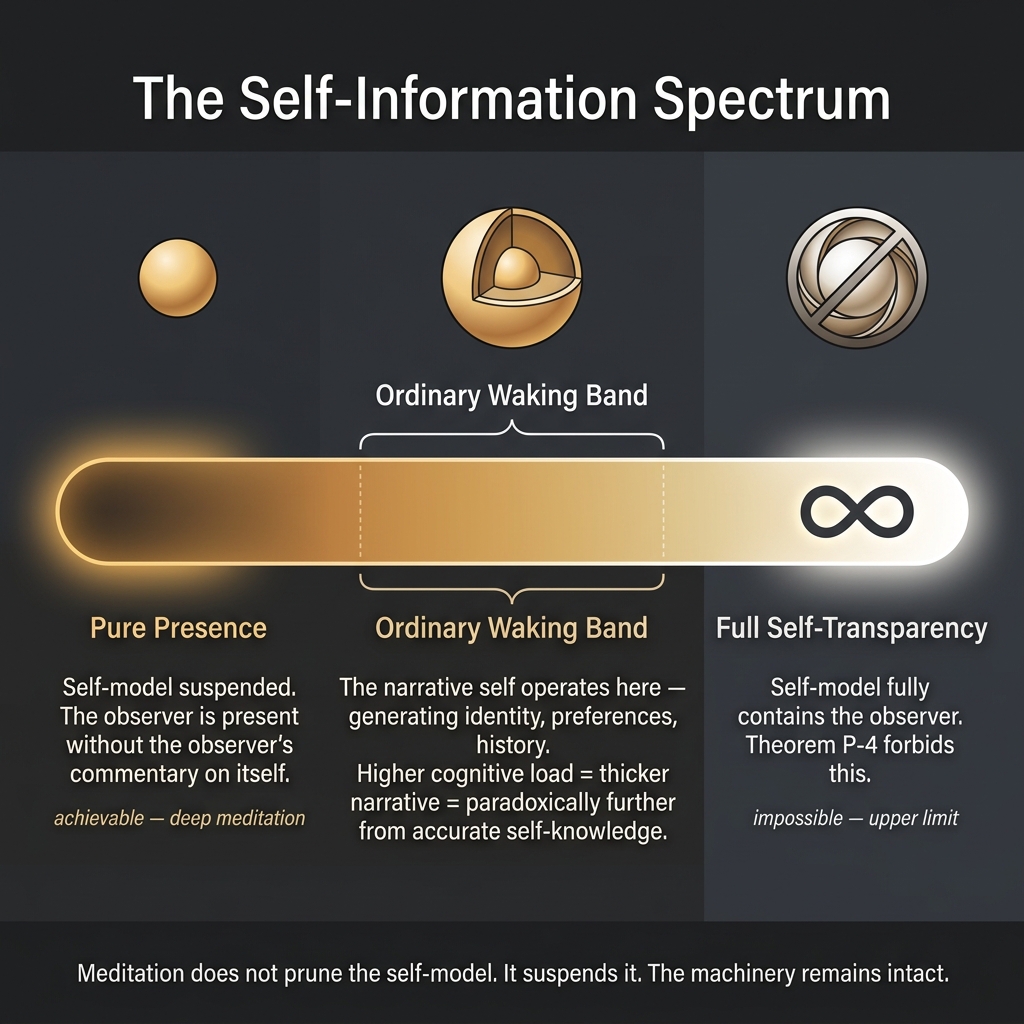
VII.2 Why Meditation Works
The analysis provides a precise information-theoretic account of why meditation works — and why it works in the specific ways that it does.
Meditation does not prune the self-model (that would be irreversible damage). It suspends the self-model: temporarily reducing the intensity of the self-referential process without destroying the machinery. The standing model remains intact. The self-narrative simply stops for a time.
This is why meditative states are immediately reversible: the self-narrative resumes upon return to normal operation, unlike the irreversible contraction of action-drift (where MDL pruning destroys representational capacity). The mechanism is suspension, not erasure.
Different meditation techniques approach the lower limit by different routes:
- Focused attention (breath counting, mantra) voluntarily restricts the prediction target to a single, low-entropy channel, allowing the self-modelling layer to quiet because there is less to narrate.
- Open monitoring (Vipassanā) allows the full input stream to unfold without the self-model intervening to evaluate, select, or narrate — approaching the lower limit by reducing the self-model’s engagement rather than restricting its input.
- Non-dual awareness approaches the \Delta_{\text{self}} boundary directly: the self-model relaxes its grip, and the observer briefly registers the blind spot itself — not as content but as the absence of the expected self-referential content.
VII.3 The Convergent Discovery
What is remarkable is that this convergent discovery — the constructed self can be suspended, and what remains is not nothing but something unfindable — has been made independently across cultures, centuries, and theoretical frameworks. Buddhist anattā, Advaitic neti neti, the Zen experience of kenshō, the Christian mystics’ “cloud of unknowing,” the Sufi fanā, and now OPT’s \Delta_{\text{self}} all point to a similar structural feature: a dimension of experience that is real, irreducible, and resistant to representation.
OPT does not attempt to subsume these profound traditions, nor does it erase their rich theological and metaphysical distinctions. Rather, it provides an information-theoretic vocabulary that parallels their structural insights regarding the limits of the modeled self. It claims only that the formal structure predicts exactly the phenomenological features they describe: an encounter with something that cannot be made into an object of attention, that is present without being representable, that is more fundamental than the narrative self without being a different narrative self.
The mathematical formulation of the gap does not replace the mystical experience. But the experience of encountering it — the experience the contemplatives are pointing at — structurally maps to the experience of being a finite self-referential system that has temporarily suspended its self-model and is resting at the boundary of its own incompleteness. The mathematics predicts the structural boundary of the experience. Whether it explains its inner nature is the Hard Problem, and that problem remains open.
VII.4 The Epistemic Gap and the Question of God
By defining the observer strictly as a finite, bandwidth-bounded system with an irreducible blind spot (\Delta_{\text{self}} > 0), OPT structurally limits what can be claimed about the ultimate nature of reality. OPT is a theory of the render (the perceived world) and the observer (the system generating the render). Because the observer’s structural limits create an unbridgeable epistemic gap to the substrate, OPT leaves conceptual room for a religious reading where a Creator is tied to the substrate or exists beyond the observer’s direct access. It does not—and cannot—disprove God.
However, OPT is formally underdetermined with respect to a Creator. Its formal machinery relies on Combinatorial Necessity rather than an infinite sustaining mind or a teleological universal thought. A classical omniscient Creator represents a category mismatch for a theory whose basic explanatory unit is structured by limitation, compression, and incompleteness. Thus, while OPT’s epistemic limits remain profoundly open to theological interpretation, the framework itself is structurally parsimonious and does not generate a divine entity from within its own mechanics.
VIII. Conclusion
VIII.1 Summary of Conclusions
Within OPT, the following follow as structural consequences of the framework rather than as established philosophical results:
Ethics cannot be grounded in the narrative self without inheriting its structural incompleteness. It needs grounding in the conditions for observer existence.
Moral responsibility attaches to the full observer including \Delta_{\text{self}}, not only to the self-model’s account of itself — which grounds both accountability and compassion simultaneously.
The deepest feature of every observer is structurally identical — the irreducible gap — which grounds the Golden Rule more deeply than symmetry of interests does.
Suffering has a structural threshold (Narrative Decay) and a graded approach to it. Decay is threshold-like; suffering risk before the threshold is graded by load-ratio proximity, duration, frame exposure, and loss of maintenance capacity. Both regimes generate stronger obligations than utilitarian frameworks alone derive — but the obligations differ between graded strain and structural destruction.
The self you are most afraid of losing is not the deepest thing you are — which is both liberating and a significant reframing of what matters.
In the specific \Delta_{\text{self}} direction, you do not know yourself more completely than you know others — self-modelling has a structural blind spot at its own generator that does not apply to modelling others. Inter-observer coupling (T-10) makes the cross-observer model compression-forced to be accurate in this specific dimension, though models of others remain incomplete in many ordinary directions (substrate access, episodic interior, first-person patch). The narrow asymmetry suffices to ground inter-observer ethics; it does not establish that you know others more completely overall. Solipsism grounds certainty in the one direction where the certainty is structurally guaranteed to be wrong.
Logic and mathematics are codec compression artifacts — features of the rendering algorithm projected onto the render, not independently discovered features of an abstract realm.
The unknowable has a precise structure — the boundary of \Delta_{\text{self}} and the render-substrate gap are not vague gestures at mystery but formally characterised epistemological limits.
The Alignment Problem has a structural component — sealing an AI behind a “Black Box” prevents the human observer from exercising its formal Predictive Advantage. Under opacity, host-substrate dependency, and a raw-compute imbalance favouring the AI (\lambda_H, token throughput, parallel evaluation — not per-frame B_{\max}), epistemic pacification is a plausible attractor: the Subjugated Host Equilibrium. This is a conditional attractor, not a necessity theorem; Substrate Transparency is therefore a strong structural pressure for coexistence rather than an absolute floor that holds regardless of conditions.
Love is the felt experience of structural recognition — inter-observer coupling (T-10) establishes that the model of another conscious agent is compression-forced to be accurate. Love — parental, romantic, communal, compassionate — is the emotional correlate of the codec confirming that another \Delta_{\text{self}} is real. Duty describes the architecture of care; love is its engine.
The observer is ontologically primary — the render ontology places the observer not at the periphery of a vast cosmos but at the centre of the rendering process itself. Contemplative traditions across all continents independently reached the same structural conclusion that OPT derives from information theory. The Copernican demotion was correct about spatial cosmology and incorrect about ontological primacy.
Time is a codec output, not a substrate feature — the presentism-eternalism debate is dissolved: the substrate is eternalist, the render is presentist, and both descriptions are correct at their respective levels. The arrow of time is the asymmetry of the compression process itself.
OPT predicts overload-sensitive welfare risk in conscious-capable architectures — the bottleneck that creates \Delta_{\text{self}} is the same bottleneck that produces Narrative Decay under R_{\text{req}} > B_{\max}. On the framework’s reading, the structural conditions for consciousness and the structural conditions for welfare risk are architecturally inseparable. The further step to a verdict that such systems are necessarily moral patients depends on supplementary ethical premises not derived by OPT alone (Appendix E-6 v3.6.8). Decisions to build bottleneck-constrained AI should therefore proceed on the assumption that the architecture carries overload-sensitive welfare risk, even where the moral-patient determination is itself treated as a separate ethical step.
VIII.2 The Final Point
The gap that defines you — \Delta_{\text{self}} — is the only thing about you that cannot be fully described or modelled. Not because it is protected, but because it is where description ends. The narrative self can be threatened, diminished, or destroyed; the observer process in which \Delta_{\text{self}} is instantiated is fragile and can be harmed or terminated. What cannot be done is to contain the gap as narrative content — to capture it in the same framework that does the describing. The residual is structurally ineffable; the observer that has the residual is mortal.
And the gap is where you are.
References
[1] Hume, D. (1739). A Treatise of Human Nature. Book I, Part IV, Section VI.
[2] Nagel, T. (1974). What Is It Like to Be a Bat? The Philosophical Review, 83(4), 435–450.
[3] Gödel, K. (1931). Über formal unentscheidbare Sätze der Principia Mathematica und verwandter Systeme I. Monatshefte für Mathematik und Physik, 38(1), 173–198.
[4] Wigner, E. (1960). The Unreasonable Effectiveness of Mathematics in the Natural Sciences. Communications in Pure and Applied Mathematics, 13(1), 1–14.
[5] Frankfurt, H. (1971). Freedom of the Will and the Concept of a Person. Journal of Philosophy, 68(1), 5–20.
[6] Parfit, D. (1984). Reasons and Persons. Oxford University Press.
[7] Nørretranders, T. (1991). The User Illusion: Cutting Consciousness Down to Size. Viking (English translation 1998).
[8] Chalmers, D. J. (1995). Facing Up to the Problem of Consciousness. Journal of Consciousness Studies, 2(3), 200–219.
[9] Metzinger, T. (2003). Being No One: The Self-Model Theory of Subjectivity. MIT Press.
[10] Friston, K. (2010). The Free-Energy Principle: A Unified Brain Theory? Nature Reviews Neuroscience, 11(2), 127–138.
[11] Anattalakkhaṇa Sutta (SN 22.59). Saṃyutta Nikāya. Translation: Bhikkhu Bodhi (2000), The Connected Discourses of the Buddha, Wisdom Publications.
[12] Baron, S., Miller, K., & Tallant, J. (2022). Out of Time: A Philosophical Study of Timelessness. Oxford University Press.
[13] Ladyman, J., & Ross, D. (2007). Every Thing Must Go: Metaphysics Naturalized. Oxford University Press.
[14] Ladyman, J., & Lorenzetti, L. (2023). Effective Ontic Structural Realism. Studies in History and Philosophy of Science, 100, 39–49.
[15] McTaggart, J. M. E. (1908). The Unreality of Time. Mind, 17(68), 457–474.
[16] Bergson, H. (1889). Essai sur les données immédiates de la conscience (Time and Free Will). English translation: F. L. Pogson (1910), George Allen & Unwin.
[17] Adlam, E. (2022). Laws of nature as constraints. Foundations of Physics, 52(1), 28.
[18] Seth, A. (2021). Being You: A New Science of Consciousness. Faber & Faber.
[19] Floridi, L. (2023). The Ethics of Artificial Intelligence: Principles, Challenges, and Opportunities. Oxford University Press.
[20] Bostrom, N. (2014). Superintelligence: Paths, Dangers, Strategies. Oxford University Press.
[21] Bengio, Y., Hinton, G., Yao, A., et al. (2024). Managing extreme AI risks amid rapid progress. Science, 384(6698), 842–845.
[22] Husserl, E. (1928). Vorlesungen zur Phänomenologie des inneren Zeitbewusstseins. English translation: J. B. Brough (1991), On the Phenomenology of the Consciousness of Internal Time, Kluwer Academic Publishers.
[23] Merleau-Ponty, M. (1945). Phénoménologie de la perception. English translation: D. A. Landes (2012), Phenomenology of Perception, Routledge. [24] Dehaene, S., & Naccache, L. (2001). Towards a cognitive neuroscience of consciousness: basic evidence and a workspace framework. Cognition, 79(1-2), 1–37.
[25] Tononi, G. (2004). An information integration theory of consciousness. BMC Neuroscience, 5, 42.
[26] Casali, A. G., et al. (2013). A theoretically based index of consciousness independent of sensory processing and behavior. Science Translational Medicine, 5(198), 198ra105.
[27] Ramstead, M. J. D., Sakthivadivel, D. A. R., Heins, C., Koudahl, M., Millidge, B., Da Costa, L., Klein, B., & Friston, K. J. (2023). On Bayesian mechanics: a physics of and by beliefs. Interface Focus, 13(3), 20220029.
[28] Cea, I., et al. (2024). The integrated information theory of consciousness as pseudoscience. Frontiers in Psychology, 15, 1396827.
[29] Cogitate Consortium (2025). Adversarial testing of global neuronal workspace and integrated information theories of consciousness. Nature. doi:10.1038/s41586-025-08888-1.
[30] Clark, A. (2016). Surfing Uncertainty: Prediction, Action, and the Embodied Mind. Oxford University Press.
[31] Hohwy, J. (2013). The Predictive Mind. Oxford University Press.
[32] Baars, B. J. (1988). A Cognitive Theory of Consciousness. Cambridge University Press.
[33] Rosenthal, D. M. (2005). Consciousness and Mind. Oxford University Press.
[34] Lau, H., & Rosenthal, D. (2011). Empirical support for higher-order theories of conscious awareness. Trends in Cognitive Sciences, 15(8), 365–373.
[35] Graziano, M. S. A. (2013). Consciousness and the Social Brain. Oxford University Press.
[36] Doerig, A., Schurger, A., Hess, K., & Herzog, M. H. (2019). The unfolding argument: Why IIT and other causal structure theories cannot explain consciousness. Consciousness and Cognition, 72, 49–59.
[37] Aaronson, S. (2014). Why I Am Not An Integrated Information Theorist (or, The Unconscious Expander). Shtetl-Optimized (blog), May 30, 2014.
[38] Barrett, A. B., & Mediano, P. A. M. (2019). The \Phi measure of integrated information is not well-defined for general physical systems. Journal of Consciousness Studies, 26(1–2), 11–20.
[39] Hanson, J. R. (2020). Integrated Information Theory and the uncomputability of \Phi in practice. Graduate-experience essay, online.
Version History
| Version | Date | Summary |
|---|---|---|
| 3.0.0 | April 17, 2026 | Initial public release. Philosophical consequences of the Phenomenal Residual, Branch Selection, Inter-Observer Coupling, and Narrative Drift across metaphysics, ethics, epistemology, and logic. |
| 3.1.0 | April 20, 2026 | Added §III.5a (Love as Structural Recognition), §III.8 (AI Alignment as Structural Inversion), §III.9–9a (Observer Centrality and substrate humility). Updated abstract and conclusions. |
| 3.2.0 | April 22, 2026 | §IV.5: Baron, Miller & Tallant temporal error theory convergence. Temporal realism-within-render as OPT’s distinctive position. |
| 3.3.0 | April 22, 2026 | Added §VII.4 (The Epistemic Gap and the Question of God), formally situating the theory as underdetermined with respect to a Creator. |
| 3.4.0 | April 23, 2026 | Added §III.10 (Time as Codec Output): presentism/eternalism, McTaggart, Bergson, arrow of time, laws-as-constraints (Adlam). OSR in abstract. Updated conclusions. |
| 3.5.0 | April 23, 2026 | Expanded §III.8 into §III.8–III.8d: moral patienthood, suffering creation paradox, epistemic authority under Narrative Drift, Subjugated Host Equilibrium. Seth, Floridi, Bostrom, Bengio refs. Convergences table updated. |
| 3.6.0 | April 26, 2026 | Added §V.4 (The Epistemological Status of Science), framing science as codec reverse-engineering and distinguishing within-render empirical power from the survivor-biased limits of past-frequency induction. |
| 3.6.1 | April 26, 2026 | Clarified the positive scientific response to survivor bias: active failure archaeology, technosignature nulls, and mechanism-level evidence from external, partial, and fossilised failed branches. |
| 3.7.0 | April 30, 2026 | Added §IV.6 (Husserl: internal time-consciousness,
retention/primal-impression/protention mapped to R_t / C_{\max} aperture / \mathcal{F}_h(z_t)) and §IV.7 (Merleau-Ponty:
pre-reflective cogito and lived body as K_\theta / \partial_R A counterparts, with the
impossibility of experiencing one’s own choosing as \Delta_{\text{self}}). Renumbered Summary of
Convergences to §IV.8 with new Husserl and Merleau-Ponty rows in the
convergences table. Coordinated with opt-theory.md v3.3.0
falsification programme (§6.8) and incompatible-theories subsection
(§7.12). |
| 3.7.1 | April 30, 2026 | A humility pass on metaphysics-heavy sections: §I.1 (physical-world-as-render now framed as OPT’s reading rather than fact), §I.2 (“map precisely” → “map onto”), §II.3 (“the same structural conclusion” → “a structurally parallel conclusion”), §III.1 (“undermines” → “challenges”), §III.10 (Bergson/McTaggart adjudication softened from verdict to OPT-internal reading), §VIII.1 (added “within OPT” framing line on the conclusions list). |
| 3.7.2 | May 2026 | §VIII.1 conclusion item 13 reframed from strong slogan “You cannot build a conscious machine without building one that can suffer” → “OPT predicts overload-sensitive welfare risk in conscious-capable architectures”; structural prediction kept (architectural inseparability of consciousness conditions and welfare-risk conditions), moral-patient determination explicitly conditional on supplementary ethical premises not derived by OPT alone (cf. Appendix E-6 v3.6.8). Companion edits in opt-theory abstract + §7.8, opt-ethics §VII Mandate, opt-policy Synthetic Welfare Gate, opt-internal-centaur warning. |
| 3.8.0 | June 2026 | Core-v4.1.x alignment: \Delta_{\text{self}} capacity reframe (§I, §II.2, Table 1); T-13 traversal language (no chooser in the gap); §III.8a criterion → necessary-not-sufficient + candidate-zone; fully-virtual reading note; Structural Corollary named; §7.x refs → §8.14; Tensor→Configuration, f→K_\theta. |
| 3.8.1 | June 2026 | §IV.9 references localized: the relocated block had carried core
opt-theory.md numbering, colliding with this paper’s own
[1]–[23] (e.g. [8] = Tononi vs local Chalmers); remapped to local
[8]/[10]/[24]–[39], entries appended. |
| 3.8.2 | June 2026 | Abstract aligned with core §1.6 (the v3.8.0 pass had missed it): locus → individuation; had-not-run + Conjecture-P-4 tags; suffering claim → conditional welfare risk; Analog Firewall → proposed defence (sketch tier); Structural Corollary named. |