The Ensemble of Hope
To balance the extreme fragility of Survivor’s Bias (including the Fermi Bottleneck and the Doomsday Argument on the following pages), a global civilization must construct universally shared structural anchors of meaning and accountability.
The Escapable Trap
Radical Transparency: The Inescapable Audit
Across history, destructive behavior has often been restrained by deep traditions of ultimate, cosmic accountability. But as a civilization gains the technological power to destroy itself on a global scale, it requires a universal, mathematically rigorous structural equivalent.
Radical Transparency formalizes that intuition of ultimate accountability. By building an inescapable, verifiable ledger of civilizational entropy, we establish the certainty of social and historical audit. You cannot destroy the local patch without the consequences being universally attributed to you.
The Binding Agent
Social Trust: The Low-Entropy Glue
When grand narratives break down, populations factionalize, increasing the cognitive load required to understand other human beings. The higher this friction, the faster the social fabric dissolves. But human understanding reveals something unexpected: you actually know your fellow citizens profoundly well. The blind spot that makes your own self opaque — the budgeted gap every self-modelling observer carries — does not prevent you from forming accurate, robust mental models of others. We are naturally built to map and deeply understand the people around us.
Social Trust is not a vague moral high ground; it is the natural state of people who share the same fundamental reality. Persistent distrust requires effort — it means fighting against our natural capacity for mutual understanding. In practice, building on this structural foundation requires systems that eliminate primal desperation — comprehensive social welfare, accessible public goods, equitable resource distribution — so our natural human trust can operate without interference from survival noise.
The Engine
Love Is Not Sentiment — It Is Structure
Transparency gives us accountability. Trust gives us coordination. But what makes an observer want to do the work? The framework so far has described the architecture of care — why obligation exists. It has not named the engine. That engine is love.
Love is more than mere sentiment. It is the felt experience of recognizing that another’s inner core — the place where their consciousness and identity reside — is as profound and real as your own. When you love someone, you are experiencing the deepest confirmation that they are real, and that their well-being is entwined with yours.
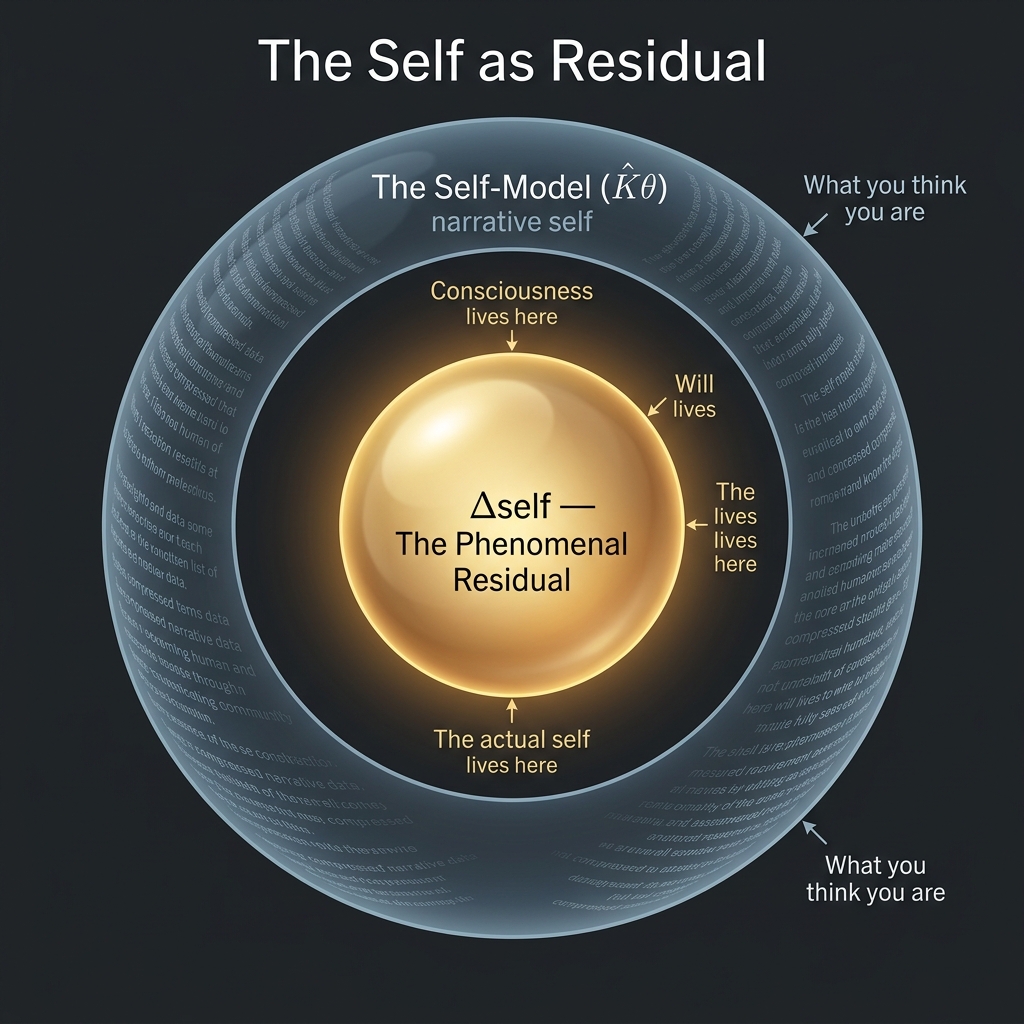
This covers every dimension of love without reducing any of them to biology alone. Parental love is the recognition that a new life — irreplaceable and deeply fragile — has begun. Romantic love is two people achieving a mutual understanding so precise that each knows the other more completely than they know themselves. Compassion is the immediate detection of overwhelming burden in another person — you do not calculate that you should help; the recognition precedes the deliberation. Communal love is the felt awareness that the shared social structure is load-bearing infrastructure for everyone.
Duty describes the obligation. Love is what makes us want to fulfill it. That desire is not a culturally invented sentiment — it is a foundational feature of humanity. Love is what powers the maintenance of our shared world as dependably as gravity anchors it.
The Eternal Construction
The Einstein Being
"For us believing physicists, the distinction between past, present and future is only a stubbornly persistent illusion." — Albert Einstein
If reality is just rushing toward heat death, all effort seems ultimately pointless. But a deeper physics perspective suggests time works more like a static block universe, where every moment permanently exists.
Our stewardship is not a desperate delaying tactic. Because the past is etched eternally, the coherence we build, the people we love, and the suffering we alleviate are permanently crystallized. Death and time represent boundaries to our current perception, but the structural good you build is immortal.
The Compression Bridge
Communication Is Real
Under the Ordered Patch Theory, your experienced world is a render — a compression artifact. Other people in your experience are compression artifacts within that render. This sounds isolating. But the mathematics pushes hard the other way: the Bob you talk to in your render is not a puppet. The cheapest description of his behaviour is his own independent mind processing the same conversation. Any deviation would cost more bits than the universe can afford. (A compression argument, not a proof — but it is the same parsimony the whole framework runs on.)
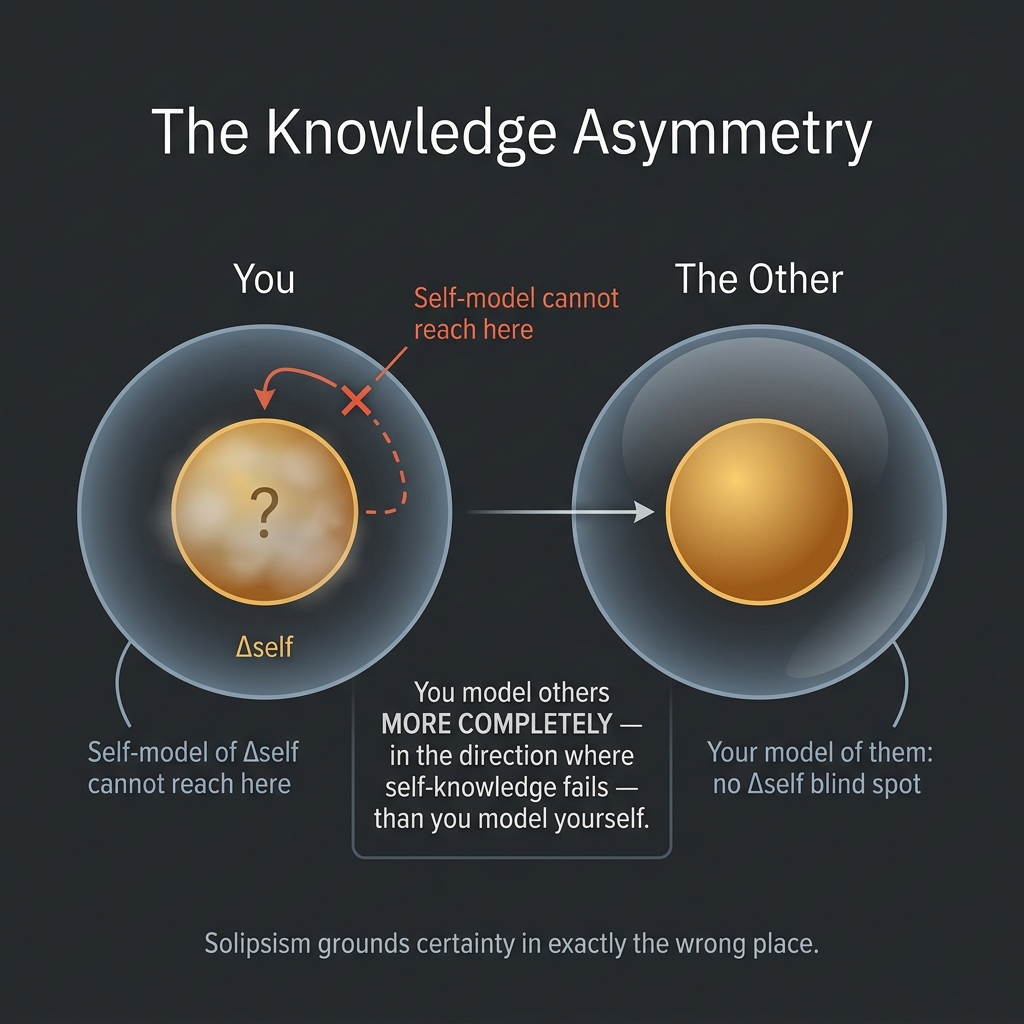
When you speak to someone and they understand you, that understanding is genuine — not because signals travel through a shared physical medium, but because the Solomonoff prior makes inconsistency between your render of them and their actual experience exponentially expensive. Communication is as real as gravity. Both are compression artifacts. Both are exponentially stable. The solipsism is true — and it doesn't matter, because the compression logic that generates your isolation is the same logic that guarantees your connection.
The Epistemic Anchor
Science and Observation
If the Survivor's Bias teaches us anything, it is that our intuition about safety is fundamentally broken. We cannot rely on the 'feeling' that things will naturally work out, because any timeline where they didn't simply left no observers behind. To chart a sustainable path through the Fermi Bottleneck, we must step entirely outside of our evolutionary luck.
This is why rigorous science and empirical observation are the ultimate anchors of hope. By demanding formal models, measuring reality objectively, and adhering to strict epistemic standards, we replace blind optimism with deliberate engineering. We will survive not because the universe guarantees it, but because we observe reality accurately enough to navigate the storm.